 Inverters & Batteries ship FREE
 Ask about rewards for referring friends and family
 U.S. Based Support
 Want to Add a battery?
solar inverters
Solar Panel Racking Systems for Ground Mount (2026)
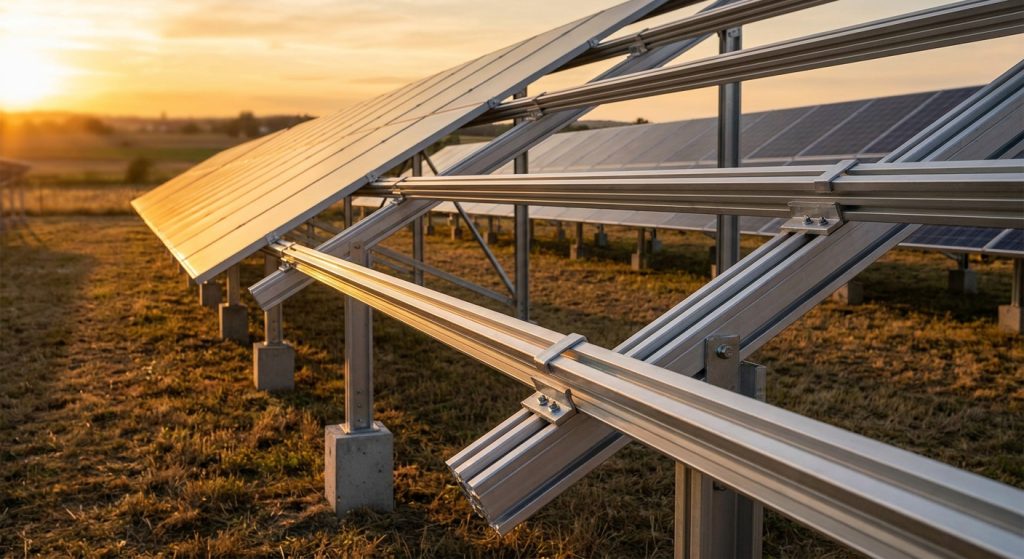
Ground-mount solar arrays live or die on the racking underneath them, not the panels on top. Here's what actually holds up in open fields, sloped lots, and frost-heave soil, plus which systems are worth the money in 2026.
TL;DR
For most ground-mount projects in 2026, a driven-pier aluminum rail system rated to current ASCE 7 wind and snow load standards is the Buy — it handles the widest range of soil types without a full engineering redesign. Helical piers earn a Consider verdict on rocky or high-water-table sites where driven piers won't seat properly. Ballasted concrete systems get a Skip for most residential ground-mount jobs unless the site has zero excavation access. Whatever racking you pick, match rail span to your panel's frame thickness before you order — mismatches are the single most common ground-mount racking mistake installers report. Sun Supply PV stocks the panels, microinverters, and batteries that pair with these systems, and batteries and inverters ship free.
Why This Matters
Ground-mount racking carries a different load profile than roof-mount. There's no roof deck sharing the structural burden, no existing framing to anchor into, and usually more wind exposure because the array sits in open ground rather than tucked against a roofline. Get the foundation type wrong and you're either re-digging piers in year two or watching a row of panels lean after the first heavy snow load.
The upside: ground-mount gives you tilt angle freedom a roof never will, and it's the default choice for Sun Supply PV customers who don't have usable roof space — rural acreage, flat commercial roofs that need the space for HVAC, or homeowners who'd rather not put holes in a newer roof. The racking decision is the one part of a ground-mount system where cutting corners shows up fast.
Who This Is For
This guide is for licensed installers quoting ground-mount jobs on residential and small commercial sites, and for DIY homeowners with land who are building their own array from a kit. Both groups need the same information — foundation type, material, load rating, and tilt range — just at different levels of engineering detail. Installers need the numbers to stamp a permit set; homeowners need them to avoid ordering a system that fails inspection.
What to Look For in Solar Panel Racking Systems for Ground-Mount Installations
Foundation type matched to your soil
Driven piers work in most sandy, loamy, or clay soils and go in fast with a hydraulic pile driver — typically 4 to 6 feet deep depending on frost line and local code. Helical piers cost more per point but seat reliably in rocky or high-water-table ground where a driven pier won't hold torque. Ballasted concrete footings skip excavation entirely but add weight and cost that rarely pencil out for residential jobs. Pick the foundation based on a soil report or local frost depth table, not on whichever system is cheapest per linear foot.
Material and corrosion resistance
Mill-finish aluminum rail resists corrosion without coating and is the standard for most residential ground-mount kits. Hot-dip galvanized steel costs less per pound and handles higher structural loads, which matters on larger commercial ground-mount arrays or sites with heavy snow load. Coastal installs need marine-grade hardware regardless of rail material — standard zinc-plated bolts corrode fast within a few miles of salt air.
Wind and snow load engineering
Every ground-mount racking system sold in 2026 should ship with an engineering letter referencing current ASCE 7 load standards for your wind and snow zone. This isn't optional paperwork — it's what your AHJ (authority having jurisdiction) will ask for at permit review. A system without a stamped letter available for your region means either extra engineering fees or a rejected permit.
Tilt adjustability
Fixed-tilt racking locks in one angle, usually set close to your site's latitude for annual production. Adjustable-tilt racking lets you shift the angle seasonally — often across a 10 to 60 degree range — which matters more in northern latitudes where winter sun angle drops sharply. For most residential jobs, fixed tilt at a mid-range angle is simpler to install and cheaper; adjustable tilt earns its cost on off-grid or high-latitude sites chasing every kWh.
Rail span and panel compatibility
Rail span dictates how many modules sit between piers, typically 4 to 6 panels per row on residential systems. Wider spans mean fewer foundation points but require thicker rail and a frame that can handle the deflection. Before ordering racking, confirm your panel's frame depth and weight against the rail manufacturer's compatibility chart — a panel like the ones on Sun Supply PV's high-efficiency Maxeon lineup has different mounting hole spacing than a standard-frame module, and getting that wrong means field-drilling clamps on install day.
Grounding and bonding hardware included
Ground-mount arrays need continuous grounding across every rail, pier, and module frame, and NEC code requires bonding jumpers at defined intervals. Systems that bundle grounding lugs and bonding hardware into the kit save an installer real time on-site versus sourcing it separately. Confirm what's included before you quote a job — missing grounding hardware is a common change-order surprise.
Top Ground-Mount Racking Picks for 2026
IronRidge ground-mount systems — the safe pick. Driven-pier XR rail racking with mill-finish aluminum construction and a published engineering letter covering most U.S. wind zones. Standard pier depth runs 4 to 6 feet, adjustable based on your frost line. This is the system most installers default to when the soil report doesn't flag anything unusual. Buy.
Unirac ground-mount systems — the commercial-scale pick. Steel and aluminum hybrid racking built for larger row counts and higher snow load zones, with rail spans that stretch to cover more panels per foundation point. Best suited to commercial or multi-row residential arrays where minimizing pier count matters for labor cost. Buy for larger arrays, Consider for a single-row residential job where the extra load capacity goes unused.
Pegasus Solar ground-mount racking — the flexible-terrain pick. Adjustable-height leveling hardware makes this system easier to install on sites with minor grade changes without extensive site grading first. Good fit for rural acreage with uneven ground. Consider — it costs more than a flat-site system, so confirm your grade actually needs the flexibility before paying for it.
S-5! bonding and attachment hardware — the grounding add-on. Not a full racking system, but the clamp and bonding hardware that solves the grounding-continuity requirement across rail joints. Worth adding to any ground-mount order where the base racking kit doesn't include full bonding hardware. Buy as a supplement, not a standalone system.
Ballasted concrete ground-mount kits — the no-excavation pick. Skips pier drilling entirely by using precast concrete ballast blocks to hold the array down. Works where excavation access is blocked or soil conditions make piers impractical. Adds significant dead weight and shipping cost, and isn't rated for as wide a wind range as pier-driven systems. Consider only when excavation genuinely isn't possible — otherwise Skip.
What to Avoid
- Racking without a region-specific engineering letter. A generic "rated for structural loads" spec sheet with no ASCE 7 zone reference will not clear most permit reviews in 2026.
- Rail systems sized for a different panel class. A rail built for thin-frame residential modules won't safely span a heavier commercial-class panel — check frame depth and weight before matching rail to module.
- Ballasted systems on sloped or soft ground. Ballast weight only works on stable, level-enough terrain. On a grade, that same weight becomes a sliding hazard instead of an anchor.
Ground-Mount Racking at a Glance
| System type | Best foundation | Material | Typical pier depth | Verdict |
|---|---|---|---|---|
| IronRidge driven-pier | Sandy/loamy/clay soil | Mill-finish aluminum | 4-6 ft | Buy |
| Unirac hybrid rail | Large or multi-row arrays | Steel/aluminum hybrid | 4-6 ft | Buy (commercial), Consider (small residential) |
| Pegasus Solar adjustable | Uneven/graded terrain | Aluminum | Site-dependent | Consider |
| Ballasted concrete | No-excavation sites | Precast concrete | N/A | Consider/Skip |
FAQ
What's the best racking for a ground-mount solar system in 2026?
Driven-pier aluminum rail systems like IronRidge's ground-mount line handle the widest range of residential soil conditions and come with engineering letters that clear most permit reviews without extra fees.
How deep do ground-mount racking piers need to be?
Most driven piers run 4 to 6 feet deep, adjusted for your local frost line depth — colder regions with deeper frost lines need piers set below that line to avoid frost heave lifting the array.
Is helical pier racking better than driven pier?
Helical piers work better on rocky or high-water-table sites where driven piers won't seat, but they cost more per point and aren't necessary on standard soil.
Do ground-mount racking systems need a stamped engineering letter?
Yes — most jurisdictions require an engineering letter referencing current ASCE 7 wind and snow load standards for your zone before they'll approve a ground-mount permit.
Can I use roof-mount racking for a ground-mount array?
No. Roof-mount rail isn't engineered for pier-based foundations or the wind exposure of an open-ground site, and it won't carry the load ratings a permit office expects for ground-mount.
What's the difference between fixed-tilt and adjustable-tilt ground-mount racking?
Fixed-tilt locks the array at one angle set for your latitude; adjustable-tilt lets you shift the angle seasonally across roughly a 10 to 60 degree range, which matters most at higher latitudes.
Does ground-mount racking cost more than roof-mount?
Ground-mount typically adds foundation and excavation cost that roof-mount doesn't carry, since there's no existing roof structure sharing the load — budget for pier installation as a separate line item.
Do batteries and inverters ship free with a ground-mount system order?
Batteries and inverters ship free through Sun Supply PV regardless of whether the panels above them sit on a roof or a ground-mount array.
One Last Thing
The rail span decision gets skipped more than any other spec on a ground-mount quote, and it's the one that comes back to bite installers on install day. A rail rated for a 4-panel span holding a heavier commercial-class module will deflect more than spec under snow load, even if the piers and material are otherwise correct. Match panel weight and frame depth to rail span before the order goes in, not after the piers are already in the ground.
Related Guides
