 Inverters & Batteries ship FREE
 Ask about rewards for referring friends and family
 U.S. Based Support
 Want to Add a battery?
solar inverters
Commercial Solar Racking Systems 2026: What to Buy
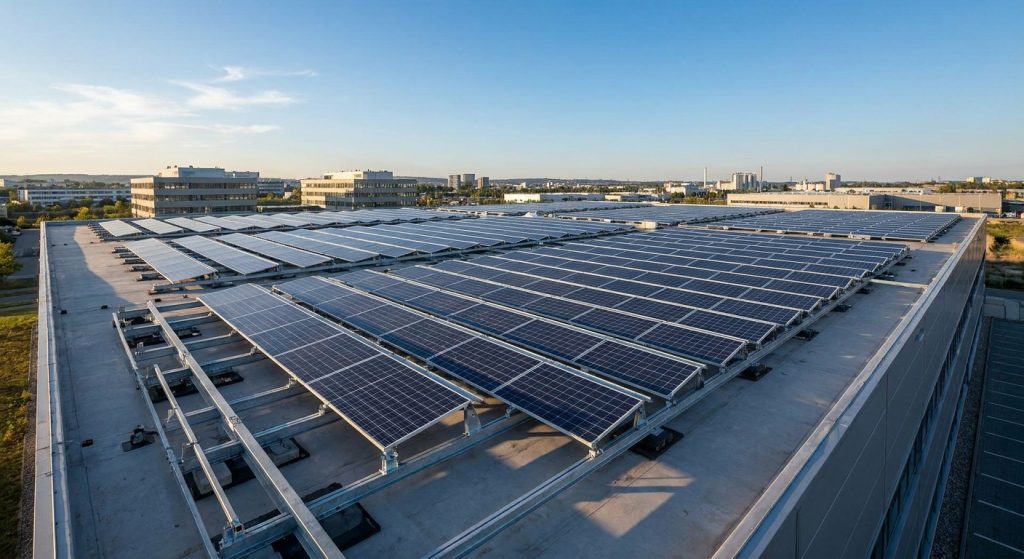
Commercial flat roof solar projects live or die on the racking decision made before a single panel goes up. Get the mounting system wrong and you're looking at roof penetrations that void warranties, ballast loads the structural engineer rejects, or a tilt angle that tanks production for the next 25 years.
TL;DR: For commercial flat roof solar in 2026, ballasted racking from IronRidge or Unirac is the Buy for most low-slope membrane roofs because it avoids penetrations entirely, while S-5! clamp-based systems are the right call only when the roof is standing-seam metal, not a true flat membrane deck. Pegasus Solar and SEG round out the field with lighter-weight ballast trays worth considering when the structural engineer flags loading limits. Commercial solar racking systems chosen for roof type, wind zone, and ballast tolerance first, price second, are the ones that don't come back as callbacks.
Who this is for
This guide is written for licensed commercial installers bidding flat roof PV jobs on TPO, EPDM, or built-up roofing, and for building owners or facilities managers evaluating a racking spec before signing off on a structural review. If your project is a pitched residential roof, the calculus around ballast, wind uplift, and penetration-free mounting doesn't apply the same way — this is a commercial flat roof problem specifically.
Why this matters
A racking mistake on a commercial flat roof is expensive in a way residential mistakes rarely are. Roofing membrane warranties on commercial buildings routinely run 15-20 years, and most roofing manufacturers will void that warranty the moment an installer punches unauthorized penetrations into the deck. Ballasted, non-penetrating racking exists specifically to keep that warranty intact — but only if the added dead load stays within what the roof structure and the original roofing contractor's spec can handle.
Wind uplift is the second variable that trips up otherwise solid bids. A racking system rated for one wind exposure category can fail structural review in a coastal or high-plains site with a different ASCE 7 wind speed requirement. Get the engineering letter from the racking manufacturer before you quote the ballast weight, not after.
What to look for in commercial solar racking systems for flat roofs
Penetration-free ballast design
Most commercial flat roof jobs specify non-penetrating racking to protect the existing roof warranty. Ballasted trays that use concrete blocks or pavers instead of lag bolts into the deck are the default assumption on TPO and EPDM roofs in 2026, and any system you spec should have a published ballast table for your wind and snow zone.
Wind uplift and snow load engineering letters
A racking system without a stamped engineering letter for your specific wind exposure category is a liability, not a deal. Ask for the letter before the bid goes out, not after the structural engineer asks for it — resubmitting a bid over missing paperwork burns weeks.
Tilt angle and row spacing
Flat roof racking usually runs a low tilt — often 5 to 10 degrees — to keep wind loading manageable and avoid inter-row shading eating into production. Steeper tilt gains a few percentage points of annual output but adds ballast weight and self-shading risk that most commercial roofs can't absorb.
Roof loading capacity
Every commercial roof has a structural load limit set at construction, and racking ballast has to fit inside what's left after HVAC units, existing equipment, and snow load are accounted for. Lighter-weight racking systems exist specifically for older buildings or roofs already carrying heavy rooftop mechanicals.
Compatibility with module-level electronics
Ballasted racking layouts affect conduit runs and combiner box placement more than pitched-roof racking does, so the electrical design and the racking layout need to be planned together, not sequentially. If the project uses module-level electronics designed for demanding roof conditions, confirm the racking rail spacing matches the mounting hardware before ordering either.
Install labor and crew time
A racking system that saves two labor-hours per row on a 500-panel commercial array adds up fast. Tool-free ballast tray assembly and pre-drilled rail systems cut crew time compared to older bolt-together designs, which matters directly to bid margin on large commercial jobs.
Top picks for commercial flat roof racking
IronRidge — the safe pick. IronRidge's commercial ballasted systems are engineered specifically for low-slope membrane roofs and come with published wind/snow engineering documentation by region, which is exactly what a structural reviewer wants to see on a permit set. Tilt options typically run 5-10 degrees for flat roof deployments. Buy for standard TPO and EPDM commercial roofs where roof warranty protection is the priority.
Unirac — the volume workhorse. Unirac's flat roof racking is built around fast ballast tray assembly, which cuts install time on large commercial arrays where crew hours drive the bid. It handles a wide range of module sizes and pairs well with high-output panels where fewer, larger modules reduce the total row count. Buy for large commercial arrays where labor speed is the deciding factor.
Pegasus Solar — the wildcard. Pegasus Solar's lighter-weight ballast trays exist for roofs where the structural engineer has flagged a tighter loading budget, often on older commercial buildings carrying legacy rooftop equipment. It's not the first system most installers reach for, but it's the one that saves a bid when the roof simply can't take standard ballast weight. Consider when structural loading is the constraint, not the default choice otherwise.
S-5! — the metal roof specialist. S-5! clamp-based attachment is built for standing-seam metal roofs, not membrane flat roofs, and it avoids penetrations by clamping directly to the seam rather than adding ballast weight at all. If your commercial project actually has a metal roof rather than a true flat membrane deck, this is the right category of system. Buy only when the roof substrate is standing-seam metal; Skip for TPO or EPDM membrane roofs.
SEG — the value option. SEG racking is a lower-cost entry into commercial ballasted mounting, workable for smaller commercial flat roof arrays where budget is the primary constraint and wind exposure is moderate. It's a reasonable fit for a straightforward, low-complexity roof, but the engineering documentation and ballast table library aren't as deep as IronRidge or Unirac. Consider for small-to-mid commercial jobs in low wind zones; get the engineering letter confirmed before quoting a high-wind site.
What to avoid
- Penetrating racking on a warrantied membrane roof. It looks cheaper on the material invoice, but voiding a 15-20 year roofing warranty to save a few dollars per panel on hardware is a bad trade for any commercial building owner.
- A racking system with no wind/snow engineering letter for your zone. A generic spec sheet is not an engineering letter. If the manufacturer can't produce a stamped letter for your ASCE 7 wind exposure category, the structural reviewer will bounce the permit.
- Steep tilt angles chosen purely for production gains. An extra 2-3% annual output from a steeper tilt isn't worth the added ballast weight and self-shading risk on a roof that's already near its loading limit.
Verdict comparison
| System | Penetration-free | Best roof type | Tilt range | Verdict |
|---|---|---|---|---|
| IronRidge | Yes | TPO/EPDM membrane | 5-10° | Buy |
| Unirac | Yes | TPO/EPDM, large arrays | 5-10° | Buy |
| Pegasus Solar | Yes | Load-constrained roofs | 5-10° | Consider |
| S-5! | Yes (clamp) | Standing-seam metal | Roof-following | Buy for metal roofs |
| SEG | Yes | Small-mid commercial, low wind | 5-10° | Consider |
FAQ
What is the best racking system for a commercial flat roof in 2026?
IronRidge and Unirac lead for standard TPO and EPDM membrane roofs because both publish wind/snow engineering documentation by region and offer penetration-free ballast designs. The right pick still depends on your specific wind exposure category and available roof loading capacity.
Do commercial flat roof solar racking systems require roof penetrations?
Most commercial flat roof racking is ballasted, meaning it uses weight rather than bolts to hold panels in place, which avoids penetrating the roofing membrane. Penetrating systems exist but are less common on membrane roofs because they risk voiding the roofing warranty.
Is ballasted racking better than penetrating racking for commercial roofs?
Ballasted racking is generally preferred on commercial membrane roofs specifically because it preserves the existing roof warranty. Penetrating racking can reduce ballast weight on structurally limited roofs but requires roofer sign-off and proper flashing at every penetration point.
Can microinverters be used with ballasted flat roof racking?
Yes — module-level electronics work with ballasted racking as long as the racking layout and conduit runs are planned together during design, not after ballast trays are placed. Racking rail spacing needs to match the mounting hardware spec before either is ordered.
How much weight does ballasted racking add to a commercial roof?
Ballast weight varies by wind zone, tilt angle, and system, which is why every reputable manufacturer publishes a ballast table rather than a single number. Get the specific ballast table for your wind exposure category before finalizing the structural review.
What tilt angle is best for a flat roof commercial solar array?
Most commercial flat roof arrays run a 5 to 10 degree tilt to balance production against wind loading and inter-row shading. Steeper tilt angles gain some annual output but add ballast weight most commercial roofs can't accommodate.
Does S-5! racking work on a true flat membrane roof?
No — S-5! is a clamp-based attachment system built for standing-seam metal roofs, not membrane flat roofs. If your project has a TPO or EPDM membrane deck, look at ballasted systems like IronRidge or Unirac instead.
Do batteries and inverters ship free from Sun Supply PV?
Yes, batteries and inverters ship free through Sun Supply PV. Racking hardware freight terms vary by order size and destination, so confirm shipping details when you place a commercial racking order.
One last thing
The detail most commercial bids miss isn't the racking brand — it's ordering the ballast blocks before the wind/snow engineering letter comes back. Crews that lock in ballast weight before confirming the letter for their specific exposure category end up re-ordering blocks mid-install, which costs more in delay than any per-unit savings on the racking itself. Get the letter first in 2026, every time, on every commercial flat roof job.
Related guides
