 Inverters & Batteries ship FREE
 Ask about rewards for referring friends and family
 U.S. Based Support
 Want to Add a battery?
solar inverters
Ballasted Solar Mounting System: Buy or Skip in 2026
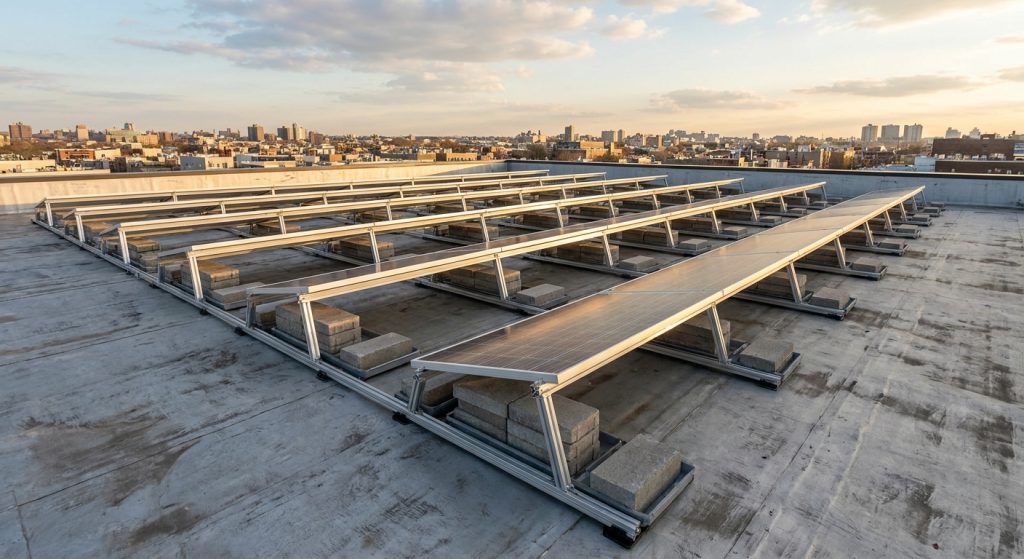
Ballasted flat roof mounting systems solve the one problem sloped-roof racking can't: you can't penetrate a membrane roof without creating a leak liability, so the array has to hold itself down with weight instead. This guide breaks down what a ballasted solar mounting system actually needs to do, which setups earn a Buy, and which ones you should walk away from on a commercial or large residential flat roof.
TL;DR: A ballasted solar mounting system uses weighted racking and tilt angle instead of roof penetrations to secure panels on flat commercial or low-slope residential roofs. For most TPO, EPDM, or built-up roofs, a ballasted solar mounting system from IronRidge or Unirac rated to local wind uplift code is the Buy — non-penetrating racking with a documented wind and structural analysis. Skip systems sold without an engineering letter or ballast schedule; that's the fastest way to fail a roofing warranty inspection or a building permit review in 2026.
Why this matters
Most flat roof failures on solar jobs trace back to two things: too much roof-loading weight in the wrong spots, or a racking system that wasn't actually engineered for the site's wind zone. A membrane roof warranty can be voided by a single unauthorized penetration, and that's before you factor in the labor cost of re-flashing a leak years later. Ballasted racking sidesteps the penetration issue entirely, but it introduces a different set of variables — roof dead-load capacity, ballast block weight, tilt angle, and row spacing all have to work together or the system underperforms or, worse, fails an uplift test.
The solar panel racking systems for commercial flat roofs category covers this exact use case, and it's worth pulling the structural documentation before you spec anything, not after.
Who this is for
This guide is built for licensed installers bidding commercial and multifamily flat roof jobs, and for building owners or facilities managers evaluating a rooftop array on a warehouse, retail box, or low-slope residential structure. If your roof is TPO, EPDM, PVC, or built-up (BUR) and has zero tolerance for new penetrations because of an active warranty, ballasted racking is very likely your only workable path — this isn't a preference call, it's a roof-type constraint.
What to look for in a ballasted solar mounting system
Documented wind uplift rating
Every ballasted system sold for commercial use should ship with an engineering letter tied to ASCE 7 wind load criteria for the install's specific zone. Without it, you're guessing at ballast weight, and guessing wrong means either an underbuilt array that lifts in a storm or an overbuilt one that overloads the roof deck. Ask for the stamped letter before you finalize a bid, not after materials arrive.
Roof dead-load capacity
Ballast is heavy — that's the whole mechanism — so the roof structure has to be rated to carry it on top of existing dead and live loads. A structural engineer needs to confirm the deck and framing can take the added weight, especially on older commercial roofs that were never designed with solar in mind. This step gets skipped more often than any other on flat roof jobs, and it's the one that gets projects red-tagged.
Tilt angle versus wind exposure
Lower tilt angles (5-10 degrees) reduce wind uplift force and usually mean less ballast is needed per row, but they also cut production slightly compared to steeper tilt on unobstructed roofs. Higher tilt captures more sun in northern latitudes but multiplies the wind load the racking has to resist. Match tilt angle to the site's exposure category, not just to production modeling.
Membrane compatibility and pad protection
Ballast trays and rails sit directly on the membrane, so every point of contact needs a compatible pad — usually EPDM or a manufacturer-approved slip sheet — to prevent puncture or abrasion over years of thermal cycling. Roofing membrane manufacturers often require this detail in writing to keep the roof warranty intact. Confirm compatibility with the roofing manufacturer before ballast trays go down, not during final inspection.
Row spacing and shading loss
Ballasted rows on a flat roof need enough spacing to avoid self-shading between rows, which eats into production if it's underestimated at design time. Tight spacing lets you fit more panels per roof, but it costs annual output — this is a real tradeoff, not a rounding error, especially on winter-sun latitudes.
Wire management and microinverter routing
On commercial flat roofs, a lot of installers are pairing ballasted racking with microinverters to simplify conduit runs and rapid shutdown compliance. If that's the plan, check solar microinverters for commercial rooftop arrays for units rated to work with the racking's wire channel design before locking the BOM.
Top picks for ballasted flat roof projects
IronRidge flat roof racking — the safe pick. IronRidge's ballasted mounting hardware ships with published wind and structural engineering documentation for most U.S. wind zones, and the rail-based design keeps ballast block count predictable across a large array footprint. One number that matters: consistent, code-referenced uplift data across zones means fewer change orders mid-permit. Buy for standard commercial flat roof jobs where predictable engineering paperwork speeds up permitting.
Unirac ballasted system — the workhorse. Unirac's flat roof platforms are built around adjustable tilt options and a modular tray design that adapts to irregular roof shapes better than fixed-angle systems. The tradeoff is more SKUs to track on a bill of materials, but that flexibility pays off on retrofit roofs with existing rooftop equipment to route around. Consider this when the roof isn't a clean rectangle.
Pegasus Solar ballasted mount — the lightweight option. Pegasus Solar's flat roof hardware is engineered to reduce per-row ballast weight relative to some legacy tray systems, which matters directly when a structural engineer flags dead-load capacity as tight. Less ballast per row means less added weight on an older deck. Consider this on roofs where the structural report comes back close to the limit.
Generic universal ballast trays with no engineering letter — the wildcard. Cheap tray-and-block kits show up on marketplaces with no wind zone documentation and no manufacturer structural backing. They might work on a low-wind, single-story residential flat roof, but on any commercial job they're a permitting dead end. Skip unless the seller can produce a stamped engineering letter for your specific site.
What to avoid
- Penetrating racking sold as low-penetration. A handful of racking systems market themselves as minimal-penetration when they still require lag bolts through the membrane. If the roof warranty prohibits any penetration, that distinction doesn't help you — confirm zero-penetration in writing.
- Metal roof racking repurposed for flat membrane roofs. Clamp-based systems built for standing seam or corrugated metal, covered in best solar panel mounting systems for metal roofs, are engineered for a completely different attachment mechanism and shouldn't be substituted on a membrane roof even if the price looks better.
- Ballast block estimates without a site-specific wind study. Rule-of-thumb ballast weight ignores corner and edge zone multipliers required under most wind codes; corners and roof edges need significantly more ballast than the field of the array.
Verdict comparison
| Criterion | IronRidge Flat Roof | Unirac Ballasted | Pegasus Solar Ballasted | Generic Universal Tray |
|---|---|---|---|---|
| Engineering documentation | Strong, code-referenced | Strong, adjustable | Available | Rarely provided |
| Best for | Standard rectangular roofs | Irregular roof shapes | Weight-constrained decks | Low-wind DIY residential |
| Roof penetration | None | None | None | Varies by kit |
| Verdict | Buy | Consider | Consider | Skip |
FAQ
What is a ballasted solar mounting system?
It's a racking method that holds solar panels down with weighted blocks or trays instead of bolts through the roof membrane, used almost exclusively on flat or low-slope commercial and residential roofs where penetrations aren't allowed.
Is ballasted mounting better than penetrating racking?
Neither is universally better — ballasted mounting protects membrane roof warranties but adds structural dead-load weight, while penetrating racking is lighter but requires flashing and sealing at every attachment point.
How much does a ballasted racking system cost in 2026?
Pricing depends on ballast block quantity, tray count, and wind zone requirements for the specific site, so get a quote based on your roof's structural report and wind exposure category rather than a flat per-watt estimate.
Do batteries and inverters ship free with a ballasted racking order?
Batteries and inverters ship free when ordered through Sun Supply PV; racking and ballast components are quoted separately based on freight weight and destination.
Can microinverters be used with ballasted flat roof racking?
Yes — pairing microinverters with ballasted racking is common on commercial flat roofs because it simplifies conduit routing and rapid shutdown compliance across long array rows.
Does ballasted mounting work on residential flat roofs?
It does, provided the roof deck has enough dead-load capacity and the membrane is compatible with ballast pad materials; a residential structural check is just as necessary as a commercial one.
What wind zone rating should a ballasted system carry?
It should carry an engineering letter referencing ASCE 7 wind load criteria specific to your site's wind zone, not a generic national average.
How is ballast weight calculated per row?
Ballast weight per row is calculated from tilt angle, roof height, exposure category, and array position — corner and edge rows typically require more ballast than interior rows under most wind codes.
One last thing
The detail that gets missed most on ballasted flat roof jobs isn't the racking brand — it's the roof edge zone. Wind codes require significantly more ballast at corners and perimeters than in the field of the array, and skipping that detail is the single most common reason a ballasted system fails an uplift inspection in 2026.
Related guides
