 Inverters & Batteries ship FREE
 Ask about rewards for referring friends and family
 U.S. Based Support
 Want to Add a battery?
solar inverters
Wholesale Solar Panels RV Marine: 2026 Buying Guide
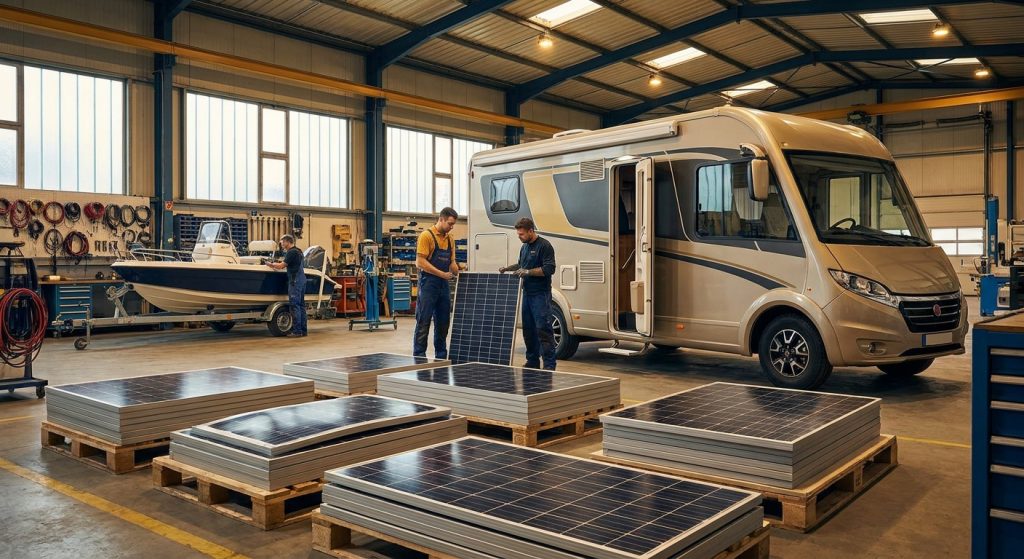
Solar for a travel trailer or a center-console boat is a different problem than solar for a rooftop. Space is tight, voltage is usually 12V or 24V instead of residential 48V-plus strings, and salt air or highway vibration will find every weak point in a mounting system within a season.
This guide breaks down what RV and marine installers should actually prioritize when sourcing panels at distributor pricing, which products in Sun Supply PV's wholesale solar catalog fit those constraints best, and where a residential-grade panel is the wrong tool even if the wattage looks good on paper.
TL;DR
For wholesale solar panels rv marine installers can actually mount and wire without a redesign, prioritize high-efficiency, small-footprint modules over big-wattage residential panels built for open roof space. The high-efficiency Maxeon panels are the strongest pick when roof space is under 60 square feet and every watt-per-square-foot matters, while the compact Maxeon panels for small roofs cover tighter RV and boat cabin layouts. Pair either with microinverters built for shaded arrays if the install sits under trees, marina masts, or bimini tops. Skip oversized commercial-class panels entirely — they don't belong on a curved RV roof or a boat deck in 2026 or any year after.
Why this matters
RV and marine solar isn't a smaller version of residential solar — it's a different design problem wearing the same panel technology. A homeowner's roof has 400+ square feet to work with and a fixed, flat mounting plane. A 32-foot fifth wheel has maybe 50 square feet of usable surface after AC units, vents, and antennas take their share, and a boat deck adds constant vibration and salt exposure that residential racking was never engineered for.
Installers who source panels meant for open residential rooftops end up fighting the equipment all install season — cutting racking to fit, overloading small battery banks with panels sized for a house, or losing output to partial shade because the system has no per-panel shade tolerance. Getting the spec right at the sourcing stage saves callbacks later.
Who this is for
This guide is built for two buyer types: licensed installers running RV and marine retrofit crews who need wholesale solar panels rv marine buyers can rely on for repeat installs, and residential DIY owners converting a travel trailer, camper van, or boat themselves. Both groups are shopping the same physical constraints — limited roof area, low-voltage battery banks, and non-standard mounting surfaces — even if one is buying a single kit and the other is buying pallets.
What to look for in wholesale solar panels for RV and marine
Wattage-to-footprint ratio, not raw wattage
A 400W panel that needs 22 square feet is worse for an RV than a 370W panel that fits in 17. Most towable RVs and center-console boats have 40 to 60 square feet of usable mounting surface total, so efficiency per square foot beats headline wattage every time.
Panel efficiency in the 20-23% range
Higher-efficiency cells matter more here than on a house roof because there's no spare space to make up the difference with extra panels. Anything below the high-teens efficiency range forces compromises on battery bank sizing or forces a second panel where there's no room for one.
Frame and junction box corrosion resistance
Salt spray on a boat and road grime on an RV both attack aluminum frames and junction box seals faster than a stationary residential install ever will. Frame coating and IP-rated junction boxes aren't optional upgrades in a marine environment — they're the difference between a 2026 install still working in 2031 and one that's corroded through in two seasons.
Low-voltage battery bank compatibility
Most RV and marine systems run 12V or 24V house banks, not the 48V-plus stacks common in residential battery installs. Panel output and any paired microinverter or charge controller need to match that voltage class, or the installer is adding a DC-DC converter stage that eats efficiency and adds a failure point.
Shade tolerance for partial-shade conditions
An RV parked under trees at a campground or a boat docked near a marina structure deals with moving partial shade that a fixed residential roof rarely sees. Panel-level shade tolerance, or microinverters that isolate shaded panels from dragging down the whole string, protects output when conditions aren't ideal.
Weight per panel
RV roofs and boat decks have load limits that a house roof doesn't worry about. A panel in the 35-50 lb range is workable on most RV roofs; heavier commercial-class modules risk structural issues on a curved fiberglass or aluminum RV roof.
Top picks for RV and marine installers
The efficiency leader: Maxeon high-efficiency panels
High-efficiency cell technology in the 20%+ range is the single biggest lever for a footprint-constrained install. When an installer has 45 square feet to work with instead of 400, every efficiency point recovers usable wattage that would otherwise require a second panel. Buy for any RV or boat retrofit where roof space is the limiting factor, not the budget.
The small-footprint pick: compact Maxeon panels for small residential roofs
Built for tight roof layouts, this line fits the same constraint problem that RV cabins and boat cabins face — small usable surface, no room for oversized modules. It's a strong match for shorter travel trailers and smaller center-console boats where a full-size residential panel simply won't lay flat. Consider when the mounting surface is under 40 square feet and full-size panels don't fit the available run.
The shade-management pick: microinverters built for shaded arrays
RV campsites under tree canopy and boats docked near masts or overhangs deal with partial shading that drags down string-wired systems. Per-panel isolation keeps one shaded panel from cutting output across the whole array. Buy for any install where shading is a known, recurring condition rather than an occasional edge case.
The general-purpose pick: residential microinverter lineup
For installs with mostly clear sky exposure and no persistent shade issue, a standard residential microinverter line still gives per-panel monitoring and simplifies wiring versus a traditional string setup. Consider as the default pairing when shade isn't the primary design constraint.
What to avoid
- Commercial-class, high-wattage panels built for flat industrial roofs. They read well on a spec sheet but the weight and dimensions don't work on a curved RV roof or a moving boat deck.
- Standard residential racking hardware without marine-rated fasteners. Stainless or coated hardware isn't optional near saltwater — standard galvanized hardware corrodes fast in that environment.
- Panels sized for 48V residential battery banks paired directly into 12V or 24V systems without a proper DC-DC conversion stage. It looks like a wiring shortcut and it isn't one.
Verdict comparison
| Pick | Best For | Key Spec | Verdict |
|---|---|---|---|
| Maxeon high-efficiency panels | Space-constrained roofs, max watts per sq ft | 20%+ cell efficiency | Buy |
| Compact Maxeon panels (small roofs) | Short trailers, smaller boat cabins | Reduced footprint vs. standard panel | Consider |
| Microinverters for shaded arrays | Campsites under trees, marina shade | Per-panel output isolation | Buy |
| Residential microinverter lineup | Clear-exposure installs, no shade issue | Per-panel monitoring | Consider |
| Commercial-class flat-roof panels | Not recommended for RV/marine | Oversized, heavy | Skip |
FAQ
What's the best wholesale solar panel setup for an RV?
A high-efficiency, compact-footprint panel paired with shade-tolerant microinverters is the strongest match for most RVs, since roof space is almost always the limiting factor rather than budget or wattage availability.
Is a marine solar install different from a residential rooftop install?
Yes — marine installs deal with constant vibration, saltwater exposure, and 12V or 24V battery banks instead of the 48V-plus systems common on houses, which changes both the hardware spec and the mounting approach.
How much roof space does a typical RV solar install need?
Most towable RVs have 40 to 60 square feet of usable roof surface once vents, AC units, and antennas are accounted for, which is why efficiency per square foot matters more than raw panel wattage.
Do microinverters make sense on an RV or boat?
They do when shading is a regular condition — campsites under trees or boats near marina structures — since per-panel isolation stops one shaded panel from dragging down the whole system's output.
Can residential solar panels be used on an RV or boat?
Technically yes, but most residential panels are sized and weighted for open, flat roofs and don't account for the corrosion resistance, low-voltage compatibility, or footprint constraints that RV and marine installs require.
Do batteries and inverters ship free from Sun Supply PV?
Yes — batteries and inverters ship free on orders through Sun Supply PV, which matters for RV and marine installers ordering microinverters and battery components alongside panels.
What voltage should an RV or marine solar system run?
Most RV and boat house battery banks run 12V or 24V, so panel and inverter selection should match that voltage class directly rather than relying on a DC-DC conversion stage to bridge a 48V-rated component down.
Is panel weight really a concern for RV installs?
Yes — a panel in the 35-50 lb range is workable on most RV roofs, while heavier commercial-class modules can exceed load limits on curved fiberglass or aluminum roof structures.
One last thing
The install detail most RV and marine crews skip: matching the junction box IP rating to the actual exposure condition, not just the panel's headline spec. A panel rated for standard rooftop weather exposure isn't automatically rated for direct salt spray on a boat deck, and that gap shows up as corrosion inside the junction box long before the cells themselves degrade. Check the IP rating on the junction box specifically, not just the panel's general weather rating, before finalizing a marine order in 2026.
Related guides
