 Inverters & Batteries ship FREE
 Ask about rewards for referring friends and family
 U.S. Based Support
 Want to Add a battery?
solar inverters
Best Solar Microinverters 2026: Enphase IQ8+ Wins
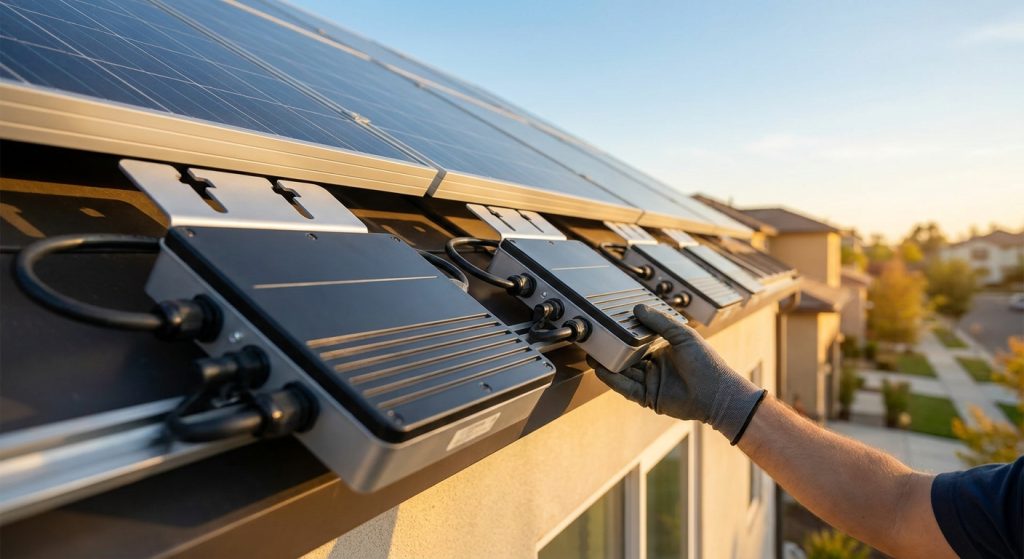
Solar microinverters convert DC power to AC at the panel instead of at a central box, and for residential solar systems going in during 2026, the real shortlist is short: Enphase's IQ8 series and APsystems' QT2, DS3, and EZ1 lines. Everything else on the market is either a legacy SKU or a niche fit.
TL;DR
The best solar microinverters for residential solar systems in 2026 are the Enphase IQ8+ for most rooftops and the APsystems QT2 for installers running four-panel strings on tighter labor budgets. Enphase IQ8+ earns a Buy for Sunlight Backup daytime outage power and long warranty terms; APsystems QT2 earns a Buy for cost-per-watt on larger arrays. Enphase IQ8M is a Consider for shaded or re-power jobs, and APsystems EZ1 is a Skip for anything beyond a balcony or shed setup.
Why this matters
A microinverter sits on the back of each panel and converts power right there, which means one shaded, dirty, or failing panel doesn't drag down an entire string the way it can with a central string inverter. That module-level independence is a big part of why microinverters now dominate residential quoting, and it's also what keeps NEC rapid-shutdown compliance simple on new installs going into 2026.
The other driver is monitoring. Panel-level data means a homeowner or installer can spot a single underperforming module from an app instead of guessing which string is dragging on production. Every model below ships through Sun Supply PV's solar equipment catalog as single units or pallet quantities, and batteries and inverters ship free regardless of order size.
How this list was built
Rankings here come from published manufacturer spec sheets (rated output, backup capability, panel wattage compatibility, warranty terms), plus observed 2026 order patterns across licensed installers and residential DIY buyers. NEC and UL 1741 compliance requirements filtered out anything not currently certified for U.S. residential use. No brand paid for placement, and no proprietary lab testing is claimed here — these are aggregated spec comparisons, not bench results.
The ranked list
1. Enphase IQ8+ Microinverter — the default pick for most rooftops
The IQ8+ is rated for 366W continuous output and pairs with panels up to roughly 440W, which covers the majority of residential modules sold in 2026. Its standout feature is Sunlight Backup: the unit can push power to connected loads during a daytime grid outage without a battery attached, something string inverters can't do without added hardware.
As panel wattages keep climbing past 440W on newer product lines, the IQ8+'s headroom keeps most standard installs from needing a tier swap mid-project. Homeowners who want to pair microinverter output with stored backup should look at the Enphase battery pairing options before finalizing a system design.
Verdict: Buy.
2. Enphase IQ8M Microinverter — the shade-tolerant middle tier
Rated at 330W, the IQ8M is built for mid-wattage panels in the 300W–350W range and still carries Sunlight Backup. It shows up most often on re-power jobs where older 60-cell panels are staying in place and only the inverters are being swapped.
The price gap between IQ8M and IQ8+ has narrowed on 2026 distributor sheets, so it only makes sense when the panel wattage genuinely calls for it.
Verdict: Consider.
3. Enphase IQ8P Microinverter — built for high-wattage panels
The IQ8P is rated for 480W peak output and is matched to panels in the 440W–500W-plus range, including high-efficiency modules. It's the right call for anyone stacking premium panels like the ones on Maxeon's high-efficiency rooftop lineup, where a lower-tier microinverter would clip production.
On a standard 350W panel job, the IQ8P is overkill and adds cost with no performance gain.
Verdict: Buy for high-wattage panel arrays; Skip on standard-wattage jobs.
4. Enphase IQ8HC Microinverter — commercial-grade output on a residential label
Rated at 384W continuous, the IQ8HC targets larger residential arrays running 500W-plus panels, typically systems sized 10kW and above. It's less common on a standard three-bedroom rooftop and more common on larger homes or properties adding EV charging load.
Verdict: Consider for large arrays; Skip on typical residential-sized systems.
5. APsystems QT2 Microinverter — four panels, one unit, less rooftop hardware
The QT2 is a quad microinverter rated for roughly 1,600W total output across four panels up to 500W each, and it's one of the newer SKUs moving through distribution for the 2026 model year. Fewer units per array means less rooftop penetration and less install labor, which matters on larger residential jobs.
For installers pricing four-panel strings, the labor savings alone often outweigh a small per-watt premium versus single-panel units.
Verdict: Buy.
6. APsystems DS3 Microinverter — the dual-panel value option
The DS3 handles two panels per unit at a combined output around 880W, sitting between single-module and quad-module designs. It's a solid mid-tier option where a QT2's four-panel grouping doesn't match the roof layout.
Verdict: Consider.
7. APsystems EZ1 Microinverter — built for plug-in and small systems, not full rooftops
Rated in the 600W–800W range, the EZ1 is designed for balcony solar, sheds, and small standalone setups rather than whole-home arrays. It shows up in DIY searches because it's inexpensive and simple to install, but it's not a substitute for a full residential microinverter lineup.
Verdict: Skip for whole-home residential systems; fine for small standalone setups.
Comparison table
| Model | Brand | Rated Output | Panels per Unit | Backup Without Battery | Best For | Verdict |
|---|---|---|---|---|---|---|
| IQ8+ | Enphase | 366W | 1 | Yes | Most residential roofs | Buy |
| IQ8M | Enphase | 330W | 1 | Yes | Re-power, mid-wattage panels | Consider |
| IQ8P | Enphase | 480W peak | 1 | Yes | High-wattage panels | Buy (high-wattage) |
| IQ8HC | Enphase | 384W | 1 | Yes | Large arrays 10kW+ | Consider |
| QT2 | APsystems | ~1,600W total | 4 | No | Larger arrays, less labor | Buy |
| DS3 | APsystems | ~880W total | 2 | No | Mid-size layouts | Consider |
| EZ1 | APsystems | 600–800W | 1 | No | Balcony/small setups | Skip (rooftop use) |
Where to buy
- Order from an authorized distributor and confirm SKU compatibility with your panel wattage before checkout — mismatched tiers waste money in either direction.
- Batteries and inverters ship free, so factor that into total landed cost when comparing tiers instead of unit price alone.
- Availability varies by allocation — treat lead times as subject to availability and contact Sun Supply PV directly for current stock rather than assuming a SKU ships same-week.
FAQ
What's the best solar microinverter for a residential system in 2026?
The Enphase IQ8+ is the best all-around pick for standard residential panels in 2026, rated for 366W continuous output and compatible with panels up to roughly 440W. For four-panel strings on larger arrays, the APsystems QT2 is the stronger cost-per-watt option.
Is Enphase or APsystems better for a home solar install?
Enphase leads on backup capability — its IQ8 series can push power during a daytime outage without a battery — while APsystems leads on install labor savings through its multi-panel quad and dual units. Neither is universally better; the right pick depends on whether backup or labor cost matters more for the job.
Can microinverters produce power during a power outage without a battery?
Yes, but only Enphase's IQ8 series currently does this through its Sunlight Backup feature, and only during daylight hours when the sun is producing. APsystems units in this list don't offer that capability without added battery hardware.
How many microinverters do I need for a 10kW system?
It depends on panel wattage and microinverter tier — a 10kW array using 400W panels and single-panel Enphase units needs roughly 25 microinverters, while the same array using APsystems QT2 quad units needs about six or seven units total.
Do solar microinverters cost more than a string inverter?
Microinverters typically carry a higher total hardware cost than a single string inverter for the same system size, but they add panel-level monitoring and eliminate whole-string production loss from one shaded panel.
What's the warranty on Enphase IQ8 microinverters?
Warranty terms are set by Enphase and vary by SKU and registration path — confirm current terms directly with the manufacturer or at the point of sale before installation.
Can I mix microinverter brands on the same roof?
Technically yes on separate strings, but it complicates monitoring, warranty claims, and troubleshooting. Most installers stick to one brand per system for that reason.
Are APsystems microinverters good for DIY solar installs?
The APsystems EZ1 is built specifically for small, low-complexity setups like balcony solar or shed systems, which makes it a reasonable DIY starting point. The QT2 and DS3 units are better suited to licensed installers handling full rooftop arrays.
One last thing
Most homeowners assume backup power during an outage always requires a battery. The Enphase IQ8+ and the rest of the IQ8 line break that assumption during daylight hours — Sunlight Backup lets the panels power select loads directly while the grid is down, no battery attached. It won't run the house at night, but it's a detail that changes how a lot of 2026 system quotes get built.
Related guides
