 Inverters & Batteries ship FREE
 Ask about rewards for referring friends and family
 U.S. Based Support
 Want to Add a battery?
solar inverters
Solar Microinverters for Shade: 2026 Buying Guide
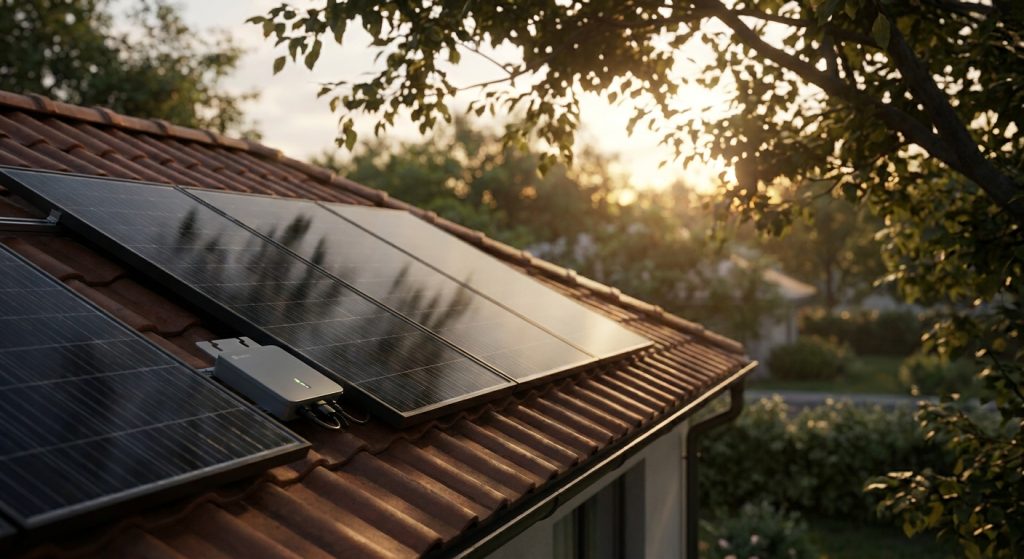
Trees, chimneys, and neighboring rooflines cut into solar production every day, and picking the wrong inverter architecture for that shade turns a decent system into a mediocre one. This guide breaks down which solar microinverters for shade actually hold their output when part of the array goes dark, and which specs matter for a shaded roof versus a wide-open one.
TL;DR
For shaded roof arrays in 2026, Enphase IQ8 Series microinverters are the Buy pick because each unit tracks its own panel independently, so one shaded panel doesn't drag down the whole string. APsystems quad microinverters are a solid Consider for cost-conscious installers running larger arrays, while a legacy string inverter without optimization is a Skip on any roof with partial shade. Solar microinverters for shade work by isolating each panel's output, which is the entire point when a chimney shadow crosses three panels for two hours a day. Pair the right microinverter with the right storage and panel wattage, and shade stops being a dealbreaker.
Why This Matters
A string inverter treats every panel on its circuit as one electrical unit. Shade one panel by 30% and, because of how bypass diodes and series wiring behave, the whole string's output can drop by more than that 30% — not less. That's the core engineering problem homeowners with a single oak tree or installers bidding a north-facing dormer run into every time.
Microinverters sidestep that problem entirely. Each panel converts its own DC output to AC on its own schedule, so a shaded panel loses its own output and nothing more. Sun Supply PV's catalog carries this distinction because it's the difference between a system that limps through a shaded afternoon and one that keeps producing at full rate on every unshaded panel. In 2026, with panel wattages climbing past 400W and shade mapping tools more accessible than ever, the inverter choice on a partially shaded roof matters more than it did a decade ago.
Who This Is For
This guide is for two overlapping buyers: the licensed installer bidding a residential job with a roof that has real shade obstructions — a two-story neighbor, mature trees, a dormer that throws a shadow across part of the array — and the homeowner doing the research before signing a contract or buying a DIY kit. Both need to know which microinverter architecture actually solves the shade problem versus which one just claims to.
What to Look for in Microinverters for Shade
Per-Panel MPPT Tracking
Each panel needs its own maximum power point tracking, full stop. Without it, a shaded panel's lower voltage output pulls the rest of the string down with it, and you lose production on panels that never saw a shadow.
Rapid Shutdown Compliance
Most jurisdictions in 2026 require NEC 2020 or 2023 rapid shutdown compliance, and microinverters handle this natively since each panel is already its own AC source. On shaded roofs with complex conduit runs around obstructions, this simplifies the electrical design considerably.
Panel-Level Monitoring Granularity
You can't fix what you can't see. Panel-level monitoring shows exactly which panels underperform and when, which matters enormously on a shaded roof where the shadow pattern shifts by season and by hour.
Minimum Branch or String Requirements
Some microinverter platforms have minimum panel counts per branch circuit. On an oddly shaped roof segment broken up by a shade obstruction, a lower minimum gives the installer more layout flexibility.
Warranty Length Relative to Duty Cycle
Shaded panels cycle through partial-power states more often than fully exposed ones, and that extra electrical cycling matters over a 20-plus year system life. A longer manufacturer warranty is a hedge against that variable duty cycle.
Storage Pairing for Uneven Daily Output
A shaded array produces less consistently through the day than an unobstructed one. Battery storage smooths that variability out, so if backup power is part of the plan, factor the microinverter's storage compatibility into the decision now rather than retrofitting later.
Top Picks for Shaded Roof Arrays
Enphase IQ8 Series — The Safe Pick
Each IQ8 microinverter operates independently down to the panel level and doesn't require a battery to keep producing during a grid outage in Sunlight Backup mode. Enphase backs the IQ8 line with a 25-year warranty, which covers the extra cycling that shaded panels see over the system's life. Installers stocking Enphase microinverters alongside storage should check Enphase battery wholesale pricing for solar installers since bundling both from one manufacturer simplifies monitoring and warranty claims. Verdict: Buy.
APsystems Quad Microinverters — The Value Pick
One APsystems unit handles four panels through independent MPPT channels, which cuts the total inverter count roughly in half on a 20-panel job compared to single-panel microinverters. That lowers hardware cost per watt without sacrificing per-panel isolation from shade. The tradeoff is a slightly more complex wiring layout on irregular roof segments. Verdict: Consider for larger arrays where cost per watt matters more than layout simplicity.
SolarEdge Power Optimizers with String Inverter — The Hybrid Alternative
This isn't a true microinverter setup — DC optimizers sit at each panel, but AC conversion still happens at one central string inverter. Optimizer-level monitoring reports near real-time production per panel, which solves the visibility problem even though the electrical architecture differs. On roofs with one or two isolated shade zones this performs close to a microinverter setup. On roofs with fragmented, scattered shade across many panels, troubleshooting a shared inverter becomes more work than it's worth. Verdict: Consider for concentrated shade patterns, Skip for heavily fragmented ones.
High-Efficiency Panel Pairing — The Offset Pick
Shaded arrays lose absolute output no matter which inverter architecture you choose, so pairing microinverters with higher-wattage panels offsets some of that loss on the unshaded portion of the roof. High-efficiency Maxeon solar panels push more watts per panel on the exposed sections, which helps make up ground lost on the shaded ones. This isn't a microinverter pick on its own, but it's the pairing decision that determines whether the final system size actually meets the homeowner's usage target. Verdict: Consider as a system-level complement, not a standalone fix.
What to Avoid
- String inverters without any per-panel optimization on a roof with known shade obstructions. They look cheaper upfront, but the production loss compounds every time a shadow crosses even one panel.
- Oversized microinverters paired with lower-wattage panels. This mismatch wastes the microinverter's rated capacity and doesn't actually solve anything the panel wasn't already limited by.
- Skipping panel-level monitoring to save on the monitoring add-on fee. Without it, neither the installer nor the homeowner can diagnose which specific panel is underperforming once the shade pattern shifts with the seasons in 2026.
For homeowners layering battery backup onto a shaded array, the best Enphase battery model for your home backup needs breaks down capacity options that pair directly with IQ8 microinverters, which matters since uneven daily production makes storage sizing less straightforward than on a fully exposed roof.
Verdict Comparison
| Pick | Per-Panel MPPT | Shade Isolation | Warranty | Verdict |
|---|---|---|---|---|
| Enphase IQ8 Series | Yes | Full, per panel | 25 years | Buy |
| APsystems Quad | Yes | Full, per panel | Manufacturer-stated, check current terms | Consider |
| SolarEdge Optimizers + String Inverter | Yes (DC-side) | Full, per panel via optimizer | Manufacturer-stated, check current terms | Consider / Skip by shade pattern |
| Standard String Inverter | No | None | Manufacturer-stated, check current terms | Skip |
FAQ
What's the best microinverter for a partially shaded roof?
Enphase IQ8 Series microinverters are the strongest fit for partial shade in 2026 because each unit tracks its own panel independently, isolating any shaded panel's loss from the rest of the array.
Is a microinverter better than a string inverter for shade?
Yes, for any roof with real shade obstructions. A string inverter ties panels together electrically, so one shaded panel can drag down the whole string's output by more than its own percentage of shading.
Do microinverters cost more than a string inverter setup?
Microinverter systems generally carry a higher per-watt hardware cost than a single string inverter, since you're buying one unit per panel or per small group of panels instead of one central unit. Check current pricing for your specific panel count and configuration.
Can I mix microinverters and a battery for backup power?
Yes. Enphase IQ8 microinverters support Sunlight Backup functionality that keeps producing during a grid outage without a battery, and pairing with an Enphase battery adds stored backup power for nighttime or heavier loads.
How much shade is too much for solar panels?
There's no fixed cutoff — it depends on the hours of shade, the time of day it occurs, and how many panels are affected. A shade analysis during the site assessment, not a general rule, determines whether a roof segment is viable.
Do I need panel-level monitoring on a shaded array?
Yes, functionally. Without panel-level data, there's no way to confirm which specific panel is underperforming once shade patterns shift by season, which makes troubleshooting guesswork instead of diagnosis.
Are microinverters harder to install than a string inverter?
Installation involves more individual units and more connection points per panel, which adds labor time compared to a single string inverter. It also removes the need to run high-voltage DC wiring across the roof, which offsets some of that added labor.
Ship free with an order from Sun Supply PV?
Microinverters ship free through Sun Supply PV, along with batteries, on qualifying orders — confirm current shipping terms at checkout.
One Last Thing
The math on shade is more brutal than most homeowners expect: on a string inverter system, a single panel shaded by 30% can cut the entire string's output by well over 30%, because of how bypass diodes redirect current around the shaded cells. Microinverters don't erase that panel's own production loss, but they stop it from spreading to every other panel on the circuit — which is the whole reason solar microinverters for shade exist as a category. Confirm the actual shade hours on the specific roof segment before locking in a system size, then match the inverter architecture to that shade pattern rather than to the lowest quote.
Related Guides
