 Inverters & Batteries ship FREE
 Ask about rewards for referring friends and family
 U.S. Based Support
 Want to Add a battery?
solar inverters
Wholesale Solar Panels Commercial: 2026 Buying Guide
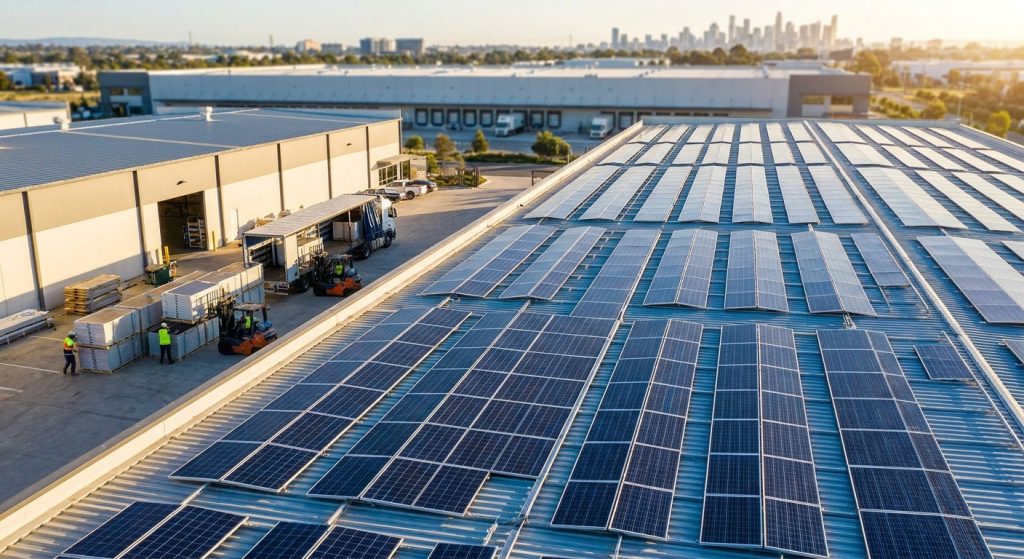
Commercial solar projects run on different math than a residential rooftop job — bigger arrays, tighter margins, and racking that has to survive wind and snow loads a home installer rarely thinks about. This guide breaks down what licensed installers and EPCs should actually check before buying wholesale solar panels for commercial solar projects in 2026.
TL;DR
For commercial-scale work in 2026, prioritize modules with documented efficiency ratings, racking rated for your specific roof type or ground condition, and a distributor that quotes volume pricing without vague lead-time promises. Maxeon solar panels are the safe pick for rooftop arrays needing high wattage density per square foot, while commercial flat-roof racking and ground-mount systems from Sun Supply PV cover the two most common installation types EPCs handle. If your project mixes shading zones or has module-level monitoring requirements, pair panels with commercial-grade microinverters rather than a single string inverter. Skip anything without clear spec sheets or warranty documentation — on a commercial job, that paperwork matters as much as the hardware.
Why this matters
A residential 8kW system and a 200kW commercial rooftop array are not the same product decision scaled up. Commercial buyers are working with tighter per-watt margins, longer install timelines, and often financing or PPA structures that depend on documented equipment specs. A wrong racking choice on a 50,000 square foot flat roof isn't a callback — it's a structural liability. Getting the panel, racking, and inverter pairing right the first time on wholesale solar panels for commercial projects saves rework, change orders, and inspection delays.
Who this is for
This guide is built for licensed solar installers, EPCs, and commercial project developers sourcing panels, racking, and balance-of-system components at distributor pricing for rooftop, ground-mount, or carport installations in 2026. If you're bidding commercial jobs — warehouses, schools, parking structures — the criteria below apply whether you're speccing a 100kW rooftop retrofit or a multi-acre ground-mount array.
What to look for in wholesale solar panels for commercial projects
Module efficiency and wattage class
Commercial roofs and ground-mount fields are usually space-constrained by permitting, setbacks, or structural load limits, so wattage per panel and per square foot drives the total system size you can fit. Higher-efficiency modules mean fewer panels, fewer racking rails, and less labor per installed kilowatt — all of which matter more on a 500-panel job than a 20-panel residential roof.
Racking load ratings matched to structure type
Flat commercial roofs, pitched metal roofs, ground-mount fields, and carports each carry different wind, snow, and ballast requirements. Racking rated for one application doesn't automatically transfer to another, and using the wrong system risks failing structural review or inspection. Solar panel racking systems for commercial flat roofs and ground-mount racking are engineered for very different load paths — confirm which one your project actually needs before ordering.
Inverter and monitoring architecture
Large commercial rooftop arrays often deal with partial shading from HVAC units, parapets, or adjacent structures — module-level microinverters or optimizers handle that better than a single central string inverter. If your array has mixed orientations or shading zones, factor inverter architecture into the panel decision, not as an afterthought.
Volume pricing and freight terms
Commercial orders run into hundreds of panels plus racking, inverters, and batteries — freight terms change your landed cost more than most installers budget for. Batteries and inverters ship free through Sun Supply PV, which is worth building into your bid math on any project that includes storage or a string/microinverter order alongside the panels.
Warranty documentation and manufacturer support
Commercial financing, PPAs, and O&M contracts often require documented product warranties on file, not just a verbal assurance. Confirm you can get manufacturer spec sheets and warranty documentation in writing before the order ships, especially on multi-building or phased projects.
Honest availability and lead times
Commercial timelines are unforgiving — a delayed panel shipment can push an entire crew schedule. Ask for a straight answer on availability and lead times rather than a vague ship date, and confirm before you commit crew schedules around it.
Top picks for commercial-scale sourcing
Maxeon solar panels — the high-efficiency pick
Maxeon modules are built around a shingled cell design that pushes efficiency higher per panel, which matters when roof space or ground footprint is the limiting factor on a commercial bid. If your project has a fixed roof area and you need to maximize installed capacity within it, higher wattage-per-panel numbers translate directly into more kW without more racking. Check current Maxeon solar panels for high-efficiency rooftop installs for spec sheets before finalizing a rooftop bid. Buy for space-constrained commercial rooftops.
Commercial flat-roof racking — the workhorse
Flat commercial roofs make up a large share of warehouse, retail, and industrial installs, and ballasted or attached racking systems built specifically for that structure type are the standard approach in 2026. The right system accounts for roof membrane type, ballast weight distribution, and wind uplift without penetrating the roof unnecessarily. Review solar panel racking systems for commercial flat roofs before specifying ballast quantities on your next bid. Buy for standard flat commercial rooftops.
Ground-mount racking — the large-scale pick
Ground-mount arrays for community solar, agrivoltaic, or campus-scale projects need racking engineered for soil conditions, frost line depth, and row spacing that rooftop systems never deal with. This is the pick when your project footprint is measured in acres rather than square feet of roof. See solar panel racking systems for ground-mount installations for the engineering documentation your permitting office will ask for. Buy for utility-adjacent and large campus ground-mount projects.
Commercial microinverters — the shading fix
On rooftops with partial shading from mechanical equipment or adjacent structures, module-level microinverters keep one shaded panel from dragging down an entire string's output. This matters most on retrofit projects where roof obstructions weren't part of the original design. Consider microinverters when your commercial rooftop has documented shading zones; Skip the added cost on a clean, unobstructed roof where a string inverter performs just as well.
Carport racking — the wildcard
Solar carports are becoming a standard ask on commercial parking lot projects in 2026, combining EV charging infrastructure with generation in one structure. This pick only applies if your project scope explicitly includes covered parking. Consider carport racking when the project brief calls for parking structure integration; Skip it if you're only bidding a standard rooftop or ground-mount job.
What to avoid
- Residential-rated racking on commercial roofs. Systems designed for a 30-panel home array often aren't rated for the wind and snow loads a 500-panel commercial roof needs — confirm load ratings match your structure, not just your panel count.
- Buying panels before confirming racking compatibility. Panel frame dimensions and racking rail systems need to match; ordering panels first and racking second on a large commercial job risks a mismatch that delays the whole install.
- Skipping documentation to save time. On financed or PPA-backed commercial projects, missing warranty paperwork or spec sheets can hold up the entire deal at closing — get documentation in hand before you need it.
Verdict comparison
| Product | Best for | Key spec to check | Verdict |
|---|---|---|---|
| Maxeon solar panels | Space-constrained rooftops | Wattage per panel | Buy |
| Commercial flat-roof racking | Warehouse/retail flat roofs | Ballast/wind rating | Buy |
| Ground-mount racking | Large-acreage arrays | Frost line/soil rating | Buy |
| Commercial microinverters | Shaded rooftop zones | Module-level MPPT | Consider |
| Carport racking | Parking structure projects | Load span rating | Consider |
FAQ
What's the difference between wholesale and retail solar panel pricing for commercial buyers?
Wholesale pricing through a distributor like Sun Supply PV is tiered to order volume and buyer type — licensed installers and EPCs typically access pricing structured for bulk commercial orders rather than single-pallet retail rates.
Is Maxeon better than standard commercial panels for rooftop projects?
Maxeon's shingled cell design pushes efficiency higher per panel, which helps on space-constrained rooftops; on projects with abundant roof or ground area, a lower-efficiency panel at a better per-watt rate may fit the budget just as well.
Do batteries and inverters ship free on commercial orders?
Yes — batteries and inverters ship free through Sun Supply PV, which is worth factoring into total landed cost when bidding a project that includes storage alongside panels.
How much does commercial solar racking cost compared to residential racking?
Commercial racking costs vary by roof type, load rating, and project scale — contact Sun Supply PV directly for current pricing on flat-roof, ground-mount, or carport systems specific to your project.
What racking do I need for a flat commercial roof vs. a pitched metal roof?
Flat commercial roofs typically use ballasted or hybrid-attached racking systems, while pitched metal roofs use rail-mounted systems fastened to seams or purlins — these are engineered differently and aren't interchangeable.
Can I use residential microinverters on a commercial project?
Residential microinverters are generally undersized for commercial array scale and monitoring requirements — commercial rooftop projects typically call for microinverters engineered for higher string counts and larger arrays.
How far in advance should I order panels for a commercial project?
Lead times vary by manufacturer and order size — contact Sun Supply PV for current availability rather than assuming stock, especially on large volume orders tied to a fixed install date.
Do commercial projects need different warranties than residential installs?
Commercial financing and PPA structures often require documented manufacturer warranties on file before closing — confirm you have spec sheets and warranty documentation in hand, not just verbal assurance, before the order ships.
One last thing
The detail that trips up commercial bids most often isn't the panel spec sheet — it's racking-to-roof compatibility that never gets checked until the crew is standing on-site with the wrong ballast blocks. Confirm racking load rating against your actual structural engineering report before you place a panel order in 2026, not after.
Related guides
