 Inverters & Batteries ship FREE
 Ask about rewards for referring friends and family
 U.S. Based Support
 Want to Add a battery?
solar inverters
Best Maxeon Solar Panels for Small Roofs (2026 Buy Guide)
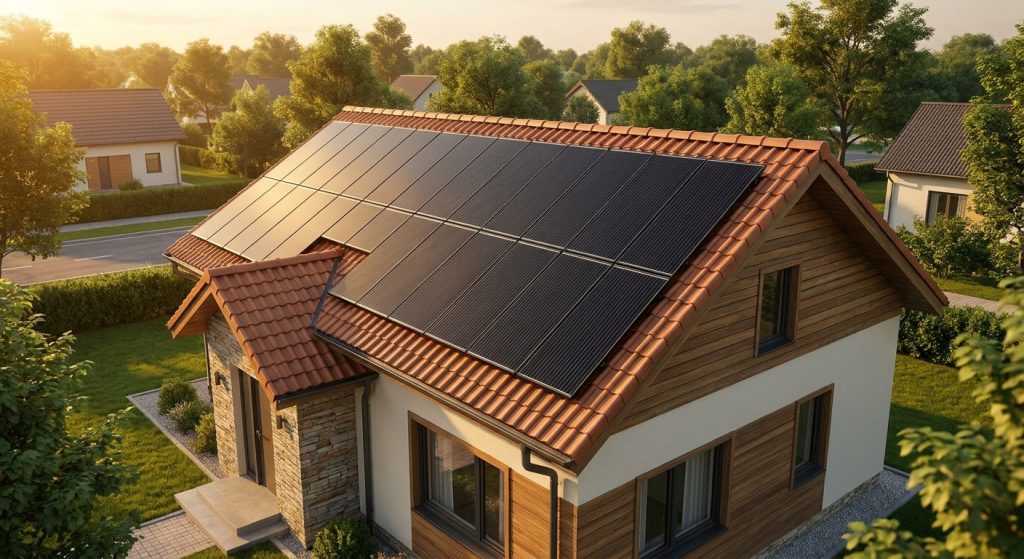
Maxeon panels pack more watts into less roof space than most tier-one modules on the market in 2026, which matters when your roof is small, shaded, or oddly shaped. This guide ranks the Maxeon lineup by what actually helps a small residential roof produce more power per square foot.
TL;DR: For small residential roofs in 2026, the Maxeon 6 is the top pick on power density (440W-460W in a standard footprint, around 22.8% efficiency) and earns a Buy. The Maxeon 3 is the value-focused runner-up with a Buy for budget-limited jobs verdict, and the Maxeon Air wins on weight for older trusses or thin-membrane roofs with a Consider verdict. Skip stacking multiple Maxeon tiers on one roof unless a licensed installer specs it — mixed-tier arrays complicate warranty claims.
Why this matters
A small roof doesn't get a do-over. If you've got 300-500 square feet of usable south- or west-facing surface, every watt per panel decides whether you hit your target system size or fall short and add a second array location. Maxeon's shingled-cell architecture is built around this exact problem — more active cell area per panel, less wasted space between cells, higher output per square meter than standard framed modules.
The Maxeon panel lineup for high-efficiency rooftops covers the full spec breakdown by model. This guide narrows that lineup down to what actually fits a tight roof in 2026 — and what to skip.
Small-roof buyers usually pair panels with a microinverter or string setup and, in a growing number of 2026 installs, battery storage for backup. If you're speccing an Enphase-based system alongside Maxeon panels, Enphase battery wholesale pricing is worth checking before you finalize a bill of materials — batteries and inverters ship free regardless of order size.
How we ranked these
Ranking criteria for small-roof suitability, weighted in this order:
- Power density — watts produced per square meter of panel, since roof area is the constraint, not budget.
- Panel weight — matters more on older roofs, tile roofs, and thin-membrane commercial-style residential roofs.
- Rated efficiency — Maxeon's published cell efficiency, since higher efficiency directly reduces the panel count needed to hit a target kW size.
- Warranty term — Maxeon panels are commonly quoted with warranty coverage well beyond the 25-year industry standard, which matters on a roof you won't want to re-work in 15 years.
- Fit for common small-roof array configurations — 10-16 panel systems, not 30-panel commercial-scale layouts.
Each model gets a verdict based on those five factors, not on price alone.
The ranked list
1. Maxeon 6 — the power-density leader
Rated in the 440W-460W range with efficiency around 22.8%, the Maxeon 6 is the highest power-per-panel option in the current lineup. On a small roof, that difference adds up fast: a 6.4kW system that needs 20 panels of a lower-output module can often be built with 14-15 Maxeon 6 panels instead, freeing up roof area for a second string or simply avoiding a shaded section altogether.
The tradeoff is standard panel weight, in the low-40-lb range per panel, which is a non-issue on most asphalt-shingle roofs built in the last 20 years but worth flagging for older structures.
Verdict: Buy for roofs where every square foot needs to produce, and where the roof structure can handle a standard-weight framed module.
2. Maxeon 3 — the value-focused pick
The Maxeon 3 runs around 400W with roughly 22.6% efficiency — a smaller gap to the Maxeon 6 than the model number suggests. For installers pricing a job where the client wants Maxeon-tier reliability without paying for the top wattage bin, the Maxeon 3 closes most of the performance gap at a lower per-watt cost tier.
On a small roof this means slightly more panels for the same system size compared to the Maxeon 6 — often one or two extra panels on a typical 10-14 panel residential array — so check roof area before committing.
Verdict: Buy for budget-conscious jobs where roof area has a little room to spare.
3. Maxeon Air — the lightweight specialist
Maxeon Air is built around a lighter, glassless-style construction that shaves a meaningful amount of weight off the standard framed panel — commonly cited at roughly a third lighter per panel. That's the deciding factor for older trusses, low-slope membrane roofs, or any structure where a full structural load calculation raises red flags.
Output lands around 425W, which is competitive but not the top of the lineup, and it's a more specialized product than the 6 or 3 — installers should confirm mounting compatibility before quoting it.
Verdict: Consider for roofs with weight constraints; Skip if your roof already handles standard framed modules without issue, since the 6 or 3 will get you more watts for the same install cost.
4. Mixed-tier small arrays
Some small-roof jobs get pitched with a mix of Maxeon 6 on the primary south-facing section and a lower-tier panel on a secondary, shaded section to save cost. It looks efficient on paper.
In practice, mixing tiers on one roof complicates monitoring, string balancing, and warranty documentation, and the wattage savings rarely justify the added complexity on a system this small.
Verdict: Skip — spec one Maxeon tier for the whole array unless a licensed installer has a specific technical reason not to.
Comparison table
| Model | Power range | Efficiency | Weight profile | Best for | Verdict |
|---|---|---|---|---|---|
| Maxeon 6 | 440W-460W | ~22.8% | Standard framed | Max output on tight roof area | Buy |
| Maxeon 3 | ~400W | ~22.6% | Standard framed | Budget-limited Maxeon-tier jobs | Buy |
| Maxeon Air | ~425W | Competitive | Roughly a third lighter | Older trusses, weight-constrained roofs | Consider |
| Mixed-tier array | Varies | Varies | Varies | Rarely, technical edge cases only | Skip |
Where to buy
- Confirm your exact panel count against roof measurements before ordering — small-roof jobs have zero margin for a miscount.
- Panel availability moves with manufacturer allocation; check current stock or contact Sun Supply PV directly for lead times rather than assuming immediate shipment.
- If the system includes battery storage or a microinverter package alongside the Maxeon panels, remember batteries and inverters ship free — factor that into your total order timing and freight planning for the panels themselves.
FAQ
What's the best Maxeon panel for a small roof in 2026?
The Maxeon 6 is the top pick for small roofs in 2026 because it delivers the highest watts per panel in the lineup, around 440W-460W, which reduces the total panel count needed to hit a target system size.
Is Maxeon 3 or Maxeon 6 better for a tight budget?
Maxeon 3 is the better fit for a tight budget — it runs about 400W at roughly 22.6% efficiency, close to the Maxeon 6's performance, at a lower price tier. The Maxeon 6 makes more sense when roof area is the harder constraint than cost.
How much does roof weight matter with Maxeon panels?
It matters most on older roofs and thin-membrane structures. Standard Maxeon 6 and Maxeon 3 panels weigh in the low-40-lb range each, which is fine for most modern asphalt-shingle roofs but worth a structural check on anything built before major code updates.
Is Maxeon Air worth it over the standard lineup?
Maxeon Air is worth it specifically when weight is the limiting factor — it's roughly a third lighter than a standard framed panel. If your roof has no weight constraints, the Maxeon 6 or Maxeon 3 will produce more watts per panel for a comparable install cost.
Can I mix Maxeon panel tiers on one small roof?
Technically yes, but it's not recommended for most residential jobs — mixed tiers complicate string design, monitoring, and warranty documentation for a wattage gain that rarely justifies the added complexity on a small array.
Do Maxeon panels come with a longer warranty than standard panels?
Maxeon panels are commonly quoted with warranty coverage that runs well beyond the 25-year industry standard for framed modules — confirm the exact term on the current spec sheet before finalizing a purchase.
How many Maxeon 6 panels does a typical small residential system need?
A 6kW-6.4kW system, common on small residential roofs, typically needs around 14-15 Maxeon 6 panels at 440W-460W each, compared to closer to 20 panels with a lower-output module.
What should I pair with Maxeon panels for battery backup?
Many 2026 residential installs pair Maxeon panels with Enphase microinverters and battery storage for backup capability — batteries and inverters ship free on qualifying orders, which is worth factoring into total project cost and timing.
One last thing
The detail most buyers miss on small roofs isn't wattage — it's panel count. Dropping from 20 panels to 14 by choosing the Maxeon 6 over a lower-density module doesn't just save roof space; it cuts the number of roof penetrations, rail sections, and mounting points an installer has to manage, which shows up in labor time even before you factor in the wattage gain.
Related guides
