 Inverters & Batteries ship FREE
 Ask about rewards for referring friends and family
 U.S. Based Support
 Want to Add a battery?
solar inverters
Best Solar Mounting Systems for Metal Roofs (2026)
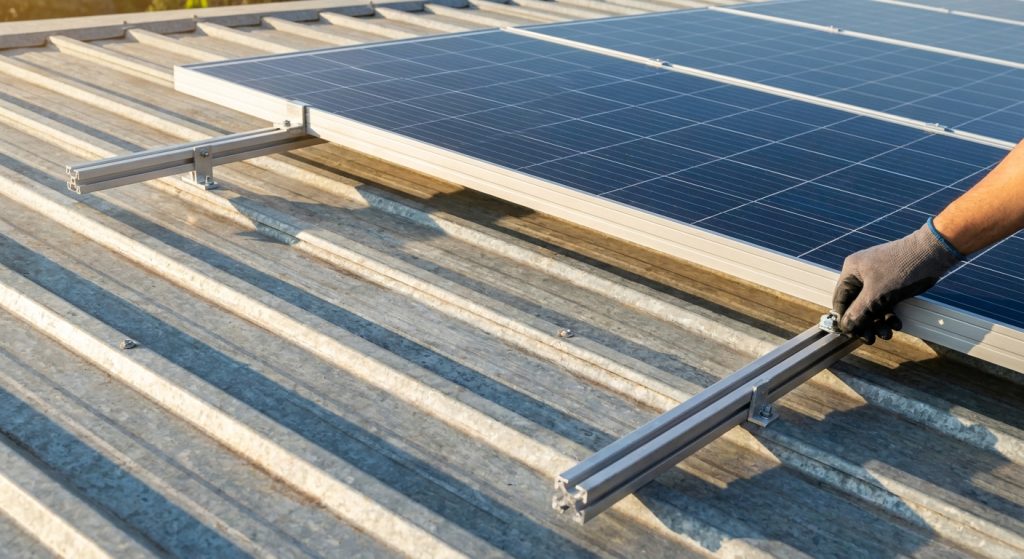
Metal roofs change the mounting equation entirely — no shingles to work around, no tar-and-flash penetrations, and often a standing seam profile that lets you skip roof penetrations altogether. Here's the ranked breakdown of the mounting systems that actually hold up on metal roofs in 2026, with verdicts for both licensed installers and DIY homeowners.
TL;DR
For solar panel mounting systems for metal roof installs in 2026, S-5! clamps are the Buy for standing seam because they attach without a single roof penetration. IronRidge XR100 rail is the Buy for corrugated and exposed-fastener metal roofs where you need a penetrating mount rated for high wind zones. Unirac RM10 Evolution is a solid Consider for installers already standardized on Unirac's rail ecosystem. Pegasus Solar's clamp line rates as a Consider for budget-conscious residential jobs. SolaDeck earns a Consider for anyone integrating a junction box into the mounting plan. Skip generic no-name clamps sold without UL 2703 bonding certification — they void warranties and fail inspections.
Why this matters
A mounting system that's wrong for your roof profile costs more than a bad install — it costs a warranty claim, a failed inspection, or a leak five years down the road. Standing seam, corrugated, and exposed-fastener metal roofs each need different hardware, and using the wrong clamp on the wrong seam height is the single most common mounting mistake installers make on metal roofs.
Metal roofing panels also come in dozens of seam profiles — Snap-Lock, Mechanical Lock, Nail Strip, corrugated R-panel — and not every clamp fits every profile. Get this wrong and you're either drilling holes you didn't need to drill, or clamping a system that can't take the wind load your local code requires. That's the difference this guide is built to solve.
Worth noting up front: solar panels themselves and the racking under them are two separate purchases, but they need to match. If you're speccing high-efficiency rooftop panels for a metal roof job, confirm the rail spacing and clamp count before the panels ship, not after.
How we ranked
Each mounting system below is scored on four factors that matter specifically for metal roofs: penetration requirement (zero, minimal, or standard), rated wind and snow load, compatibility with common metal roof profiles sold in the U.S. in 2026, and warranty length. Products without published UL 2703 bonding and grounding certification were excluded outright — that certification is non-negotiable for any rack-mounted PV system inspected under current code.
The ranked list
1. S-5! Clamps — the zero-penetration pick
S-5! S-5-N and S-5-K clamp series mount directly onto standing seam ribs using a set-screw design that never breaks the metal's surface. That's the entire pitch: no drilling, no sealant, no penetration to fail years later.
Rated pull-out strength runs up to 1,200 lbs per clamp on the S-5-N model depending on seam profile and gauge, and the line carries a 25-year product warranty. For any standing seam roof — the most common profile on new metal residential builds in 2026 — this is the fastest, lowest-risk install on the list. Verdict: Buy.
2. IronRidge XR100 Rail with FlashFoot2 — the high-wind pick
For corrugated, R-panel, and exposed-fastener metal roofs where a standing-seam clamp won't grip, IronRidge's XR100 rail paired with the FlashFoot2 mounting base gives you a penetrating system engineered for wind zones up to 180 mph and snow loads up to 100 lbs per square foot in certified configurations.
The rail integrates with IronRidge's grounding and bonding hardware, which matters because it's already UL 2703 listed as a system, not just as individual parts. Installers running residential microinverter systems on the same roof appreciate that IronRidge's rail spacing lines up cleanly with most 60-cell and 72-cell module footprints. Verdict: Buy.
3. Unirac RM10 Evolution — the installer-standardized pick
Unirac's RM10 Evolution rail system is built for installers who run high volume and want one rail platform across composite shingle, tile, and metal roofs. On metal, it pairs with Unirac's L-foot and standoff hardware for exposed-fastener profiles.
It's not the fastest install on this list, and it doesn't beat S-5! on standing seam speed, but if your crew is already trained on Unirac's torque specs and bonding hardware across other job types, switching systems roof-to-roof slows you down more than it helps. Verdict: Consider for shops standardized on Unirac; Skip if this is a one-off metal roof job.
4. Pegasus Solar Metal Roof Clamps — the budget pick
Pegasus Solar's clamp line covers both standing seam and corrugated profiles at a lower price point than S-5! or IronRidge, without giving up UL 2703 certification. The tradeoff is a narrower published wind rating range and fewer seam-profile variants than the category leaders.
For a straightforward residential job on a common Snap-Lock seam profile with moderate wind exposure, this is a reasonable Consider. For anything coastal, high-altitude, or on an unusual seam profile, step up to S-5! or IronRidge instead.
5. SolaDeck Integrated Junction Box Mount — the wire-management pick
SolaDeck isn't a full racking system — it's a junction box and conduit management solution that mounts alongside your rail or clamp system. On metal roofs specifically, it solves the problem of running conduit across ribbed or corrugated panels without extra penetrations for the junction box itself.
Pair it with any of the clamp systems above if your inspector is picky about exposed conduit runs, which is increasingly common in 2026 code cycles. On its own it's not a mounting decision — it's a Consider as an add-on, not a standalone choice.
6. SEG Rail-Based Systems — the value rail alternative
SEG's rail platform is a lower-cost alternative to IronRidge and Unirac for exposed-fastener metal roofs, with published wind ratings adequate for most inland U.S. zones. It lacks the breadth of accessory ecosystem the two category leaders have built out, which matters if you're doing anything beyond a standard rectangular array.
For a simple, single-plane metal roof job with no shading or unusual roof geometry, SEG is a fair Consider. For complex arrays or anything requiring shaded roof array microinverter placement around obstructions, the accessory gaps start to show. Verdict: Consider.
Comparison table
| System | Penetration | Rated Wind/Snow | Warranty | Best Roof Profile | Verdict |
|---|---|---|---|---|---|
| S-5! Clamps | None | Up to 1,200 lb pull-out | 25 years | Standing seam | Buy |
| IronRidge XR100 + FlashFoot2 | Standard | 180 mph / 100 lb-sq ft | 25 years | Corrugated, exposed-fastener | Buy |
| Unirac RM10 Evolution | Standard | Varies by config | 20 years | Mixed roof fleets | Consider |
| Pegasus Solar Clamps | Minimal | Moderate | 20 years | Snap-Lock standing seam | Consider |
| SolaDeck Junction Mount | None (add-on) | N/A | Varies | Any (wire management) | Consider |
| SEG Rail Systems | Standard | Adequate inland | 15-20 years | Simple exposed-fastener | Consider |
Where to buy
- Buy from an authorized distributor, not a marketplace reseller. UL 2703 certification and warranty registration depend on the hardware being sourced through the manufacturer's authorized channel — that's true for S-5!, IronRidge, Unirac, Pegasus Solar, SolaDeck, and SEG alike.
- Match clamp and rail purchases to your panel order. If you're ordering maxeon panels for small residential roofs alongside racking, confirm rail length and clamp count against the actual module dimensions before checkout, not after delivery.
- Check lead times before you commit an install date. Metal roof clamp availability varies by seam profile and season — confirm current stock and lead times directly rather than assuming same-week shipping in 2026.
FAQ
What's the best solar mounting system for a standing seam metal roof?
S-5! clamps are the standard choice for standing seam in 2026 because they attach to the seam itself with set screws, requiring zero roof penetrations.
Is IronRidge better than Unirac for metal roofs?
IronRidge's XR100 rail carries a higher published wind rating in certified configurations, making it the stronger pick for high-wind zones; Unirac's RM10 Evolution wins for installers who need one rail platform across multiple roof types.
Do metal roof clamps void the roof warranty?
Most metal roof manufacturers accept non-penetrating clamps like S-5! without voiding the roofing warranty, but penetrating systems like IronRidge or Unirac rail mounts should always be confirmed against the specific roof manufacturer's warranty terms first.
How much does solar mounting hardware cost for a metal roof?
Pricing varies by manufacturer, seam profile, and array size — contact a distributor directly for current wholesale or retail pricing rather than relying on outdated estimates.
Can you install solar panels on corrugated metal roofing?
Yes — corrugated and R-panel roofs typically use a penetrating rail system like IronRidge XR100 or SEG's rail platform rather than a standing-seam clamp, since corrugated profiles don't have a raised seam to clamp onto.
Do microinverters change the mounting system choice?
No — microinverters mount to the rail or racking itself and don't change which clamp or rail system fits your metal roof profile, though rail spacing should still match your chosen residential microinverter layout.
What warranty should I expect on metal roof mounting hardware?
Most major brands in this category — S-5!, IronRidge, Unirac — publish 20 to 25-year warranties on mounting hardware as of 2026, though terms vary by specific product line.
Is a DIY metal roof solar install realistic?
It's realistic for a straightforward standing seam roof with S-5! clamps and a licensed electrician handling the interconnection, but corrugated and exposed-fastener profiles with penetrating rail systems are better left to a licensed installer given the wind and water sealing requirements.
One last thing
The detail most homeowners miss: standing seam clamp spacing isn't arbitrary — it's tied to the seam's structural rib spacing, which varies by manufacturer even within the same profile name. Two roofs both labeled "Snap-Lock" can need different clamp models entirely. Confirm the exact seam manufacturer and profile before ordering hardware, not after the panels arrive. And remember: batteries and inverters ship free, so if you're pairing this mounting job with a battery install, that part of the order won't add freight cost on top of the racking.
Related guides
