 Inverters & Batteries ship FREE
 Ask about rewards for referring friends and family
 U.S. Based Support
 Want to Add a battery?
solar inverters
Solar Microinverters for Commercial Roofs: 2026 Verdict
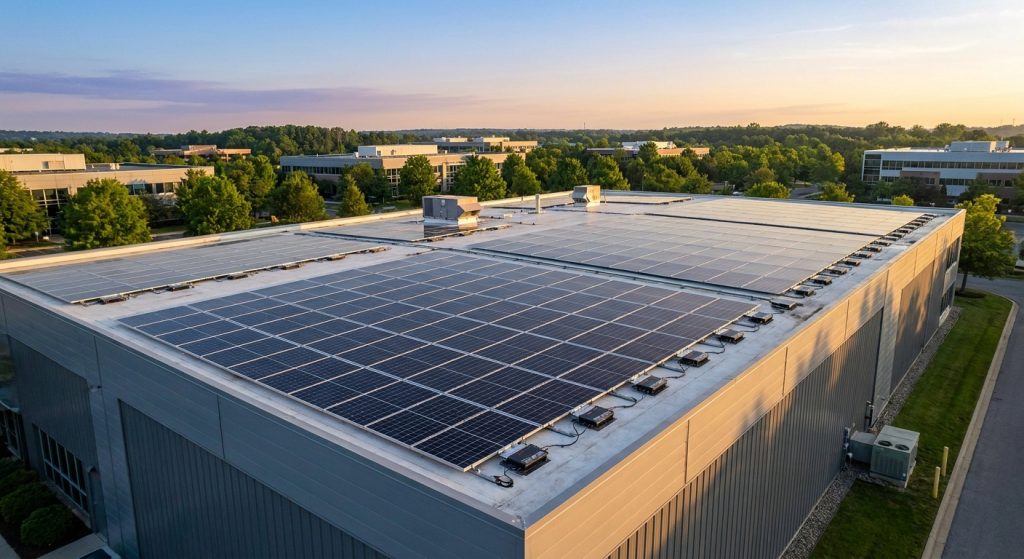
Commercial rooftop arrays don't behave like a 24-panel residential job scaled up — they run three-phase service, mixed roof orientations, and O&M contracts that need per-panel diagnostics, not a single string-level fault code. Here's what actually matters when you're specifying solar microinverters for commercial roofs in 2026, and which models hold up once you're past 100 panels.
TL;DR
For commercial rooftop arrays in 2026, Enphase IQ8M and IQ8H microinverters are the default pick — module-level monitoring, NEC 690.12 rapid shutdown compliance, and a 25-year limited warranty make them the safe call on mixed-orientation roofs. Buy. APsystems QT2 quad-branch units make sense when four-panel circuits cut conduit runs on dense commercial retrofits. Consider. Skip unbranded or end-of-life-firmware microinverters on anything over 50kW — the RMA logistics alone will eat whatever you saved per unit. Sun Supply PV stocks Enphase and APsystems microinverter lines at distributor pricing, with free shipping on inverters.
Why this matters
A residential microinverter decision is mostly about per-panel monitoring convenience. A commercial rooftop decision is about labor economics across hundreds of units, three-phase compatibility, and whether your O&M contract can actually pull fault data without a truck roll.
Code compliance shifted the math further. NEC 690.12 rapid shutdown requirements — already standard in most AHJs by 2026 — push module-level electronics from a nice-to-have to a baseline spec on any new commercial installation. String inverters can meet rapid shutdown with add-on devices, but that's another failure point per string, and on a 300kW rooftop that's a lot of extra hardware to inspect.
The other factor: commercial roofs are rarely a single clean south-facing plane. Parapets, HVAC penthouses, and stepped rooflines mean multiple orientations and partial shading are the rule, not the exception — which is exactly the scenario module-level electronics were built to handle.
Who this is for
This guide is for licensed installers bidding commercial rooftop jobs — warehouses, distribution centers, multi-tenant retail, schools — and for property owners or EPCs specifying equipment directly rather than leaving it entirely to a design-build contractor. If you're comparing string inverters against microinverters for a 50kW-plus flat or low-slope commercial roof, this is the decision framework.
What to look for in commercial microinverters
Module-level monitoring and O&M reporting
Commercial owners sign O&M contracts expecting per-panel fault data, not a string-level alarm that tells you something in a 20-panel run underperformed but not which unit. Microinverters report production and fault codes per panel, which turns a service call into a 10-minute fix instead of a half-day string trace.
NEC 690.12 rapid shutdown compliance
Rapid shutdown at the module level is baked into most current code cycles. Microinverters clear this natively — no add-on shutdown devices, no extra points of failure to inspect during commissioning or annual fire marshal walkthroughs.
Mixed-orientation and shading tolerance
Parapet shadows, rooftop equipment, and stepped roof planes mean a chunk of any commercial array runs at less-than-ideal orientation for part of the day. Microinverters isolate each panel's output, so one shaded row doesn't drag down an entire string's production the way it would with a central or string inverter setup. For arrays where shading is a known, persistent issue rather than occasional, the shaded roof array microinverter guide walks through the specific model considerations.
Panel wattage and voltage matching
High-efficiency commercial modules are pushing higher wattage per panel, and not every microinverter model is rated for the full range. Confirm the microinverter's rated input matches the panel you're pairing it with — pairing a legacy low-wattage-rated unit with a newer high-output module clips production you paid for. If you're specifying high-efficiency rooftop panels for the array, confirm compatibility before the order goes in, not after the pallets arrive.
Three-phase and branch circuit design
Most commercial services run three-phase power, and not every residential-oriented microinverter branch circuit design scales cleanly to that. Confirm the manufacturer's commercial branch circuit combiner options and whether the microinverter line has a documented commercial-scale reference design — this is a spec sheet question, not a guess.
Warranty term and RMA logistics at volume
On a 40-unit residential job, one RMA is an afternoon. On a 400-unit commercial array, a slow RMA process on a bad batch is a multi-week labor problem. Confirm warranty length and how the manufacturer handles bulk RMA before you commit to a brand for a large job, not after unit twelve fails.
Top picks for commercial rooftop arrays
Enphase IQ8M / IQ8H — the default pick. Module-level monitoring, native NEC 690.12 compliance, and a 25-year limited warranty make this the safe baseline spec for most commercial rooftop bids in 2026. The IQ8 series is grid-forming, meaning it can produce power during a grid outage when paired with compatible storage — relevant if the project scope includes backup. For general specification questions and how these units perform outside the commercial context, the residential microinverter comparison covers the same product family in more detail. Verdict: Buy.
Enphase IQ8X — the high-wattage matcher. Rated for higher-output modules than the base IQ8 line, this is the pick when the panel spec calls for higher per-panel wattage than the standard IQ8M/IQ8H input rating supports. Confirm current model availability with Sun Supply PV before finalizing a bill of materials — subject to availability. Verdict: Buy, if panel wattage requires it.
APsystems QT2 — the density play. A quad-branch design handles four panels per unit, which can cut conduit runs and labor hours on tight commercial retrofits where roof penetrations are already a constraint. Confirm current warranty terms directly, since RMA logistics matter more at commercial volume than the per-unit price difference. Verdict: Consider for retrofit jobs where labor savings on conduit outweighs a single-brand ecosystem preference.
Legacy or discontinued-firmware units — the trap. Older microinverter generations still show up in bulk-liquidation listings at attractive per-unit pricing, but firmware support and monitoring platform compatibility often lag behind current-generation units. On a commercial array with a multi-year O&M contract attached, a monitoring gap two years in is a real liability. Verdict: Skip unless the manufacturer confirms active firmware and monitoring support through the contract term.
What to avoid
- Unbranded or off-brand microinverters with no documented UL 1741-SA certification. They may clear inspection on paper but create liability if the AHJ or utility interconnection agreement later questions the certification.
- Mixing microinverter generations on the same branch circuit. Firmware mismatches between an older and newer generation of the same brand can create monitoring blind spots that are hard to diagnose after commissioning.
- String inverters marketed as "commercial-grade" without add-on rapid shutdown devices already spec'd in. If it's not in the bill of materials, it's not compliant, and retrofitting it after the fact costs more than specifying it correctly the first time.
Verdict comparison
| Model / type | Best for | Module-level monitoring | Rapid shutdown | Verdict |
|---|---|---|---|---|
| Enphase IQ8M / IQ8H | General commercial rooftop | Yes, per-panel | Native, NEC 690.12 | Buy |
| Enphase IQ8X | High-wattage panel pairing | Yes, per-panel | Native, NEC 690.12 | Buy |
| APsystems QT2 | Dense retrofit, four-panel branch | Yes, per-panel | Native | Consider |
| Legacy/discontinued firmware units | Nothing at commercial scale | Limited or unsupported | Varies | Skip |
| Unbranded string add-on shutdown | Nothing | No | Add-on only | Skip |
FAQ
What's the best solar microinverter for commercial rooftop arrays in 2026?
Enphase IQ8M and IQ8H are the most commonly specified units for commercial rooftop bids in 2026, based on module-level monitoring, native rapid shutdown compliance, and a 25-year limited warranty.
Are microinverters better than string inverters for commercial roofs?
For mixed-orientation or partially shaded commercial roofs, microinverters generally outperform string inverters because each panel operates independently — one shaded row doesn't drag down an entire string's output.
Do commercial microinverters need NEC rapid shutdown compliance?
Yes. NEC 690.12 rapid shutdown requirements apply at the module level in most jurisdictions by 2026, and microinverters meet this natively without add-on shutdown hardware.
Can microinverters handle mixed-orientation commercial roofs?
Yes — that's the primary technical advantage. Each microinverter isolates a single panel's output, so orientation or shading differences across roof planes don't cascade across an entire string.
How much do commercial microinverters cost per watt?
Pricing varies by volume, current manufacturer terms, and order size. Contact Sun Supply PV directly for current wholesale pricing on Enphase and APsystems commercial microinverter lines.
Is Enphase or APsystems better for large commercial arrays?
Enphase IQ8 series is the more commonly specified default for general commercial rooftop work in 2026; APsystems QT2's four-panel branch design is worth considering specifically when conduit runs and labor time are the deciding factor on a retrofit.
Do microinverters ship free from Sun Supply PV?
Yes — inverters and microinverters ship free through Sun Supply PV, along with batteries.
What warranty do commercial microinverters carry?
Enphase's IQ8 series carries a 25-year limited warranty. Confirm current terms for APsystems and any other brand directly before finalizing a bill of materials, since terms can change.
One last thing
The detail that trips up more commercial bids than any spec sheet: firmware generation mismatches on the same branch circuit. Two units from the same manufacturer, same model number, but different firmware batches can create monitoring gaps that don't show up until an O&M contract is already six months in and the property owner is asking why panel 214 hasn't reported data since installation. Confirm firmware generation consistency across the full order before it ships, not after it's on the roof.
Related guides
