 Inverters & Batteries ship FREE
 Ask about rewards for referring friends and family
 U.S. Based Support
 Want to Add a battery?
solar inverters
Enphase Battery Price 2026: Wholesale Guide for Installers
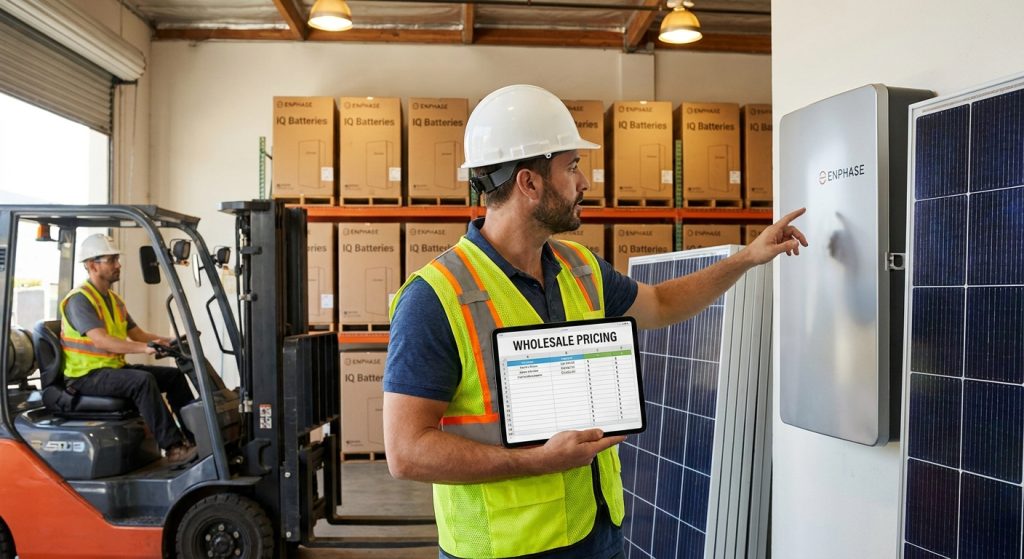
Enphase battery pricing at the wholesale level moves with unit type, stack size, and order volume — not a flat sticker number. This guide breaks down what actually drives the enphase battery price in 2026 and which Enphase storage products deserve a Buy call for licensed installers and residential buyers alike.
Bottom Line
The enphase battery price isn't one figure — it shifts with unit selection, stack configuration, and whether you're ordering a single battery or a pallet run. The IQ Battery 5P is the Buy for most single-battery residential installs in 2026, the IQ Battery 10C is a Consider for whole-home backup jobs needing higher continuous output, and older Encharge stock is a Skip once current-generation units are available. Batteries and inverters ship free through Sun Supply PV, which changes the math meaningfully once you're stacking multiple units on one order.
Why this matters
Installers price jobs off unit cost plus freight, and freight on a stacked battery order isn't small — a pallet of storage units weighs hundreds of pounds. Residential buyers comparing quotes often get quoted per-unit numbers that hide what a full stack actually costs delivered. Knowing which Enphase battery fits the job before you call for a quote saves both sides a round of back-and-forth in 2026, when lead times and allocation still vary by product line.
Who this is for
This guide is built for two buyers who ask the same question differently. Licensed installers want a predictable wholesale tier and a battery that matches the inverter stack they've already quoted. Residential DIY buyers want a battery sized to their panel and backup goals without paying for capacity they won't use. Both groups need the same underlying data: usable capacity, continuous power, and how the unit stacks.
What to look for in an Enphase battery for installers and buyers
Usable capacity per unit
The kWh number on the spec sheet is the first filter, and it's the number that determines how many units a job needs. A single IQ Battery 5P delivers roughly 5 kWh of usable capacity, which covers overnight essentials for a smaller home but won't carry a whole-home backup load through a multi-day outage. Get this wrong and you're either underselling backup capability or quoting more hardware than the job needs.
Continuous and peak power output
Capacity tells you how long the battery lasts; continuous power output tells you what it can actually run at once. The IQ Battery 5P is rated around 3.84 kW continuous, while the IQ Battery 10C steps up to roughly 5.12 kW continuous — the difference that matters when a home has a well pump, an HVAC compressor, and a range running simultaneously during an outage.
Stackability and system expansion
Enphase batteries are built to stack, but the practical limit depends on the site's panel and the inverter configuration already in place. An installer quoting a two-battery system today should confirm the homeowner's panel can support a third unit later without a service upgrade — that's a conversation that belongs in the original quote, not a change order in 2027.
Chemistry and safety certification
Enphase's current battery line runs on lithium iron phosphate (LFP) chemistry, which carries a different thermal profile than the older lithium NMC chemistry used in some earlier storage products. LFP is the safer default for indoor and garage-adjacent installs, and it's what most current UL 9540A testing references — confirm certification status on the specific model before quoting a permit-sensitive jurisdiction.
Warranty term
Enphase backs its current battery line with a stated warranty term measured in years, not a vague "long-term" promise — check the current documentation for the exact figure on the model you're quoting, since warranty terms have shifted across product generations. A shorter or unclear warranty on older stock is a real cost to flag to the homeowner before close.
Wholesale tier and MOQ structure
Distributor pricing moves in tiers tied to order volume, and installers ordering in stacks of four or more units typically sit in a different pricing conversation than a single residential order. Confirm the tier structure and any minimum order quantity before quoting a job with a tight margin, and reach out directly for current wholesale terms rather than assuming last quarter's pricing still applies in 2026.
Top picks for 2026
The default residential pick — IQ Battery 5P
Hook: the battery most single-family backup jobs are built around. One spec that matters: roughly 5 kWh usable capacity per unit, enough for essential-loads backup on a typical 2,000-square-foot home. Verdict: Buy for standard residential jobs where the homeowner wants overnight backup without paying for whole-home capacity.
The whole-home backup pick — IQ Battery 10C
Hook: the unit for homeowners who want the fridge, HVAC, and well pump running through an extended outage. One spec that matters: continuous output near 5.12 kW, meaningfully higher than the 5P line. Verdict: Consider when the site's load profile justifies the higher continuous output — confirm with a load calculation before quoting, not after.
The compact-footprint pick — IQ Battery 3T
Hook: the smaller-format unit for installs where wall space or panel capacity is tight. One spec that matters: a usable capacity around 3.5 kWh, sized for partial backup rather than whole-home coverage. Verdict: Consider for retrofit jobs where space is the constraint, not budget.
Legacy Encharge stock
Hook: older-generation units that occasionally show up in remaining inventory. One number that matters: warranty terms and chemistry specs on legacy units differ from current IQ Battery models, and support timelines for older product lines run shorter. Verdict: Skip unless the job specifically calls for compatibility with an existing legacy Enphase system already on site.
What to avoid
- Quoting capacity without checking continuous output — a battery with the right kWh number can still fall short on peak load if the home runs a well pump or electric range during an outage.
- Assuming stack limits without confirming the panel — a homeowner who wants to add a third battery in 2027 needs that headroom designed into the original install, not retrofitted later.
- Buying legacy stock to save on the unit price — a shorter warranty window and older chemistry can cost more in service calls than the up-front number suggests.
Verdict comparison
| Model | Usable Capacity | Continuous Output | Best Fit | Verdict |
|---|---|---|---|---|
| IQ Battery 5P | ~5 kWh | ~3.84 kW | Standard residential backup | Buy |
| IQ Battery 10C | ~10.5 kWh | ~5.12 kW | Whole-home backup | Consider |
| IQ Battery 3T | ~3.5 kWh | Lower continuous draw | Space-constrained retrofits | Consider |
| Legacy Encharge | Varies by unit | Varies by unit | Existing legacy systems only | Skip |
FAQ
What determines the enphase battery price at wholesale?
Unit selection, stack size, and order volume set the wholesale tier — a single-unit residential order and a four-unit installer stack sit in different pricing conversations. Contact a distributor directly for current tier pricing rather than relying on a quote from a prior quarter.
Is the IQ Battery 10C better than the IQ Battery 5P?
The 10C isn't universally better — it's built for higher continuous output and larger capacity, which only matters if the home's backup load actually needs it. A homeowner wanting overnight essentials backup gets better value from the 5P.
Do batteries ship free?
Batteries and inverters ship free through Sun Supply PV, which matters more on multi-unit stacked orders where freight weight adds up fast.
Can residential buyers order Enphase batteries directly, or only licensed installers?
Both licensed installers and residential DIY buyers can order — pricing and support differ by buyer type, so confirm your tier when you place the order.
How many Enphase batteries does a typical home need?
Most single-family backup jobs run one to two units depending on load; whole-home backup jobs frequently run three or more, which is why panel headroom for future stacking matters at the design stage.
What warranty comes with a new Enphase battery in 2026?
Enphase states a specific warranty term on current-generation batteries — check the manufacturer's current documentation for the exact figure on the model you're quoting, since terms have shifted across product generations.
Are legacy Enphase battery units still worth buying?
Only if the job needs compatibility with an existing legacy system already installed on site — otherwise current-generation IQ Battery units carry better warranty terms and chemistry.
Does order volume change the enphase battery price?
Yes — wholesale tiers are volume-based, and installers ordering in stacks typically see different pricing structure than single-unit residential orders. Reach out for current tier terms before finalizing a job quote.
One last thing
The number that gets missed most often isn't the battery price — it's the panel headroom question. A homeowner who buys one IQ Battery 5P in 2026 and wants to add a second unit in 2027 needs that expansion capacity designed into the original electrical work, not bolted on later at a change-order rate. Ask the panel question before the first unit ships, not after.
