 Inverters & Batteries ship FREE
 Ask about rewards for referring friends and family
 U.S. Based Support
 Want to Add a battery?
solar inverters
Solar Panels for High Wind Areas: What Holds Up in 2026
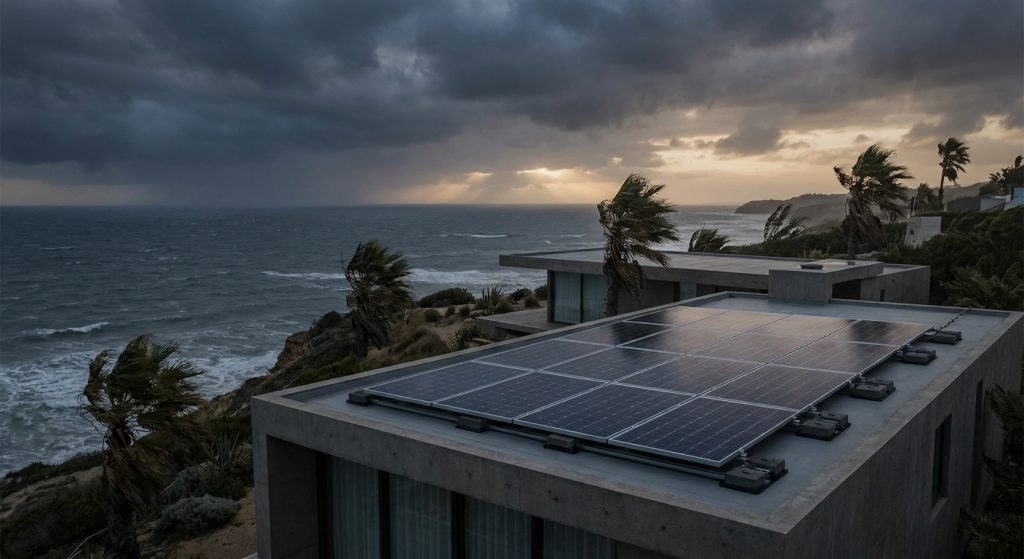
When a Category 3 storm rolls through the Gulf Coast, the panels rarely fail first — the racking does. Wind uplift, not wattage, is what tears solar arrays off roofs in a hurricane, and that single fact should drive every decision you make when shopping for solar panels for high wind areas in 2026.
Most buyers start by comparing panel brands. Wrong starting point. A 440W REC Alpha Pure or a Q.Cells Q.Tron panel performs almost identically in a storm to a cheaper module — what separates a roof that survives 150 mph gusts from one that doesn't is the racking system, the attachment spacing, and whether the install was engineered to the correct exposure category. Sun Supply PV sells both sides of that equation: the panels and the racking hardware that keeps them on the roof.
Why this matters
ASCE 7-22, the structural engineering standard most U.S. jurisdictions now reference for solar permitting, sets required wind design speeds by location — coastal stretches of Florida, Louisiana, and the Carolinas commonly land in the 150-180 mph exposure C or D range, while inland zones might only require 115-130 mph ratings. That gap is the difference between an entry-level rail system and one engineered specifically for storm zones.
NOAA's Atlantic hurricane season runs June 1 through November 30 every year, including 2026, which means any install going in ahead of summer needs its wind load math finalized well before storm season, not during it. A racking system rated below your county's required design speed will fail a permit inspection before it ever faces real wind.
Who this is for
This guide is for two groups: licensed installers bidding jobs in coastal wind-exposure zones who need racking that clears inspection on the first submission, and homeowners in hurricane-prone counties — Florida, coastal Texas, the Carolinas, parts of the Gulf Coast — who want to know what actually holds up before they sign a contract. If your roof sits outside a designated high-wind zone, standard-rated racking is fine and you're overpaying for anything beyond it.
What to look for in solar panels for high-wind areas
Wind load rating in mph, not just a spec sheet claim
Every racking system carries an engineered wind rating, usually expressed in mph at a given exposure category. A rail rated for 140 mph in exposure B is not the same as 140 mph in exposure C or D — coastal terrain multiplies wind force compared to sheltered inland sites. Confirm the rating matches your actual exposure category, not the best-case number on the datasheet.
Attachment point density
More attachment points per panel means the uplift load gets distributed across more roof structure instead of concentrating on a few lag bolts. High-wind installs typically need tighter rail spacing and additional mid-clamps compared to a standard install in a low-wind county. Wind load requirements for solar racking walks through how to calculate the spacing your specific roof and code jurisdiction require.
Module frame strength
A thin-frame panel can still be structurally rated for high wind if the racking clamps compensate, but frame gauge matters at the margins. Panels with reinforced frames — common in commercial-grade lines from JA Solar and Trina Solar — tolerate a wider range of clamp positions without flexing.
Corrosion resistance for coastal salt air
Salt spray corrodes standard aluminum and steel hardware faster near the coast. Stainless steel fasteners and marine-grade coatings aren't optional upgrades in a barrier-island install — they're the difference between racking that lasts 25 years and one that needs replacement in 8.
Code compliance and engineering documentation
Most high-wind counties require a stamped structural calculation before permitting, not just a manufacturer's generic wind chart. Skipping this step is the single most common reason high-wind installs get rejected at inspection.
Top picks for high-wind racking and mounting
Ground-mount racking for open, exposed sites. Ground-mount arrays face full wind exposure with nothing to break the gust — that means deeper embedment depth and wider footing spacing than a roof-mount job. Ground-mount racking systems are engineered around exposure category and frost depth simultaneously, which matters if you're building in a coastal-plus-freeze zone like parts of the Carolinas. This is the right call for rural and agricultural sites with open sightlines and no shading — a strong pick when you have the land and the budget for deeper foundations.
Standing-seam metal roof clamps for coastal homes. S-5! clamps attach directly to the seam without roof penetrations, which removes one entire category of leak risk in wind-driven rain. Metal roofs already handle wind better than asphalt shingle, and a non-penetrating clamp system keeps that advantage intact. This is the strongest option for coastal residential retrofits where the roof is already metal — a clear fit, not a compromise.
IronRidge XR-100 rail systems for standard composition-shingle roofs. Rated for a wide range of wind exposure categories when paired with the correct attachment spacing calculation, this is the workhorse choice for the majority of residential hurricane-zone jobs. It requires more attachment points per panel in exposure C/D zones than in a sheltered inland install, so the per-panel hardware cost runs higher — budget for that upfront rather than getting surprised at permit review.
What to avoid
- Generic "wind-rated" marketing claims with no mph number attached. If a racking listing doesn't specify a wind speed and exposure category, it hasn't been engineered for your zone — it's been engineered for somewhere.
- Ballasted flat-roof systems with insufficient ballast weight for coastal exposure. Ballast-only systems work fine inland but frequently need supplemental mechanical attachment once you're within a few miles of open coastline.
- Standard zinc-coated hardware in salt-air environments. It will corrode faster than the panels themselves degrade, turning a 25-year warranty into a 10-year hardware replacement job.
Comparison at a glance
| Criteria | Ground-mount | Roof-mount (shingle) | Roof-mount (standing-seam metal) |
|---|---|---|---|
| Typical wind rating range | Highest achievable, site-engineered | Moderate-high with added attachment points | High, benefits from non-penetrating clamp |
| Corrosion resistance needed | High (full exposure) | Moderate | Moderate |
| Install complexity | Highest (footings, trenching) | Moderate | Lower (no penetrations) |
| Engineering stamp required | Almost always | Usually in high-wind counties | Usually in high-wind counties |
FAQ
What wind speed can solar panels handle?
The panel itself typically tolerates well over 200 mph in lab testing, but the racking system is the actual limiting factor in the field — most engineered systems in 2026 carry ratings between 120 and 180 mph depending on exposure category and attachment spacing.
Do hurricane-rated solar panels exist?
There's no single "hurricane-rated" panel certification — what matters is the racking and mounting system's engineered wind load rating for your specific exposure category, plus a structural engineer's stamp where your county requires one.
Is ground-mount or roof-mount better in high-wind areas?
Ground-mount allows the deepest, most site-specific engineering because footings and embedment depth can be customized, but roof-mount with proper attachment spacing performs just as well on most residential jobs and costs less to install.
Do I need a structural engineer stamp for solar in a hurricane zone?
Most high-wind counties require one before permitting. The structural engineer stamp process confirms your roof and racking combination meets the local wind design speed, and skipping it is the top reason high-wind permits get rejected.
How much wind load rating do I need in Florida versus an inland state?
Coastal Florida counties commonly require 150-180 mph exposure C or D ratings under ASCE 7-22, while inland states often only require 115-130 mph — check your county's adopted code cycle before ordering racking.
Are microinverters or string inverters better in high-wind climates?
Wind rating has nothing to do with inverter type — it's a racking and attachment question. Choose microinverters or string inverters based on shading and monitoring needs, not storm exposure.
Do batteries and inverters ship free with orders from Sun Supply PV?
Yes — batteries and inverters ship free, which matters in high-wind regions where backup power after storm-related grid outages is often the whole reason for going solar in the first place.
What roof type performs best in a hurricane?
Metal roofs with non-penetrating clamp attachment generally outperform asphalt shingle in wind-driven rain events, mainly because there are fewer penetration points for water to find during sustained high wind.
One last thing
Most high-wind failures in 2026 storm-damage reports trace back to under-spaced attachment points, not panel or racking brand quality — installers who add 20-30% more attachment hardware than the minimum calculated spacing see dramatically fewer post-storm callbacks. If your installer quotes a wind-zone job without asking for your county's ASCE 7-22 design speed first, that's the question to ask before you sign anything.
Related guides
