 Inverters & Batteries ship FREE
 Ask about rewards for referring friends and family
 U.S. Based Support
 Want to Add a battery?
solar inverters
Pole Mount Solar Racking Systems: 2026 Buying Guide
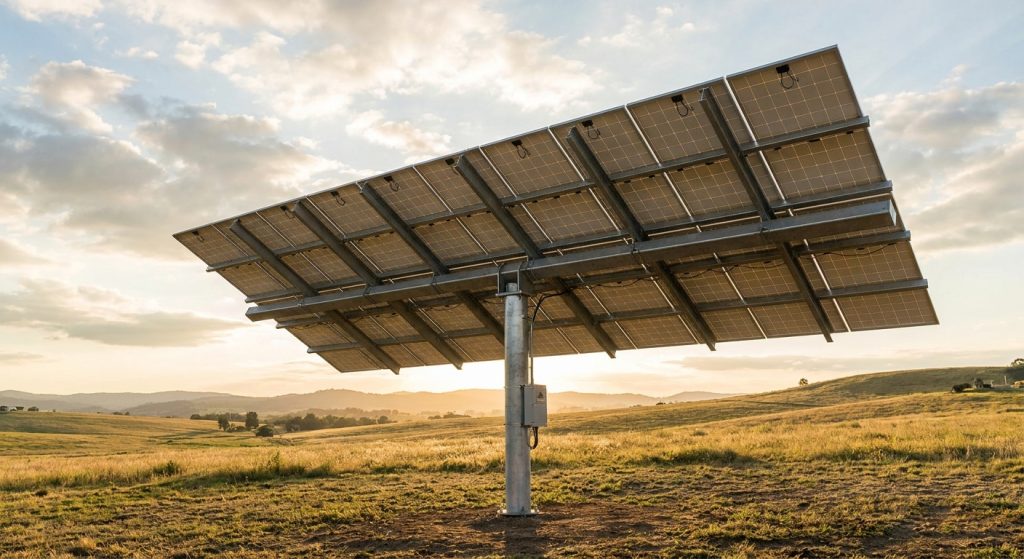
Pole-mounted racking solves a problem rooftop systems can't: it puts panels wherever the sun is best, not wherever the roof happens to face. For rural properties, farms, and homeowners with shaded or undersized roofs, a single pole or a row of poles can carry more capacity per panel than a comparable roof array, and it does it at the optimal tilt angle for the site's latitude.
This guide breaks down what actually matters when you're speccing pole mount solar racking systems for 2026 installs, whether you're a licensed installer bidding a rural job or a homeowner adding a standalone array next to the barn. The short version: embedment depth and wind rating decide whether the structure survives its first winter storm, and everything else is a secondary consideration once those two are locked in.
Who this is for
Pole mount racking is built for sites where roof mounting isn't the answer — acreage owners with open land, farms adding agricultural racking systems near outbuildings, off-grid cabins, and homeowners whose roof is shaded, undersized, or facing the wrong direction. It's also the default choice when a client wants ground-level access for panel cleaning or snow removal without a ladder. If your site has clear southern exposure on open ground and at least 200-400 square feet of usable space per array, pole mount is worth pricing out before you default to a roof job.
Why this matters
A pole mount array lives or dies on two numbers: how deep the pole goes into the ground, and what wind load the structure is engineered to survive. Get either wrong and you're not looking at a warranty claim — you're looking at a pole in the yard after the next 60 mph gust. Roof racking borrows the roof's structure to resist wind uplift; pole racking has to resist it entirely on its own, through the pole and the footing. That changes the math on everything from pole diameter to concrete volume, and it's why pole mount systems get engineered per site far more often than roof kits do.
What to look for in pole mount racking
Wind and snow load rating for your site
Most pole mount racking on the market ships rated to a baseline exposure category, but the number that matters is what your local building department requires, not the catalog spec. Exposure C sites (open terrain, coastal, high plains) need a different embedment and pole schedule than a wooded Exposure B lot even at the same wind speed map value. Confirm the rating against your county's adopted code before you order steel, not after.
Pole embedment depth and soil bearing capacity
Embedment typically runs 30 to 42 inches for residential-scale arrays, deeper in loose or sandy soil, shallower in solid bedrock with anchoring. Frost line depth in northern climates can push footings past 36 inches on its own, independent of wind load. A geotechnical read of the soil — or at minimum a local frost-depth chart — should drive this number, not a generic spec sheet.
Tilt adjustability and seasonal angle changes
Roof arrays are stuck at whatever angle the roof gives you. Pole mounts aren't. Adjustable-tilt racking lets you swing the array 18 to 45 degrees a couple of times a year to chase winter sun angle or shed snow faster, which can meaningfully change production in northern latitudes. Fixed-tilt is cheaper and simpler; adjustable costs more up front and needs a maintenance visit twice a year.
Panels per pole and array density
Single-pole "top of pole" configurations typically carry 4 to 8 panels. Side-of-pole and multi-pole layouts scale to 12 panels or more per structure. More panels per pole lowers the cost per watt on foundation work, but it also raises the wind load the pole has to resist — bigger arrays need bigger pipe, not just a bigger footing.
Corrosion resistance and pole material
Galvanized steel schedule 40 pipe is the standard, typically in 4 to 8 inch diameters depending on array size and wind exposure. Coastal sites and anywhere with road salt exposure should confirm the galvanization spec holds up over the system's service life — this is a detail worth checking against the manufacturer's documentation rather than assuming.
Engineering and permit documentation
Most jurisdictions require stamped engineering for ground and pole mount arrays above a certain size, and some require it regardless of size. Getting a structural engineer stamp early in the process avoids a redesign after the permit office kicks the plans back.
Where pole mount racking earns its keep
Single top-of-pole mounts are the straightforward pick for smaller residential arrays — 4 to 8 panels on one pole, minimal footprint, lowest install labor. The tradeoff is a hard ceiling on capacity per structure; past 8 panels you're adding poles, not panels. Good fit for a homeowner adding a standalone array next to a shop or garage.
Side-of-pole and multi-pole layouts scale further, often 12+ panels across a run of poles, and this is where agricultural racking systems show up most — farms with open acreage and a need for real capacity, not a token array. Foundation work adds up fast at this scale, so a soil report before ordering steel pays for itself.
Adjustable-tilt pole mounts cost more and need a biannual angle adjustment, but in northern latitudes the production gain from chasing winter sun angle is real. This is the configuration to spec when a client is tracking every kWh, not just offsetting a bill.
Heavy-duty dual-pole mounts are the answer for high-wind zones or arrays pushing past what a single pole schedule can carry safely. Bigger pipe, deeper embedment, more concrete — and a stamped engineering package almost every jurisdiction will require at this scale.
Once you've settled on a configuration, wholesale solar panels for residential installers is the faster path to sourcing the panels themselves alongside the racking, rather than pricing them separately.
What to avoid
- Repurposing roof racking hardware for a pole application. Roof rail systems aren't engineered to resist wind load without the roof deck behind them — they'll look fine on paper and fail the first real storm.
- Guessing at embedment depth instead of pulling a soil report. A footing that's fine in clay can be undersized in sand, and the failure mode isn't gradual — it's a pole leaning after one bad season.
- Skipping the tilt-adjustment maintenance on an adjustable system. An adjustable-tilt mount left at one angle year-round loses most of the production advantage it was bought for, and you've paid for hardware you're not using.
Comparison at a glance
| Configuration | Panels per structure | Typical embedment | Best fit |
|---|---|---|---|
| Top-of-pole (single) | 4-8 | 30-36 in | Small residential arrays, tight footprint |
| Side-of-pole (multi-pole) | 12+ | 36-42 in | Farms, agricultural sites, larger capacity |
| Adjustable-tilt | 4-12 | 30-42 in | Northern latitudes, production-focused sites |
| Heavy-duty dual-pole | 12+ | 42 in+ | High-wind zones, large arrays |
Frequently asked questions
What's the best pole mount racking for a residential array? For most homeowners adding a standalone array, a single top-of-pole mount carrying 4 to 8 panels is the simplest and cheapest configuration to permit and install. Side-of-pole layouts make sense once you're past that panel count.
Is pole mount racking better than ground mount? Pole mount and ground mount both put panels off the roof, but pole mount uses fewer footings for the same panel count and typically offers easier tilt adjustment. Ground mount racking spreads the array across more footings and can suit larger, lower-profile installations — see the full breakdown on the ground-mount racking systems page.
How deep does a pole mount solar racking system need to go? Embedment typically runs 30 to 42 inches depending on soil type, wind exposure, and local frost line depth. Colder climates often push past 36 inches regardless of wind load, purely to get below the frost line.
Do I need a permit for a pole mount solar array? Most jurisdictions require a permit and, above a certain array size, stamped structural engineering. Check with your local building department before ordering steel — requirements vary by county even within the same state.
Can pole mount racking handle high wind zones? Yes, with the right pole schedule, embedment depth, and in most cases a heavier dual-pole configuration rather than a single pole. Coastal and open-plain sites in particular should confirm the rated wind speed against the local code map before finalizing a design.
How many panels can one pole carry? Single top-of-pole setups typically handle 4 to 8 panels; side-of-pole and multi-pole layouts scale to 12 or more. The limiting factor is the pole schedule and footing, not the panels themselves.
Does tilt angle matter on a pole mount array? It matters more on pole mount than roof mount because you can actually change it. Adjustable-tilt racking lets you optimize seasonally, which can meaningfully improve winter production in northern latitudes.
What's the cost difference between fixed and adjustable tilt? Adjustable-tilt racking costs more up front and needs a biannual site visit to adjust the angle, while fixed-tilt is cheaper and maintenance-free. The right call depends on whether the site is production-focused or budget-focused.
One last thing
The detail most people miss on pole mount arrays: the pole schedule that survives a wind load calculation on paper isn't always the one that survives the soil on your actual site. A wind-rated design assumes a soil bearing capacity that may not match what's under your property — run the numbers with an actual wind load calculation before ordering steel, not after the concrete truck shows up. And if the array is feeding a hybrid inverter or battery setup down the line, remember batteries and inverters ship free at Sun Supply PV, so the racking decision doesn't have to compete with shipping costs on the rest of the system.
Sun Supply PV stocks pole mount solar racking systems alongside the panels, inverters, and structural documentation guides needed to spec the job correctly the first time, not after a permit office kicks it back in 2026.
Related guides
