 Inverters & Batteries ship FREE
 Ask about rewards for referring friends and family
 U.S. Based Support
 Want to Add a battery?
solar inverters
Solar Mounting Systems for RV Rooftops: 2026 Guide
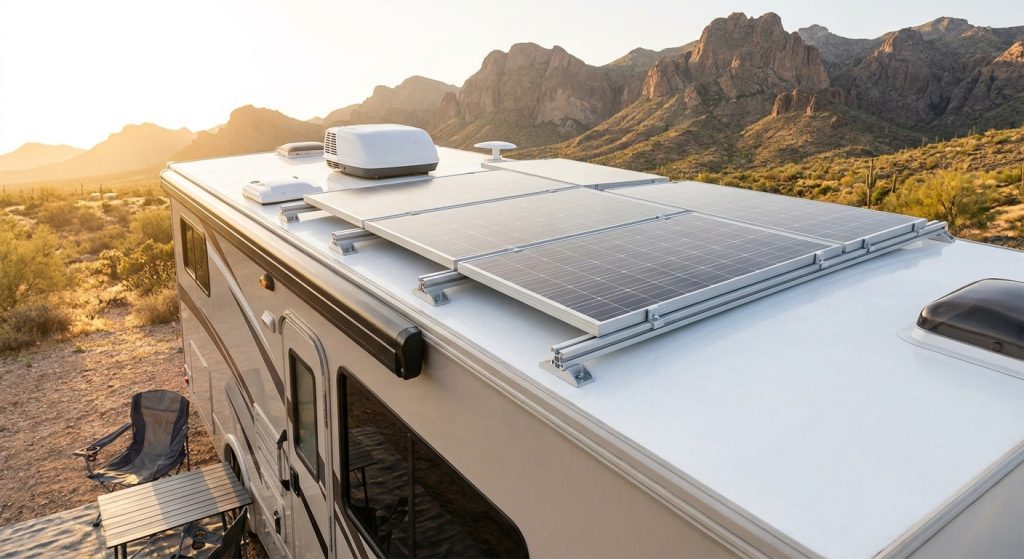
RV rooftops take abuse that a house roof never sees. Highway speeds push sustained wind loads across a curved aluminum surface, road vibration works every fastener loose over time, and the panel that sat flat in a driveway gets asked to survive a 500-mile drive with a headwind. Standard residential racking wasn't built for that, and using it anyway is the most common reason RV solar installs fail early.
The short version: rail-based flush mounts (IronRidge and Unirac both make low-profile kits) handle aluminum and fiberglass RV roofs well, adhesive Z-brackets work for no-drill fiberglass applications, and standing-seam clamps from S-5! fit metal-roof cargo conversions and toy haulers. Whatever you pick, it needs a wind rating built for moving loads, not static ballast, and hardware that won't gall or corrode after a season of road salt and rain. Wholesale RV and marine solar hardware is priced for installers doing multiple builds, but the same panels and mounts work fine for a one-off DIY retrofit.
Why this matters
Ground-mount and rooftop racking calculations assume a stationary structure with engineered anchor points and a wind load model based on static gusts. An RV rooftop moves. It flexes at speed, it vibrates over rough pavement for hours at a stretch, and it experiences dynamic pressure differentials that a parked house roof never sees. A bracket rated for 130 mph static wind on a house can still fail on an RV traveling 70 mph into a 20 mph headwind, because the fatigue cycling from thousands of miles of vibration is a different failure mode than a single storm gust.
That's why RV-specific mounting hardware exists as its own category instead of just "smaller versions of house racking." The bracket spacing, the sealant type, the fastener torque spec — all of it gets built around movement, not permanence.
Who this guide is for
This is written for three overlapping groups: full-time RVers and van-lifers adding or upgrading a rooftop solar array, installers building out custom mobile power systems for clients, and weekend campers retrofitting a travel trailer with panels for the first time. None of these buyers need to compromise on hold strength to save weight, and none of them need residential-grade ballasted racking that assumes the roof never moves.
What to look for in RV rooftop mounting systems
Roof penetration method
Most RV roofs are aluminum, fiberglass, or a rubber/TPO membrane over a wood or foam substrate, and each material dictates whether you bolt through or adhere on top. Bolt-through mounts give the strongest hold but require sealing every penetration with butyl tape or a compatible sealant rated for roof material, and a bad seal is the number one cause of RV roof leaks after solar retrofits. Adhesive VHB-backed brackets skip penetrations entirely, which matters on membrane roofs where every hole is a future leak point.
Wind load and vibration rating at highway speed
Look for mounts rated specifically for mobile applications, not just static wind load figures pulled from a house-roof spec sheet. A rack that only lists a static wind rating and no vibration or fatigue testing is a gap worth asking the manufacturer about directly. The math is different for a moving structure, and wind load requirements for solar racking explains how static and dynamic loading actually differ if you want the underlying engineering.
Weight and RV roof load capacity
Every pound added to an RV roof is a pound subtracted from cargo capacity and a shift in the rig's center of gravity. A typical 400W rigid panel runs somewhere in the 35-45 lb range before mounting hardware, so four panels can add close to 180 lbs before you've added a single bracket. Low-profile aluminum racking keeps hardware weight down without sacrificing hold strength, which matters more on a travel trailer with a tight GVWR than it does on a house.
Tilt capability versus flush mounting
Flush mounts are more aerodynamic and lower the risk of wind catching an angled panel at highway speed, but they lose output when the rig is parked and the sun angle isn't favorable. Tilt-leg kits solve that for boondockers who park for days at a time and want to chase sun angle, but they need to fold flat and lock securely before the rig moves again — a tilt leg left up during a drive is a liability, not a feature.
Hardware corrosion resistance
Road salt, rain, and constant vibration attack fasteners faster on a moving vehicle than on a stationary roof. Stainless steel or anodized aluminum hardware resists galvanic corrosion where dissimilar metals meet, and mismatched hardware is one of the most common causes of loosened brackets after a season of driving.
Compatibility with roof material
Aluminum roofs, fiberglass roofs, and rubber membrane roofs each call for a different bracket base and sealant approach. Confirming compatibility before ordering saves a return shipment and a wasted afternoon of drilling holes that don't seal properly.
Mounting approaches that actually work on RV rooftops
Flush-mount rail systems. IronRidge and Unirac both build low-profile rail kits that adapt well to aluminum RV roofs, spacing brackets to distribute load across multiple roof ribs instead of concentrating stress at a few points. Rail length and bracket spacing are adjustable, so a single kit covers panels from roughly 100W portable units up to full 400W rigid panels. This is the setup most installers reach for first because it's proven, adjustable, and easy to service later — the tradeoff is more roof penetrations than an adhesive system.
Adhesive Z-brackets. For fiberglass and membrane roofs where drilling is a liability, VHB adhesive-backed Z-brackets skip penetrations entirely and rely on industrial-strength tape rated for exterior UV and temperature swings. They hold up fine for lighter flexible panels and shorter routes, but they're not the right call for heavy rigid panels on rigs doing serious interstate mileage — the adhesive bond has limits that a bolt-through mount doesn't.
Tilt-leg kits. Pegasus Solar-style tilt mounts let you angle panels 0 to roughly 40 degrees when parked, which noticeably improves output on a low winter sun angle. The legs need to fold flat and lock before the rig moves, so these work best for boondockers and full-timers who park for multiple days rather than weekend campers making short hops.
Standing-seam clamps. S-5! clamps grip the seams of a metal roof without any penetration at all, which is why they show up on metal-roof toy haulers and cargo-trailer conversions. They're rated for both static and dynamic loads on standing-seam profiles, and as of 2026 they remain one of the only true no-drill options for a metal roof specifically.
Whichever mount you choose, pair it with hardware sized for your actual panel wattage — an MPPT charge controller built for RV and marine setups and the battery bank behind it both ship free, so the electrical side of the build doesn't add shipping cost on top of the mounting hardware.
What to avoid
- Ballasted residential racking. It's designed to sit under its own weight on a stationary roof — there's no ballast option on a moving vehicle, and the anchor points aren't rated for vibration.
- Undersized J-hooks or roof clips pulled from a house-roof kit. They're not tested for the fatigue cycling a rig sees over thousands of miles and tend to work loose within a season.
- Mismatched fastener metals. Stainless bolts into an aluminum bracket without an isolating washer sets up galvanic corrosion that eats the bracket from the inside over a year or two of road exposure.
Comparison at a glance
| Mount type | Roof compatibility | Tilt capability | Wind/vibration handling | Best for |
|---|---|---|---|---|
| Flush-mount rail (IronRidge/Unirac) | Aluminum, fiberglass | Flush only | Strong, proven on highway routes | Full-timers, installers building multiple rigs |
| Adhesive Z-bracket | Fiberglass, membrane | Flush only | Moderate, better for lighter panels | No-drill retrofits, shorter routes |
| Tilt-leg kit (Pegasus-style) | Aluminum, fiberglass | 0-40 degrees | Good when locked flat for travel | Boondockers parking multiple days |
| Standing-seam clamp (S-5!) | Metal roof only | Flush only | Strong, no penetration risk | Toy haulers, cargo conversions |
FAQ
What's the best solar mounting system for an RV rooftop?
Flush-mount rail systems from IronRidge or Unirac are the most common choice for aluminum and fiberglass RV roofs in 2026 because they distribute load across multiple points and adjust to different panel sizes. Metal-roof toy haulers do better with S-5! standing-seam clamps since they avoid penetrating the roof entirely.
Can you use standard residential solar racking on an RV?
Not reliably — residential racking is engineered around static wind loads and ballast weight on a stationary structure, not the vibration and dynamic wind pressure an RV sees at highway speed. Mounts built specifically for mobile applications account for fatigue cycling that residential hardware isn't tested against.
Do RV solar panels need to be tilted?
Tilting adds meaningful output gain when parked for multiple days at a low sun angle, but it's not required — flush mounts perform fine for shorter stays and are more aerodynamic while driving. Tilt-leg kits like Pegasus Solar's suit full-timers and boondockers more than weekend campers.
Is adhesive mounting safe for RV solar panels at highway speed?
Adhesive VHB brackets hold up for lighter flexible panels and moderate mileage, but heavy rigid panels on rigs doing serious interstate driving need bolt-through mounting for a stronger hold. Check the adhesive's rated shear strength against your panel weight before committing to a no-drill setup.
How much wind load should RV solar mounts handle?
Look for mounting hardware tested for both static wind pressure and vibration/fatigue cycling, not just a static rating borrowed from a house-roof spec sheet. The physics of a moving structure at 65-75 mph differ from a stationary roof in a storm.
What roof material do most RVs have, and does it change the mount type?
Aluminum, fiberglass, and rubber/TPO membrane are the three most common RV roof materials, and each one changes whether bolt-through or adhesive mounting makes more sense. Membrane roofs in particular benefit from adhesive or clamp-based mounts since every bolt hole is a future leak risk.
How much weight do solar mounts add to an RV roof?
A typical 400W rigid panel runs 35-45 lbs before hardware, and low-profile aluminum racking adds only a few additional pounds per panel. Four panels plus mounting hardware can approach 200 lbs total, which matters on a trailer with a tight GVWR.
Do I need a structural engineer stamp for RV solar mounting?
Most RV rooftop installs don't require an engineer stamp the way a permitted residential rooftop system does, since RVs fall outside standard building permitting in most jurisdictions. If you're doing a heavier commercial-grade mobile build, getting a structural engineer stamp is worth confirming with local code before finalizing the design.
One last thing
Check your total rig height after adding rooftop panels and racking before your first road trip in 2026 — tilt-leg brackets left even partially raised, or a rail system that sits an inch higher than expected, has taken more than one RVer by surprise at a low bridge or a drive-through. Measure with the mount installed, not just the panel spec sheet.
Related guides
