 Inverters & Batteries ship FREE
 Ask about rewards for referring friends and family
 U.S. Based Support
 Want to Add a battery?
solar inverters
Hybrid Inverter Whole Home Backup: 2026 Buying Guide
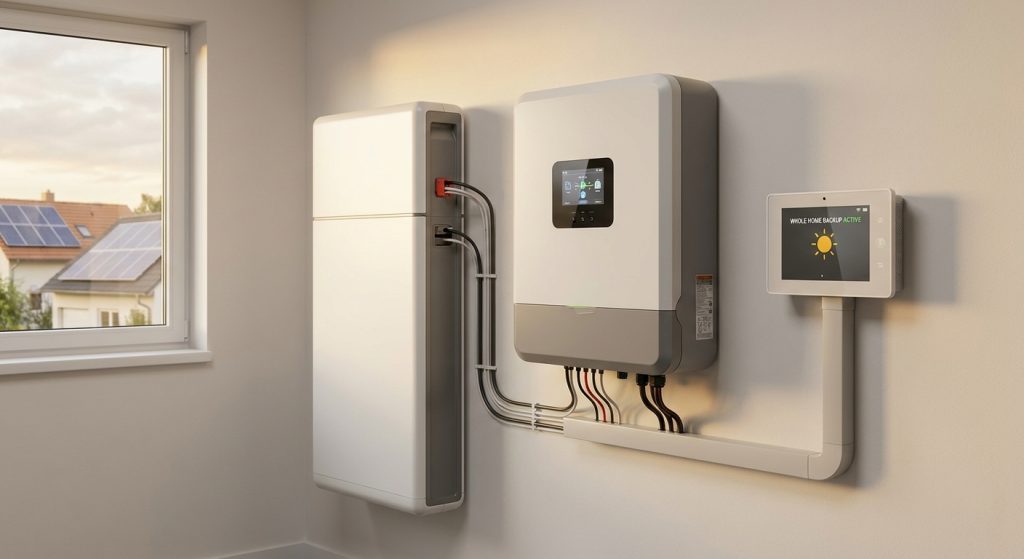
When the grid goes down, the difference between losing power for six hours and keeping the whole house running comes down to one component: the hybrid inverter. A hybrid inverter whole home backup setup manages solar input, battery charge and discharge, and the transfer to backup power in one box — get the sizing or the transfer speed wrong and the system either drops critical circuits or won't carry the load at all. This guide breaks down what separates a hybrid inverter setup that holds up during a real outage from one that trips the moment the well pump or HVAC kicks on, and which pairings in the Sun Supply PV catalog get it right heading into 2026.
Who this is for
This guide is built for two buyers who ask the same question from different angles. Licensed installers need a hybrid inverter whole home backup spec that satisfies NEC 2023 rapid shutdown requirements, stacks batteries without a redesign, and doesn't generate callback complaints six months in. Residential buyers — especially those with well pumps, home medical equipment, or an EV in the garage — need a system that survives a multi-day outage without babysitting circuit breakers. Both groups are shopping the same shelf, and the criteria below apply to each.
Why this matters
A grid-tied string inverter without battery backup shuts off the moment utility power drops, by design — that's the anti-islanding rule every grid-tied inverter follows. A hybrid inverter changes that equation: it can island the home, draw from a battery bank, and keep essential circuits alive for hours or days depending on battery capacity and load. The gap between those two setups only shows up during an outage, which is exactly the wrong time to discover you bought the wrong one. Getting the hybrid inverter sized correctly against your battery and panel up front avoids that surprise entirely.
What to look for in a hybrid inverter for whole-home backup
Continuous power rating vs. surge capacity
A hybrid inverter's continuous rating tells you what it can carry all day; surge capacity tells you what it can handle for the two or three seconds a well pump or AC compressor draws on startup. A 12kW continuous inverter with only 15kW surge will trip under a hard start from a 5-ton HVAC unit. Match surge capacity to your highest single-appliance draw, not just your total connected load.
Automatic transfer switching speed
When utility power drops, the inverter has to detect the loss and switch to battery power fast enough that sensitive electronics — routers, medical devices, some refrigerator compressors — don't reset or fault. Sub-20-millisecond transfer is now standard on most 2026 hybrid inverters; anything slower is worth asking about directly before buying.
Circuit-level control and load management
Whole-home backup doesn't mean every circuit gets equal priority during a long outage — it means the system can shed non-essential loads (pool pump, dryer) while protecting essential ones (well pump, fridge, medical equipment) automatically. A circuit-level monitoring panel paired with the inverter gives installers and homeowners that control without manual breaker flipping during an outage.
Battery compatibility and stacking
Check whether the inverter is locked to one battery brand or accepts multiple chemistries and stack configurations. A hybrid inverter that only pairs with one battery line limits future capacity additions — if the homeowner wants to add a second battery in 2027, the inverter needs headroom for it now.
Code compliance and installation requirements
NEC 2023 rapid shutdown, UL 9540 certification for the battery, and local AHJ backup-circuit rules all affect what's installable without extra permitting steps. Installers should confirm certification status before quoting a job; residential buyers should ask their installer to confirm it before signing.
Sizing to your actual appliance load
A 10kWh battery sounds like a lot until a well pump, sump pump, and refrigerator are all cycling on the same circuit. Sizing has to start from a real load list, not a square-footage estimate.
Top picks for whole-home backup
Sol-Ark hybrid inverters — the workhorse pick. Rated for continuous output in the 12kW-15kW range with surge capacity built for hard-starting well pumps and HVAC compressors, Sol-Ark units are a common spec for installers building off-grid-capable backup systems. Solid for larger homes with heavy single-appliance draws — confirm battery stacking limits with your installer before finalizing the design.
FranklinWH — the smart-grid pick. The FranklinWH system pairs its inverter with an integrated home energy gateway that manages circuit priority automatically during an outage, without a separate monitoring panel. A strong fit if you want load management built in rather than added on — see the FranklinWH whole-home backup setup breakdown for stacking specifics.
EG4 — the value-conscious pick. EG4 hybrid inverters are a common choice for DIY-inclined residential buyers and installers working budget-sensitive jobs, with split-phase output suitable for most U.S. residential panels. Reasonable for straightforward backup needs — less suited to homes wanting deep circuit-level automation without adding a separate monitoring panel.
Enphase IQ8 microinverters with battery — the grid-forming pick. Enphase's IQ8 series can form a microgrid at the panel level even without a central hybrid inverter, which changes the backup architecture entirely — power stays live circuit by circuit rather than through one central transfer point. Worth a serious look for new installs where microinverter-level resilience matters more than a single big inverter.
Tesla Powerwall 3 — the integrated pick. Powerwall 3 bundles the hybrid inverter and battery into one unit, which simplifies the install but limits third-party inverter swaps down the line. Makes sense for buyers who want one vendor and one warranty conversation — less flexible for installers who like mixing brands across a system.
For a side-by-side on full battery-and-inverter backup systems rather than just the inverter piece, the best whole-home battery backup systems for power outages breakdown covers pairing logic in more depth.
What to avoid
- Grid-tied-only string inverters marketed as "backup-ready." Without a battery and hybrid architecture, these still shut off the instant the grid drops — that's the anti-islanding rule, not a workaround.
- Undersized surge capacity relative to your heaviest appliance. A system that looks right on paper trips the first time the well pump and AC compressor start at the same moment.
- Non-stackable inverters bought for "future expansion." If the inverter's battery ceiling is fixed, adding capacity later means replacing the inverter, not just adding a battery.
Verdict comparison
| Inverter/System | Continuous Rating | Transfer Speed | Battery Flexibility | Best Fit |
|---|---|---|---|---|
| Sol-Ark | 12-15kW | Sub-20ms | Multi-chemistry stacking | Heavy single-appliance loads |
| FranklinWH | Varies by config | Sub-20ms | Integrated gateway priority | Automated load management |
| EG4 | Split-phase, budget tier | Sub-20ms typical | Standard stacking | Straightforward backup, tighter budget |
| Enphase IQ8 | Per-microinverter, aggregate | Circuit-level | Microgrid architecture | New installs, distributed resilience |
| Tesla Powerwall 3 | Integrated | Sub-20ms | Single-vendor, fixed | Simplicity, one-vendor warranty |
FAQ
What's the best hybrid inverter for whole-home backup in 2026?
There's no single best answer — Sol-Ark suits heavy-load homes with well pumps or large HVAC systems, while FranklinWH and Enphase IQ8 suit buyers who want automated circuit management built in rather than added separately.
Is a hybrid inverter better than a standard string inverter for backup?
Yes, for backup purposes specifically — a standard grid-tied string inverter shuts off during an outage by design, while a hybrid inverter can island the home and run off battery power.
How much battery capacity do I need for whole-home backup?
It depends on your actual load list, not square footage — a home with a well pump, sump pump, and standard refrigerator needs meaningfully more capacity than one running just lighting and a fridge. A proper load calculation before buying prevents undersizing.
Do batteries and inverters ship free from Sun Supply PV?
Yes, batteries and inverters ship free through Sun Supply PV, which matters given the freight weight on hybrid inverters and battery banks.
Can I add a second battery to my hybrid inverter later?
Only if the inverter you bought supports stacking beyond your initial configuration — confirm the stacking ceiling before installation, not after.
Does whole-home backup mean every circuit stays powered during an outage?
Not necessarily — most systems prioritize essential circuits (well pump, fridge, medical equipment) and shed non-essential ones (pool pump, dryer) unless paired with a circuit-level monitoring panel.
What transfer switching speed should a hybrid inverter have?
Sub-20-millisecond transfer is standard on most 2026 hybrid inverters and fast enough to avoid resets on routers and sensitive electronics — ask directly if a quoted system is slower than that.
Is Tesla Powerwall 3 a hybrid inverter or just a battery?
Powerwall 3 bundles an integrated hybrid inverter with the battery in one unit, which simplifies installation but ties you to one vendor for future inverter decisions.
One last thing
The detail most buyers skip: surge capacity, not continuous rating, is usually what trips a hybrid inverter during an actual outage. A homeowner sizing for "12kW continuous" without checking the surge number against their well pump's startup draw is the single most common undersizing mistake seen across 2026 installs — check that number before anything else on the spec sheet.
Related guides
