 Inverters & Batteries ship FREE
 Ask about rewards for referring friends and family
 U.S. Based Support
 Want to Add a battery?
solar inverters
Solar Battery Backup for Medical Equipment: 2026 Picks
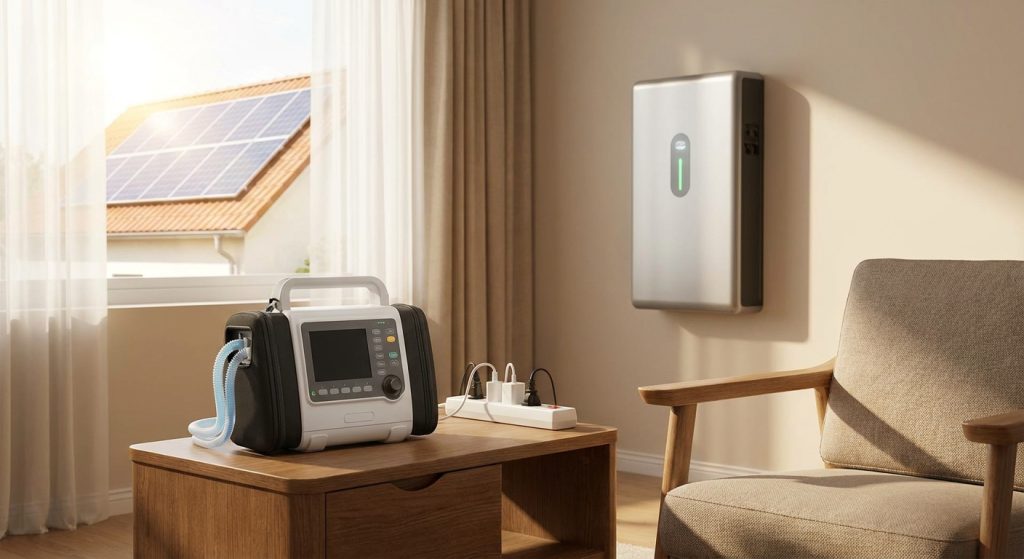
Running a CPAP machine, oxygen concentrator, or dialysis equipment on grid power that can drop out during a storm isn't a hypothetical risk — it's a daily dependency. This guide breaks down what actually matters when sizing a solar battery backup for medical equipment, which battery brands handle continuous medical loads without hiccups, and what setups look fine on paper but fail the people who need them most.
Why This Matters
A standard grid outage is an inconvenience for most households. For a home running an oxygen concentrator (typically 300-600 watts continuous draw) or a ventilator, it's a medical emergency measured in minutes, not hours. Portable generators buy time but come with fuel logistics, carbon monoxide risk, and a startup gap that a device on life support can't tolerate.
A properly sized solar battery backup for medical equipment eliminates that gap. The battery holds charge from the solar array or the grid, and when utility power drops, an automatic transfer switch shifts the connected circuits to battery power with no manual intervention. Getting the sizing and switching logic right is the difference between a system that quietly does its job in 2026 and one that fails during the exact week you need it.
Who This Guide Is For
This is written for two groups: homeowners managing a family member's medical equipment who need backup power that won't fail silently, and licensed installers speccing systems for clients with documented medical needs. Both groups care about the same three things — continuous output under load, runtime that covers a multi-day outage, and a transfer switch fast enough that a device never notices the grid went down. Neither group has patience for vague marketing about whole-home backup that turns out to mean two circuits and a porch light.
If you're speccing this for a client, sizing a solar battery system for whole-home backup is the starting point before you pick a specific battery model — get the load calculation right first, brand second.
What to Look for in a Solar Battery Backup for Medical Equipment
Continuous power output, not just capacity
Capacity (kWh) tells you how long a battery lasts. Continuous output (kW) tells you whether it can actually run your equipment alongside a refrigerator, well pump, or HVAC system at the same time. A battery rated at 10 kWh but capped at 3.84 kW continuous output will trip under a combined medical and household load faster than a smaller-capacity unit with higher continuous output. Ask for the kW rating before you ask about kWh.
Runtime at full medical load
Manufacturer runtime estimates assume average household loads, not a house running an oxygen concentrator around the clock. Recalculate runtime based on actual continuous wattage of the medical device plus critical loads like refrigeration and a well pump if applicable. A 13.6 kWh battery running a 400-watt concentrator plus a 150-watt refrigerator cycle has very different real-world runtime than the spec sheet number.
Automatic transfer switching with no gap
Devices like ventilators and CPAP machines with humidifiers don't tolerate a power interruption, even a brief one. The battery's transfer switch needs to move connected circuits from grid to battery automatically and near-instantly — this isn't a feature to skip to save money. Confirm the transfer mechanism is automatic, not a manual breaker flip, before anything else on this list.
Whole-home vs. partial-panel backup
Some battery systems back up the entire panel; others back up a designated critical-loads subpanel only. For medical equipment households, decide early which circuits absolutely must stay live — medical device outlets, refrigeration, and at least one HVAC zone in extreme climates — and confirm the battery and panel configuration covers exactly those circuits.
Circuit-level monitoring
Knowing which circuit is drawing what, in real time, matters more in a medical-equipment household than almost any other use case. If a battery is discharging faster than expected, circuit-level visibility tells you why before the battery runs dry. The SPAN Smart Panel is built specifically for this kind of granular, circuit-by-circuit visibility.
Certification and safety standards
UL 9540 certification for the battery and UL 9540A for the installation's fire safety testing aren't optional boxes to check — they're the baseline for any battery installed in a home where equipment failure has real consequences. Confirm certification status directly with the installer or distributor before committing to a specific unit.
Top Picks for Homes Running Medical Equipment
Enphase IQ Battery 5P — the steady, modular pick. Rated at 3.84 kWh per unit and stackable, the IQ Battery 5P is built to scale in increments, which matters if your medical load grows over time (a second device, a new prescription requiring more equipment). Continuous output per unit supports layered critical circuits without oversizing on day one. This is the right Enphase battery model for households that want to start smaller and add capacity as needs change, and it's a strong fit for medical equipment backup where predictable, incremental scaling beats a single oversized unit.
FranklinWH aPower — the whole-home continuous power pick. At 13.6 kWh per unit with strong continuous output, the aPower is built for households that need the whole panel backed up, not just a critical-loads subpanel. For a home running multiple medical devices plus standard household loads simultaneously, this capacity buffer matters. Review the FranklinWH whole-home backup setup if your medical equipment shares circuits with kitchen or HVAC loads that can't be separated onto a subpanel.
EG4 — the budget-flexible pick for off-grid or hybrid setups. EG4's lithium battery lineup pairs with hybrid inverters in modular capacity increments, giving installers room to size a system tightly around a documented medical load without paying for capacity a household doesn't need. It's a reasonable fit for rural or off-grid homes where a full whole-home system isn't practical, but confirm transfer switch specs carefully since EG4 setups vary more by installer than turnkey brands.
Tesla Powerwall — the pick for homes already running EV charging. If the household also charges an EV, integrating Powerwall with the charger and medical-equipment circuits under one monitored system avoids running two separate backup strategies. Powerwall's continuous output handles simultaneous EV charging and critical medical loads when sized correctly, though EV charging should be programmed to pause automatically during a grid outage so it never competes with medical circuits for battery capacity.
What to Avoid
- Portable power stations marketed for camping or tailgating. They look similar to home battery systems in marketing photos but max out at a few hundred watt-hours — nowhere near enough for multi-day medical equipment backup.
- Generators as the sole backup plan. Fuel supply chains fail during the same storms that cause outages, and generator startup time creates exactly the power gap a medical device can't tolerate. A generator can supplement a battery system; it shouldn't replace one.
- Any battery system without a documented, automatic transfer switch. If an installer can't clearly explain the transfer mechanism and switching time, that's a system built for general household convenience, not medical reliability.
Comparison at a Glance
| Battery | Capacity | Continuous Output | Best For |
|---|---|---|---|
| Enphase IQ Battery 5P | 3.84 kWh per unit, stackable | Scales per unit | Incremental, growing medical loads |
| FranklinWH aPower | 13.6 kWh | High continuous output | Whole-home backup with shared circuits |
| EG4 (modular) | Varies by configuration | Installer-configured | Off-grid or budget-sized medical loads |
| Tesla Powerwall | 13.5 kWh | High continuous output | Homes with EV charging + medical equipment |
Batteries and inverters ship free, and specs above reflect published manufacturer data as of 2026 — confirm current configuration options and lead times directly before finalizing a system, since availability varies by model and region.
FAQ
What's the best solar battery backup for medical equipment? There isn't a single universal answer — the right choice depends on continuous wattage of the specific device, whether other household circuits need to stay live, and whether the home already has EV charging or off-grid needs. FranklinWH and Tesla Powerwall suit whole-home continuous loads; Enphase suits incremental scaling.
Is a battery better than a generator for medical equipment backup? Yes, for equipment that can't tolerate a power gap. A battery with an automatic transfer switch changes over in a fraction of a second, while a generator requires startup time and manual or fuel-dependent operation.
How much battery capacity does a CPAP or oxygen concentrator need? A CPAP typically draws 30-60 watts; an oxygen concentrator draws 300-600 watts continuously. Runtime depends on total battery capacity divided by combined continuous load, including any other critical circuits sharing the system.
Do these battery systems work during a multi-day outage? Yes, if the solar array can recharge the battery during daylight hours and the household load is sized correctly against battery capacity. A battery without solar recharging only extends the outage window, it doesn't solve it indefinitely.
Does a solar battery system need a subpanel for medical equipment? Not always, but a dedicated critical-loads subpanel makes it simpler to guarantee medical circuits stay powered without competing against non-essential loads like an electric range or dryer.
How fast does the transfer switch respond when the grid drops? Manufacturer transfer switches on modern battery systems are built for near-instant switching so connected medical devices don't lose power during the transition — confirm the specific switching behavior with the installer for your chosen model.
Can I add an EV charger to a system already sized for medical equipment? Yes, but program the EV charger to pause automatically during grid outages so it never draws from battery capacity reserved for medical circuits.
What certification should a home medical-backup battery have? Look for UL 9540 battery certification and UL 9540A installation testing — both are standard requirements for safe residential battery installations in 2026.
One Last Thing
The detail most homeowners miss: battery capacity numbers on spec sheets assume ideal temperature ranges, and a garage or unconditioned space running 10-15 degrees hotter or colder than the battery's rated range can measurably shorten both lifespan and usable capacity. If the install location isn't climate-controlled, factor that into sizing conversations with your installer rather than trusting the sheet number as-is.
Related Guides
