 Inverters & Batteries ship FREE
 Ask about rewards for referring friends and family
 U.S. Based Support
 Want to Add a battery?
solar inverters
Solar AC/DC Disconnect Switches for Grid-Tie Systems 2026
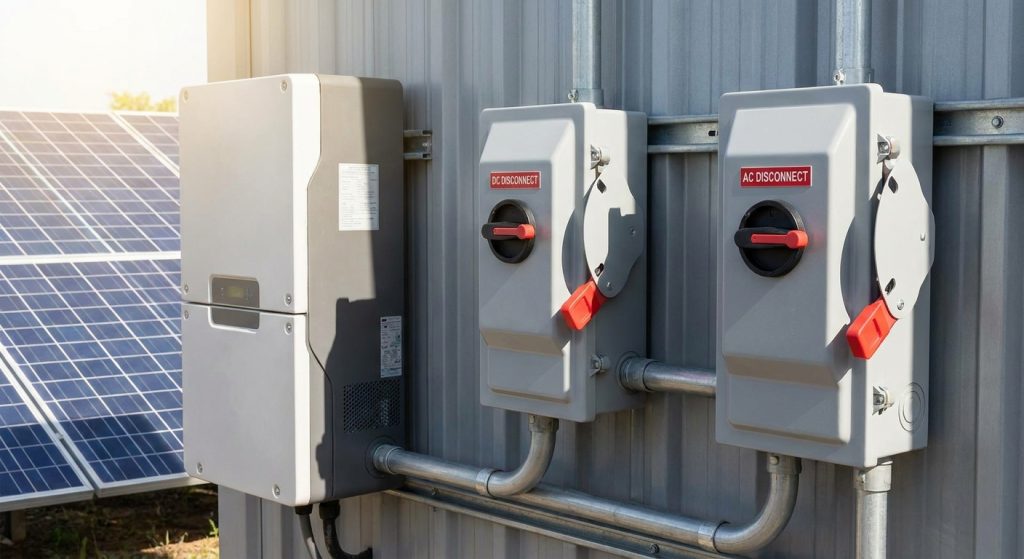
An AC/DC disconnect switch is the physical safety break between a solar array and the grid, and getting the sizing, enclosure rating, and placement wrong is one of the fastest ways to fail a permit inspection. This guide walks through what licensed installers and residential buyers actually need on a grid-tie job in 2026, with the specs that matter and the ones that don't.
Most grid-tie systems need two separate disconnect points: one on the DC side between the array and the inverter, and one on the AC side between the inverter and the utility meter. Some inverters, particularly newer hybrid grid-tie units, now integrate one or both into the chassis. That doesn't always satisfy your local AHJ, so the disconnect conversation has to start before the order goes in, not after the inspector shows up. Sun Supply PV stocks disconnect-rated gear alongside the inverters and racking that need it, and pairing the two at order time avoids a second shipment delay.
Why this matters
NEC 690.13 requires a readily accessible disconnecting means for every PV system tied to a building's wiring. NEC 690.12 rapid shutdown rules add another layer: conductors outside a 1-foot boundary of the array must drop to 30 volts within 30 seconds of shutdown initiation. Miss either requirement and the system doesn't get permission to operate, full stop.
This isn't a paperwork detail. A disconnect switch is what lets a lineworker or firefighter isolate a live rooftop array during an emergency, and utilities won't authorize interconnection without proof it's installed correctly. For installers, this is inspection-pass-or-fail territory. For DIY residential buyers, it's the difference between a system that gets PTO (permission to operate) in weeks versus one that sits disconnected for months over a redline.
Who this is for
This guide is built for two buyers: licensed installers speccing disconnects for grid-tie jobs across different AHJs, and residential owners managing a DIY or owner-builder install who need to hand a code-compliant system to an inspector. Both need to know amperage, enclosure rating, and placement rules before the array goes up, not after.
What to look for in a solar AC/DC disconnect switch
Voltage and amperage rating
The switch has to be rated above your system's actual operating voltage and current, with margin. Most residential string systems run DC disconnects rated at 600V and 30-60A; commercial arrays with higher string voltages often need 1000V-rated switches. Undersizing the rating is a fire risk, not just a code violation.
NEMA enclosure rating
Any disconnect mounted outdoors needs a NEMA 3R enclosure at minimum to handle rain and dust. Indoor disconnects, like ones mounted next to a service panel in a garage, can use a lighter-duty NEMA 1 enclosure, but outdoor-rated is the safer default for anything exposed to weather.
Fused vs. non-fused
Fused DC disconnects add overcurrent protection at the disconnect point, which some AHJs require for multi-string arrays feeding a combiner. Non-fused switches are simpler and cheaper but push fusing responsibility upstream to the combiner box or inverter. Know which your jurisdiction expects before ordering.
Lockable in the open position
Fire code in most jurisdictions requires the disconnect to be lockable in the open (off) position so first responders can isolate the array and know it will stay isolated. This is a small hardware detail that gets checked on every fire marshal walkthrough.
Placement and accessibility
Code generally requires the AC disconnect to be readily accessible, meaning no ladder or tool needed to reach it, and often within 10 feet of the service equipment depending on local amendment. Rooftop-mounted DC disconnects need to survive UV and thermal cycling for the life of the system, which is 25 years plus on a typical rooftop array.
Integration with the inverter
Some hybrid inverters now ship with an integrated DC disconnect in the chassis, which can eliminate one external box. Confirm with the local AHJ before relying on this instead of a separate switch, since not every jurisdiction has caught up to inverter-integrated disconnects yet.
Where the disconnects fit on different system types
String inverter systems need a dedicated DC disconnect between the combiner and the inverter, plus an AC disconnect between the inverter and the meter. If the array uses multiple strings, a multi-string combiner box upstream of the disconnect keeps the wiring organized and gives the inspector one clean point to check fusing.
Microinverter systems, since each panel outputs low-voltage AC at the module level, don't need a DC disconnect at all in most jurisdictions — the AC disconnect at the combiner or service point covers the whole array. Residential microinverters simplify the disconnect picture considerably compared to string setups, which is one reason installers favor them on complex roof shapes.
Hybrid grid-tie and battery systems carry the most disconnect complexity, since they need isolation points for the grid connection, the battery, and sometimes a critical loads panel. Hybrid grid-tie inverters built for 2026 installs increasingly bundle disconnect functionality, but a separate service-rated AC disconnect at the meter is still standard practice on most jobs.
Whole-home backup systems with circuit-level monitoring add another wrinkle: the disconnect strategy has to account for which circuits stay live during an outage and which don't, which is a wiring decision made well before the disconnect switch gets mounted.
What to avoid
- Indoor-rated switches mounted outside. A NEMA 1 enclosure looks nearly identical to a NEMA 3R unit in a catalog photo, but it will corrode and fail inspection within a season of weather exposure.
- Undersized fusing on multi-string arrays. A disconnect rated for the inverter's max current but not the combined short-circuit current of all strings feeding it is a common redline in 2026 inspections.
- Skipping the lockable handle. Some budget disconnects don't include a padlock hasp on the handle. It's a cheap part to miss and an automatic fail on a fire marshal walkthrough.
Comparison table
| Criteria | String inverter systems | Microinverter systems | Hybrid battery-tied systems |
|---|---|---|---|
| DC disconnect required | Yes, between combiner and inverter | Usually not required | Yes, at the battery and array |
| Typical amperage | 30-60A | N/A (AC only) | 60-100A |
| Enclosure rating | NEMA 3R outdoor | NEMA 3R outdoor | NEMA 3R outdoor, dual points |
| Fusing needed | Often, on multi-string | No | Yes, on DC battery side |
| Lockable handle | Required | Required | Required on all points |
Frequently asked questions
What's the difference between an AC and DC disconnect on a solar system?
A DC disconnect isolates the array from the inverter on the direct-current side, while an AC disconnect isolates the inverter's output from the grid on the alternating-current side. Grid-tie string systems typically need both; microinverter systems usually only need the AC side.
Is a disconnect switch required by code for grid-tie solar?
Yes. NEC 690.13 requires a readily accessible disconnecting means on every grid-tied PV system, and utilities won't approve interconnection without one verified at inspection.
Can microinverter systems skip the DC disconnect?
In most jurisdictions, yes, since microinverters convert to AC at the module level and there's no high-voltage DC run to isolate. Confirm with the local AHJ, since amendments vary by state and county.
How much does a solar AC/DC disconnect switch cost in 2026?
Pricing varies by amperage, fusing, and enclosure rating, and it shifts with distributor stock — contact Sun Supply PV directly for current pricing on specific models rather than relying on a fixed number.
What amperage disconnect do I need for a 10kW array?
Most 10kW residential string systems run a 60A-rated disconnect comfortably, but the exact rating depends on the inverter's max output current and any combined string fusing upstream. Check the inverter's spec sheet before ordering.
Where does the AC disconnect go — inside or outside?
Most utilities and AHJs want the AC disconnect mounted outdoors, near the utility meter, so a lineworker can isolate the system without entering the building. Some jurisdictions allow indoor placement if it's within reach of the meter.
Is a lockable disconnect required for firefighter access?
Yes, in nearly every jurisdiction with adopted fire code. The disconnect has to be lockable in the open position so first responders can isolate the array and trust it stays isolated during a call.
Can a hybrid inverter's built-in disconnect replace a separate switch?
Sometimes, but not universally. Some 2026-model hybrid inverters ship with an integrated DC disconnect that satisfies code in jurisdictions that recognize it, but plenty of AHJs still require a labeled, external switch regardless of what's inside the chassis.
One last thing
The integrated-disconnect trend is moving faster than some local code books can keep up with. A growing number of hybrid inverters ship in 2026 with the DC disconnect built into the enclosure, which can shave one external box and one labor hour off an install — but several AHJs still want a separate, externally labeled switch regardless of what's inside the inverter. Call the local building department before you drop the external disconnect from the bill of materials, not after the panel's already on the wall.
Related guides
