 Inverters & Batteries ship FREE
 Ask about rewards for referring friends and family
 U.S. Based Support
 Want to Add a battery?
solar inverters
Sigenergy Battery EV Charger Integration: 2026 Guide
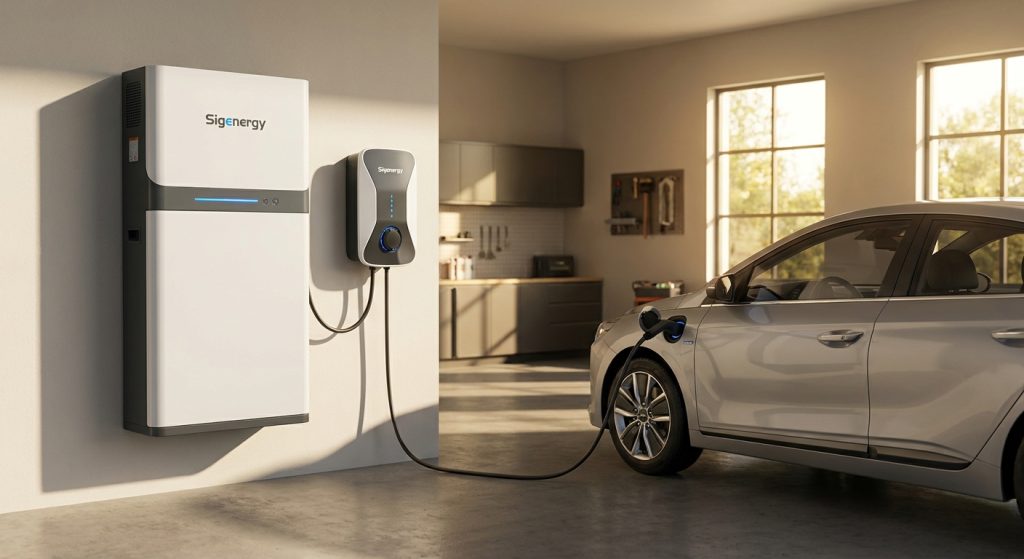
A Sigenergy battery EV charger setup solves a real problem: your car and your house end up fighting for the same amps, and most battery systems weren't built to referee that fight. A Sigenergy battery EV charger pairing runs solar, home backup, and EV charging through one hybrid inverter instead of three separate boxes fighting for the same circuit. For homes running a Level 2 EV charger alongside solar and battery storage, the Sigenergy SigenStor system stands out in 2026 for native EV load management built into the inverter itself. Tesla Powerwall 3 and FranklinWH aPower are both proven, well-documented alternatives, though they need an added EV charging module or smart panel to do the same job Sigenergy handles out of the box.
Why this matters
EV chargers draw hard, continuous loads — a Level 2 charger pulling 40 to 48 amps at 240V isn't a spike, it's a sustained draw for hours. Add that to a home already running a battery backup system, and you've got two big loads competing for the same panel capacity. Most Tesla Powerwall setups for homes with EV chargers get this wrong at the design stage — not because the battery is undersized, but because nobody accounted for what happens when the car starts charging during a grid outage.
The fix isn't a bigger battery. It's a system that knows the EV charger exists and can throttle or prioritize it. That's the entire pitch behind Sigenergy's SigenStor platform in 2026, and it's why this comparison matters more than raw kWh numbers.
Who this is for
This guide is for two groups: homeowners who already have solar and battery backup and are adding — or already have — a Level 2 EV charger, and licensed installers quoting systems where EV load management is part of the spec sheet, not an afterthought. If you're just comparing battery brands with no EV charger in the picture, most of the criteria below still apply, but the EV-specific sections won't matter as much.
What to look for in a Sigenergy battery EV charger system
Continuous output vs. your EV charger's draw
A battery's peak output number looks great in a spec sheet and means nothing during an outage if it can't sustain your EV charger's continuous draw. A 48A Level 2 charger needs roughly 11.5 kW of sustained output on top of whatever else is running in the house — check the continuous rating, not the surge rating, before you size anything.
Native EV load management
Systems that talk directly to the EV charger can throttle charging speed instead of tripping the whole circuit when demand spikes. This is the single biggest differentiator between Sigenergy's SigenStor and most standalone battery-plus-charger combinations in 2026 — the inverter sees the EV load as part of its management logic, not as a mystery draw.
Backup mode that includes the EV circuit
Some battery backup configurations exclude high-draw circuits like EV chargers from the backed-up panel entirely. That's fine if you don't need to charge during an outage — it's a dealbreaker if you do. Confirm the EV charging circuit is wired into the backup subpanel, not just the main panel.
Modular capacity and stacking
One battery module rarely covers a home running solar, backup loads, and EV charging all at once. Look for systems that stack cleanly — Sigenergy's modules, Tesla's expansion packs, and FranklinWH's aPower units all support adding capacity without replacing the inverter.
Permitting and code compliance
EV circuits combined with battery backup can trigger additional inspection requirements depending on your jurisdiction's NEC cycle. This isn't a spec you compare between brands — it's a step you don't skip, and it's worth confirming with your installer or AHJ before committing to a system layout.
Shipping and lead time
Batteries and inverters ship free through Sun Supply PV, which matters more than it sounds like once you're comparing landed cost on a multi-thousand-dollar system. Availability varies by SKU, so confirm current lead times before you lock in an install date.
Top picks for EV charging integration
Sigenergy SigenStor — the integrated pick. SigenStor pairs a hybrid inverter with modular battery capacity and native EV charging management, meaning the system throttles EV load automatically instead of relying on a separate smart panel. Combined continuous output across solar, battery, and EV load runs up to roughly 20 kW depending on configuration. A strong fit if you want one inverter managing everything instead of stitching together three vendors' hardware.
Tesla Powerwall 3 — the proven pick. Powerwall 3 delivers 13.5 kWh of capacity per unit and up to 11.5 kW of continuous output, which covers most single Level 2 charger scenarios on its own. It doesn't natively prioritize EV load the way SigenStor does, so you'll want a smart charger or load-management add-on if you're running the EV circuit through backup. Wholesale pricing for Tesla Powerwall 3 is worth checking against your project scope before you spec the rest of the system — a solid fit for homes with a single EV and straightforward backup needs.
FranklinWH aPower — the whole-home pick. Each aPower unit runs 13.6 kWh of usable capacity and stacks up to multiple units per site, which makes it a strong fit for homes running EV charging plus heavy appliance load during outages. The FranklinWH battery setup for whole-home backup pairs well with a smart panel for EV load prioritization, though that's an added component rather than a built-in feature — worth considering if whole-home coverage matters more than a single integrated inverter.
Enphase IQ Battery 5P — the modular pick. At 5 kWh per unit with a 3.84 kW continuous rating, a single 5P won't carry a 48A EV charger on its own — you'll need to stack two or three units to get there. The best Enphase battery model for home backup needs breaks down which configuration actually covers EV charging loads. Worth considering for homes already on Enphase microinverters looking for a matched ecosystem; confirm your unit count covers EV backup before finalizing if that's a requirement.
What to avoid
- Standalone EV chargers with zero communication to the battery inverter. They look like a simple, cheap add-on, but they can trip your backup circuit the moment the car starts pulling amps during an outage.
- Sizing a single small battery module against a 48A charger. The math doesn't work — you'll either need to stack modules or accept that EV charging won't run on backup power.
- Skipping the permitting conversation because "it's just a battery." Adding an EV circuit to a backed-up panel is exactly the kind of change that gets flagged at inspection if it wasn't accounted for in the original design.
System comparison
| System | Capacity per unit | Continuous output | Native EV load management | Best fit |
|---|---|---|---|---|
| Sigenergy SigenStor | Modular, stacks per site | Up to ~20 kW combined | Yes | Single-inverter integration |
| Tesla Powerwall 3 | 13.5 kWh | 11.5 kW | No (needs add-on) | Single EV, straightforward backup |
| FranklinWH aPower | 13.6 kWh | Varies by stack | No (needs smart panel) | Whole-home coverage |
| Enphase IQ Battery 5P | 5 kWh | 3.84 kW | No | Matched Enphase ecosystem, multi-unit stack |
FAQ
What is a Sigenergy battery EV charger setup?
It's a system where Sigenergy's SigenStor hybrid inverter manages solar generation, battery storage, and EV charging load together, throttling the charger automatically instead of letting it compete with backup circuits. This is the core feature separating it from most battery-plus-charger combinations sold in 2026.
Is a Sigenergy battery compatible with any EV charger?
Sigenergy's native load management works best with chargers designed to communicate with the SigenStor system, though the battery itself still backs up standard circuits regardless of charger brand. Confirm compatibility with your installer before finalizing a charger model.
How much power does an EV charger draw from battery backup?
A typical Level 2 charger pulls 30 to 48 amps at 240V, which translates to roughly 7.2 to 11.5 kW of continuous draw — often more than a single small battery module can sustain alone.
Is Tesla Powerwall 3 better than Sigenergy SigenStor for EV charging?
Powerwall 3 has a higher single-unit continuous output rating at 11.5 kW, but it lacks SigenStor's native EV load prioritization, so Sigenergy wins on integration while Tesla wins on raw single-unit output.
Does Sigenergy ship free from Sun Supply PV?
Batteries and inverters ship free through Sun Supply PV — confirm current lead times and availability for specific Sigenergy SKUs before you commit to an install date.
Can FranklinWH aPower run a Level 2 EV charger during an outage?
Yes, provided the EV circuit is wired into the backed-up subpanel and enough aPower units are stacked to cover the continuous draw — a single unit alone may not be enough for a 48A charger plus household load.
How many kWh do I need for overnight EV charging on battery?
A full overnight charge on a depleted EV battery can require 20 to 40+ kWh depending on the vehicle, which usually means stacking multiple battery modules if you want EV charging fully covered during an extended outage.
Do licensed installers need special permitting for EV plus battery systems?
Code requirements vary by jurisdiction and NEC cycle, so check with your local AHJ — adding an EV circuit to an existing backup panel design is a common trigger for additional inspection steps.
One last thing
Most homeowners size their battery for the house and forget the car entirely — then find out during the first outage that a 48A charger alone can eat an entire Powerwall's continuous output. Run the EV charger's draw as its own line item when sizing any 2026 battery system, not as an afterthought bolted onto the home's normal load calculation.
Related guides
