 Inverters & Batteries ship FREE
 Ask about rewards for referring friends and family
 U.S. Based Support
 Want to Add a battery?
solar inverters
Rapid Shutdown Device Solar NEC Guide (2026): What Works
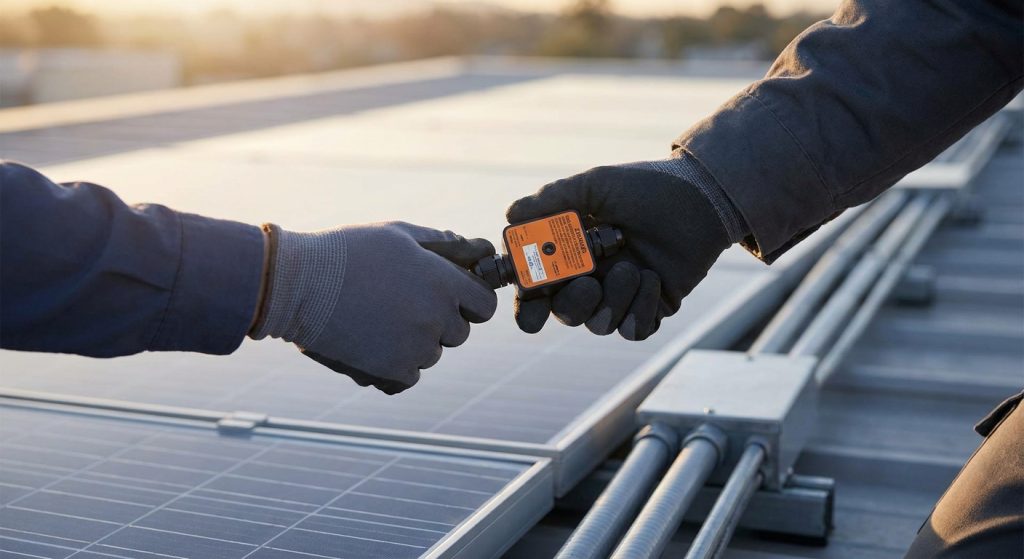
A rapid shutdown device isn't optional hardware — it's the difference between passing inspection and pulling permits again. Whether you're a licensed installer speccing a residential retrofit or a homeowner trying to understand why your quote includes a line item you've never heard of, this guide breaks down what NEC 690.12 actually requires, which device types satisfy it, and where installers get tripped up.
Here's the short version before the detail: module-level microinverters and power optimizers meet rapid shutdown by design, string inverters need an add-on RSD transmitter-receiver pair, and the correct choice depends entirely on which NEC edition your local AHJ has adopted for 2026. Get that wrong and you're re-wiring a rooftop after final inspection.
Why this matters
NEC 690.12 sets the rule: conductors inside the array boundary — defined as 1 foot from the module edge under the 2017 and later code cycles — must drop to 80 volts within 30 seconds of shutdown initiation. Conductors outside that boundary have to fall to 30 volts in the same window. Miss either number and the system fails inspection, full stop.
The complication is that not every jurisdiction runs the same code cycle. Some AHJs are still enforcing the 2017 NEC into 2026, others have moved to 2020 or 2023 language, and the shutdown method that satisfies one doesn't always satisfy the other without an add-on device. That's the entire reason this category exists — string inverter systems built before 2017 rarely have a compliance path without retrofitting a rapid shutdown device.
Who this is for
This guide is built for two groups working from the same rooftop: licensed installers who need to spec the right device before a permit gets submitted, and residential buyers evaluating a quote who want to understand why microinverters or optimizers cost more than a bare string inverter. Both groups are solving the same problem — getting a system through inspection without a second site visit.
What to look for in a rapid shutdown device for NEC compliance
The correct NEC edition for your AHJ
Rapid shutdown rules changed meaningfully between the 2014, 2017, 2020, and 2023 NEC cycles, and adoption isn't uniform across states in 2026. Confirm which edition your local jurisdiction enforces before ordering hardware, because a device compliant under one cycle can still fail plan review under another.
Module-level vs. array-level shutdown
Module-level shutdown — built into microinverters and power optimizers — satisfies 690.12 without any additional transmitter hardware. Array-level RSD, common with string inverters, requires a separate device paired to a receiver at each module or string, which adds cost and a second point of failure.
Voltage and time-to-shutdown specs
Every compliant device has to hit 80 volts within 30 seconds inside the 1-foot array boundary and 30 volts within 30 seconds outside it. Don't take a manufacturer's compliance claim at face value — check the listed spec sheet numbers against those two thresholds directly.
Communication protocol compatibility
RSD transmitters and receivers from different manufacturers frequently don't talk to each other. Mixing brands on a retrofit is the single most common cause of failed rapid shutdown commissioning tests, so match the RSD hardware to the inverter or microinverter brand already on the roof.
Labeling and placarding
NEC 690.56 requires a placard at the service disconnect identifying the rapid shutdown switch location and operation. Inspectors check this on every visit in 2026 — a missing or incorrect placard is an easy fail that has nothing to do with the electrical work itself.
Warranty and field reliability of the transmitter-receiver pair
A rapid shutdown device sits outside year-round and gets tested exactly once, during commissioning, unless there's an emergency. Reliability data on the transmitter-receiver pair matters more here than almost any other component on the roof, because a failure shows up during a fire department response, not a routine service call.
Top picks by device type
The built-in compliance path: module-level microinverters
Enphase and APsystems microinverters carry rapid shutdown compliance as a function of the hardware itself — no separate transmitter needed. That eliminates an entire category of commissioning failure tied to mismatched RSD firmware. For residential retrofits and new installs where simplicity at inspection matters more than marginal string-inverter cost savings, solar microinverters for residential solar systems is the straightforward call.
The retrofit-friendly pick: power optimizers
SolarEdge-style optimizers pair with a compatible inverter to satisfy module-level shutdown while keeping string-inverter economics on larger arrays. They're particularly useful on partially shaded roofs where per-module MPPT also recovers production loss that a straight string design would leave on the table. Check solar power optimizers for partially shaded roofs when the roof geometry demands per-panel optimization anyway.
The large-array workhorse: commercial rooftop microinverters
On commercial flat and low-slope roofs with dozens or hundreds of modules, module-level shutdown scales better than a centralized RSD transmitter network — fewer single points of failure across a large conductor run. Solar microinverters for commercial rooftop arrays is built around that scale.
The string-inverter compromise: combiner-box-integrated RSD
For multi-string residential arrays where a string inverter is already specified for cost reasons, an RSD transmitter integrated at the combiner box lets conductors meet the 1-foot boundary rule without switching to module-level hardware. It's a compromise, not a shortcut — commissioning still requires matched receivers at every module. See solar combiner boxes for multi-string residential arrays for the combiner-side hardware.
What to avoid
- Pre-2017 array-boundary-only RSD hardware. Devices built to the 2014 NEC standard shut down conductors at the array boundary but not at the module level, and most AHJs enforcing 2020 or 2023 code will reject that design outright in 2026.
- Third-party RSD add-ons not tested with your inverter brand. A transmitter that isn't UL-listed as a matched pair with your specific inverter model is a commissioning risk, not a cost saver.
- Skipping the placard. It sounds minor until an inspector fails the job over a missing label at the disconnect, which happens more often than most installers expect.
Rapid shutdown device comparison
| Device Type | Shutdown Method | Best For | Key Spec | Verdict |
|---|---|---|---|---|
| Microinverters (residential) | Module-level, built-in | New installs, straightforward retrofits | 80V/30 sec at 1-ft boundary | The default safe route for most homeowners |
| Power optimizers | Module-level via paired inverter | Shaded or complex roofs | Per-module MPPT + RSD combined | Right call when shading is already a factor |
| Commercial microinverters | Module-level, built-in | Large flat-roof arrays | Scales across hundreds of modules | The workhorse for commercial rooftop scale |
| Combiner-box RSD | Array-level with matched receivers | Existing string-inverter designs | Requires receiver at every module | Workable, but adds a compatibility step |
FAQ
What is a rapid shutdown device in solar?
It's the hardware required under NEC 690.12 that drops array conductor voltage to safe levels — 80 volts within the 1-foot array boundary, 30 volts outside it — within 30 seconds of activation, so firefighters and first responders can work near a roof safely.
Is rapid shutdown required by NEC in 2026?
Yes, in every jurisdiction that has adopted the 2017 NEC or later, which covers most of the U.S. by 2026. The specific compliance path still depends on which code edition your local AHJ enforces.
Do microinverters meet rapid shutdown requirements?
Yes. Microinverters satisfy module-level shutdown by design because each module has its own conversion and shutoff point, with no separate transmitter hardware required.
What's the difference between module-level and array-level rapid shutdown?
Module-level shutdown happens at each individual panel, typically via microinverters or optimizers. Array-level shutdown relies on a transmitter-receiver system layered onto a string inverter design to hit the same voltage thresholds.
How much does a rapid shutdown device cost?
Costs vary by manufacturer and system size, and pricing is best confirmed directly against current wholesale terms rather than quoted here — contact a distributor for current figures.
Can I retrofit rapid shutdown onto an existing solar array?
Yes, usually through a combiner-box-integrated RSD transmitter paired with receivers at each module, though compatibility with the existing inverter brand has to be confirmed first.
Does SolarEdge need a separate rapid shutdown device?
No — SolarEdge power optimizers are designed to satisfy module-level shutdown when paired with a compatible SolarEdge inverter, without an additional standalone RSD transmitter.
What happens if a system fails rapid shutdown inspection?
The inspector issues a correction notice, and the installer has to fix the noncompliant wiring or hardware before a re-inspection — which usually means a second site visit and schedule delay.
One last thing
Most rapid shutdown failures in 2026 aren't hardware failures — they're paperwork and labeling failures. Installers lose more inspection cycles to a missing 690.56 placard or a mismatched receiver firmware version than to an actual voltage spec miss. Check the placard before the truck leaves the site, every time.
Related guides
