 Inverters & Batteries ship FREE
 Ask about rewards for referring friends and family
 U.S. Based Support
 Want to Add a battery?
solar inverters
Off-Grid Solar Kit Cabin: Best Picks for 2026
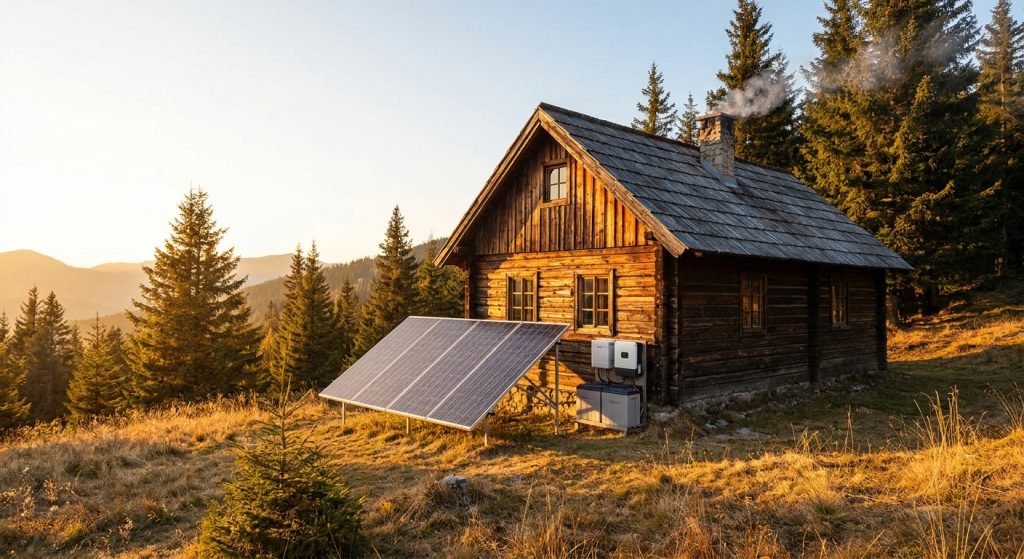
A cabin at the end of a dirt road doesn't care about your utility bill — it cares about whether the lights turn on at 9pm in January. Off-grid solar kits built for cabins and remote properties solve a different problem than rooftop grid-tied systems: no net metering, no utility fallback, just panels, batteries, and a charge controller doing all the work.
Most cabin owners land here after running a generator for a season and getting tired of hauling fuel. A properly sized off-grid solar kit cabin setup for 2026 typically runs a 6-10kW battery bank, 3-6kW of panels, and a charge controller matched to your array voltage. The right kit depends on how much you actually use — a weekend cabin with a mini-fridge and some LED lights needs a fraction of what a year-round remote home with well pump and space heat requires.
Why this matters
Grid-tied systems lean on the utility when the sun isn't out. Off-grid systems don't have that safety net, so every component has to be sized correctly the first time. Undersize the battery bank and you're rationing power by February. Undersize the charge controller and you damage it under full sun load. Get the racking wrong on a site with real wind exposure and the whole array is a liability by year two.
This isn't a system you patch later with an add-on panel. Off-grid kits are closed systems — battery capacity, controller amperage, and panel wattage all have to match at install, which is why buyers researching an off-grid solar kit cabin build usually spend more time on the wholesale solar panels sourcing question than on any other part of the project.
Who this is for
This guide is written for two overlapping buyers: the cabin owner replacing a noisy generator with quiet, sized-right solar, and the licensed installer bidding remote-property jobs where there's no utility interconnect to fall back on. Both need the same fundamentals — correct battery sizing, a charge controller rated for the array, and racking that survives the site's actual wind and snow load, not the manufacturer's minimum spec.
What to look for in an off-grid solar kit for cabins
Battery capacity that matches real seasonal use, not average use
A cabin used three months a year and one occupied year-round have completely different battery math. Size for your lowest-sun month, not the annual average — December and January production in northern latitudes can run 40-60% below summer output, and an undersized bank means empty batteries exactly when you need them most.
Charge controller type and amperage headroom
MPPT controllers pull 20-30% more usable power from the same panel array than PWM controllers, which matters when every watt is coming off a finite bank rather than a grid. Size the controller with headroom above your actual array output, not right at the edge — MPPT charge controllers for off-grid battery banks sized too close to array max output degrade faster under full summer sun.
Racking rated for the actual site, not the catalog default
Remote properties often sit on ridgelines, open fields, or coastal exposure where wind load is nothing like a suburban rooftop. Ground-mount arrays on exposed sites need racking engineered for that specific wind zone, not the standard residential spec sheet.
System voltage — 24V vs 48V
48V systems run lower amperage for the same wattage, which means thinner wire runs and less voltage drop over the longer cable distances common on remote properties. A cabin more than 50 feet from the battery bank to the load center almost always does better on 48V.
Inverter sizing for surge loads
Well pumps, air compressors, and power tools all draw a surge load 3-5x their running wattage on startup. An inverter sized only for continuous wattage will trip or shut down the instant a well pump kicks on — size for surge, not steady-state.
Shipping and lead time honesty
Batteries and inverters are heavy, and remote-property freight adds complexity. Confirm lead times before you commit to an install date rather than assuming stock — availability on any given battery or inverter model is subject to change, so get a firm answer before scheduling labor.
Top picks for cabin and remote-property kits
The lithium battery bank — EG4 batteries for off-grid solar systems are stackable lithium units built specifically for off-grid use, which matters because cabin loads fluctuate more than grid-tied backup loads do. Stackable architecture means you can start with a smaller bank and add capacity in a later season instead of re-engineering the whole system. Batteries ship free through Sun Supply PV, which matters given how much freight weight a lithium bank carries. Good fit for anyone building in phases rather than all at once.
The charge controller — an MPPT charge controller sized for an off-grid battery bank is the piece that decides how much of your panel output actually reaches storage. MPPT topology recovers more usable energy than PWM in partial-shade or variable-angle mounting, which is common on cabin roofs that weren't designed around solar from the start. This is not the place to cut cost — a controller running near its rated ceiling all season shortens its own service life.
The racking — ground-mount racking systems for solar installations solve the problem that a lot of cabins simply don't have roof space or roof orientation that works. Ground mounts also let you angle the array for winter sun optimization, which matters more off-grid than on-grid since every degree of tilt affects your worst-month production. Confirm the wind and snow rating for your specific site before ordering — don't assume the standard package covers an exposed ridge.
The inverter — pair the battery bank with an inverter sized for surge loads specific to your equipment list, not just the continuous wattage on the nameplate. Inverters ship free alongside batteries, which keeps freight cost predictable on a remote build where every truck trip adds up.
What to avoid
- Undersized battery banks bought on price alone. A bank sized for average daily use runs out during a stretch of cloudy days in a way a grid-tied system never would — size for the worst week, not the average one.
- PWM controllers on large arrays. They're cheaper upfront and leave real production on the table every single day the array runs.
- Standard residential racking on exposed sites. A racking system rated for a suburban rooftop with modest wind exposure is not automatically rated for a ridge line or open field — wind load requirements for solar racking differ enough between sites that a stamped calculation matters more off-grid than on a sheltered lot.
Verdict comparison
| Component | Best fit for | Key spec to check | Bottom line |
|---|---|---|---|
| EG4 stackable battery | Phased builds, seasonal cabins | Usable kWh per module | Add capacity as needs grow |
| MPPT charge controller | Any array over 2kW | Rated amperage vs array max | Headroom protects controller life |
| Ground-mount racking | Sites with no usable roof orientation | Wind/snow rating for the site | Confirm site-specific rating before ordering |
| 48V system architecture | Runs over 50 ft to load center | Voltage drop over cable run | Lower amperage, thinner wire |
FAQ
What size off-grid solar kit do I need for a cabin?
Most weekend cabins run comfortably on a 3-5kW array paired with a 6-10kWh battery bank, while year-round remote homes with well pumps and heating loads often need 6-10kW of panels and 15kWh or more of storage. The right number comes from your lowest-sun month usage, not your annual average.
How many solar panels does an off-grid cabin need?
A basic cabin setup runs 8-15 panels at typical 400-450W ratings, depending on roof or ground-mount space and winter sun hours available at your latitude. Properties further north need more panels to hit the same watt-hour target in December.
Do I need a generator backup with an off-grid solar kit?
A generator backup is common practice for remote properties even with a well-sized solar kit, since multi-day cloud cover in winter can outlast even a generous battery bank. Most installers spec the generator as backup, not primary power.
What's the difference between off-grid and grid-tied kits?
Grid-tied systems can pull from the utility when solar production drops, while off-grid systems rely entirely on battery storage and have no fallback. That difference is why off-grid battery sizing and charge controller selection matter more than on a grid-tied residential roof.
How much battery storage does a remote cabin need?
A baseline figure for 2026 builds is 2-3 days of full autonomy without sun, meaning enough storage to run essential loads through a stretch of overcast weather. Well pumps and refrigeration typically drive that number higher than lighting and small electronics alone.
Can I install an off-grid solar kit myself?
Residential DIY buyers install off-grid kits regularly, though local permitting and any interconnection with a backup generator often require licensed electrical work. Check your local jurisdiction before starting — permitting rules vary significantly by county.
Is a 48V or 24V system better for cabins?
48V systems handle longer cable runs and higher loads more efficiently than 24V, which makes them the better choice for any cabin where the battery bank sits more than 50 feet from the load center. 24V still works fine for small, compact installs with short wire runs.
How much does an off-grid solar kit cost in 2026?
Cost depends heavily on battery capacity, panel count, and racking type, so check current pricing directly rather than relying on a rule of thumb. Batteries and inverters ship free, which removes one variable cost from the total.
One last thing
The detail most first-time cabin builders miss isn't the panel count — it's cable run length. A 48V system with a battery bank 80 feet from the load center loses meaningfully less power to resistance than the same setup wired at 24V, and that gap only grows as loads increase. Get the voltage architecture right before you order a single panel, because rewiring a finished off-grid system is a lot more expensive than planning it correctly in 2026.
Related guides
