 Inverters & Batteries ship FREE
 Ask about rewards for referring friends and family
 U.S. Based Support
 Want to Add a battery?
solar inverters
MPPT Charge Controllers for Off-Grid Battery Banks 2026
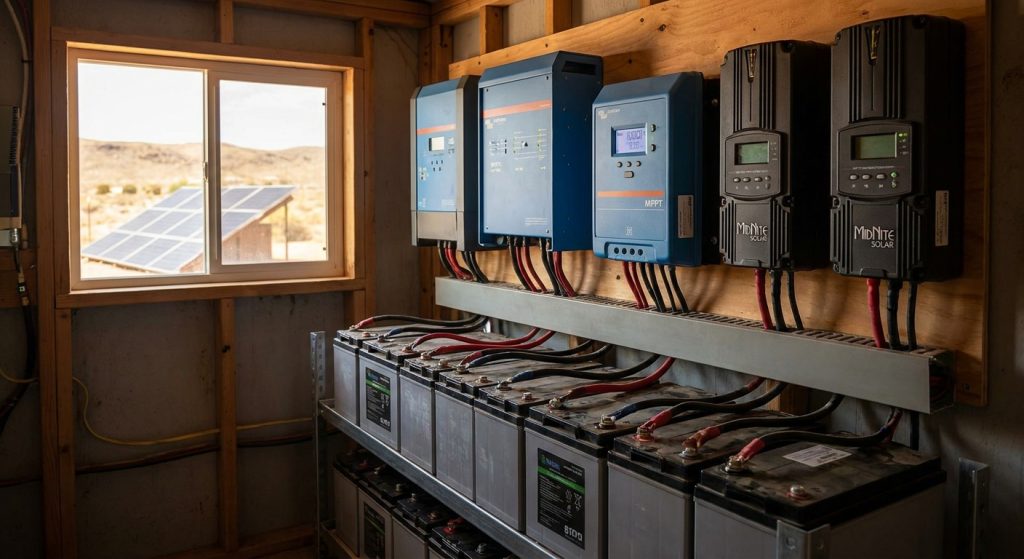
An MPPT charge controller is the single component that decides how much of your solar array's output actually reaches your battery bank instead of getting wasted as heat. For anyone running an off-grid battery bank in 2026 — whether it's a weekend cabin on a single EG4 battery or a full off-grid house with three or four battery cabinets — matching the right controller (or hybrid inverter with a built-in MPPT stage) to your array size and battery chemistry is the difference between a system that charges fully every sunny day and one that limps along at 70% capacity for years.
This guide breaks down what actually matters when you're sizing an MPPT charge controller for an off-grid bank, which use cases call for a standalone controller versus a hybrid inverter with integrated MPPT, and where people waste money on features they don't need.
Why this matters
A charge controller isn't just a gatekeeper — it's a converter. MPPT (Maximum Power Point Tracking) controllers actively adjust voltage and current from your array to squeeze out 20-30% more usable power than older PWM controllers, especially in cold weather or partial shade. For an off-grid battery bank, that difference compounds daily. Undersize the controller and you'll clip your array's output on the best sun days of the year. Oversize it and you've paid for amperage you'll never use.
The first decision point is whether you need a dedicated MPPT charge controller at all, or whether a hybrid inverter with an integrated MPPT charging stage — like the units covered in best solar inverters for hybrid grid-tie and battery systems — already does the job. For most residential off-grid setups built in 2026, the hybrid inverter route consolidates charging, inversion, and battery communication into one box, which simplifies wiring and warranty claims.
Who this is for
This guide is written for two overlapping buyers: licensed installers speccing off-grid systems for cabins, ranches, and remote residences, and DIY homeowners building a battery bank without a grid connection at all. If you're grid-tied with battery backup for outages only, your sizing math is different — you're optimizing around outage duration, not year-round solar charging. True off-grid buyers need to think about worst-case winter sun hours, not average annual output.
What to look for in MPPT charge controllers for off-grid banks
PV input voltage window
Every MPPT controller has a maximum open-circuit voltage (Voc) rating, typically between 100V and 150V for residential-scale units, and a minimum operating voltage. Off-grid arrays in cold climates see Voc spike well above rated numbers on freezing mornings — a controller rated at 150V with an array that peaks at 145V in January leaves almost no safety margin. Size your string voltage to stay at least 10-15% under the controller's max rating.
Charge current rating in amps
Controllers are rated in amps at the battery-side voltage — commonly 60A, 80A, or 100A units for residential off-grid banks. A single EG4 battery paired with a mid-size array typically needs 60-80A of charge capacity to reach full charge inside a normal winter day's sun hours; larger multi-battery banks push toward 100A or require multiple controllers in parallel. Undersizing this number is the single most common mistake in off-grid design.
Battery chemistry compatibility
Lithium iron phosphate (LiFePO4) batteries, now the standard for most 2026 off-grid installs, charge differently than lead-acid — they need tighter voltage regulation and don't tolerate the same float-charge habits. Confirm the controller (or hybrid inverter's integrated charging profile) has a defined LiFePO4 charge curve, not just a generic lithium setting. This matters directly for anyone wiring an EG4 battery for off-grid backup power, since charge curve mismatches shorten battery life faster than almost any other wiring error.
Multi-stage charging and temperature compensation
Bulk, absorption, and float stages need to be distinct and battery-chemistry-aware, not just voltage cutoffs. Temperature compensation matters more in off-grid installs than grid-tied ones because battery rooms in cabins and outbuildings swing 40-50°F between seasons without HVAC moderating them.
Communication and monitoring integration
Standalone controllers with no display or app connectivity are harder to troubleshoot from a distance — a real problem for off-grid cabins that sit empty for weeks. Hybrid inverters with built-in monitoring, like the systems referenced under solar inverters for whole-home backup during grid outages, let you check state of charge and fault codes remotely instead of driving out to check a blinking LED.
Altitude and environmental durability
Most controllers derate above 6,500-10,000 feet due to reduced cooling from thinner air — a real consideration for mountain cabins and rural properties at elevation. Check the manufacturer's derating chart before finalizing amperage, not after installation.
Top picks by use case
The single-battery cabin setup. For a small off-grid cabin running one or two EG4 batteries and a 3-5kW array, a 60A MPPT stage covers charging without excess headroom you'll never use. Pairing directly with an EG4 battery for off-grid solar systems keeps the system simple: one battery chemistry profile, one charge curve, minimal wiring complexity. This is the right fit for buyers who want dependable charging without managing a multi-controller array.
The whole-home off-grid build. Larger off-grid homes running well pumps, HVAC, and full appliance loads need charging capacity in the 100A-plus range, usually delivered through a hybrid inverter rather than a standalone controller. The hybrid inverter category consolidates MPPT charging, battery communication, and inversion into a single unit rated for these loads — and batteries and inverters ship free, which matters when you're moving heavy equipment to a rural site.
The multi-battery expandable bank. Buyers planning to add battery capacity over time — starting with two batteries and scaling to four or five over a couple of years — should size the controller or hybrid inverter's MPPT stage for the eventual bank, not the starting one. Retrofitting a second controller later adds parallel-wiring complexity that's avoidable if you plan ahead in 2026 rather than in year three.
The RV or mobile power setup. Mobile systems have tighter space and weight constraints, and typically run smaller arrays (400W-1500W) with correspondingly lower amp requirements — 20-40A controllers cover most mobile use cases without the bulk of a residential-scale unit.
What to avoid
- PWM controllers marketed as budget MPPT alternatives. They look similar on a spec sheet but leave 20%+ of your array's output on the table, especially in cold or partly cloudy conditions common through winter 2026.
- Controllers with generic lithium settings and no chemistry-specific charge curve. This shortens LiFePO4 battery life even when the controller technically supports lithium batteries.
- Undersized amperage to save upfront cost. A controller rated below your array's actual output clips power on your best sun-hour days — precisely when you need the charge most.
Comparison at a glance
| Use case | Typical amp rating | Battery chemistry fit | Best fit for |
|---|---|---|---|
| Single-battery cabin | 60A | LiFePO4, single-bank | Small off-grid cabins, minimal loads |
| Whole-home off-grid | 100A+ (hybrid inverter) | LiFePO4, multi-bank | Full residential loads, well pumps, HVAC |
| Multi-battery expandable | 80-100A, plan for growth | LiFePO4, scalable | Buyers phasing in battery capacity |
| RV / mobile | 20-40A | LiFePO4, single-bank | Mobile and marine power systems |
FAQ
What's the best MPPT charge controller amp rating for off-grid use?
Most single-battery cabin setups run well on a 60A controller, while whole-home off-grid systems typically need 100A or more, often delivered through a hybrid inverter rather than a standalone unit.
Is a hybrid inverter better than a standalone MPPT controller for off-grid systems?
For most 2026 residential off-grid builds, yes — a hybrid inverter consolidates MPPT charging, battery communication, and inversion into one unit, simplifying wiring and monitoring compared to a separate charge controller plus inverter.
Do MPPT charge controllers need a specific lithium battery setting?
Yes. A generic lithium toggle isn't the same as a defined LiFePO4 charge curve — confirm the controller or inverter has chemistry-specific bulk, absorption, and float stages before pairing it with a lithium battery bank.
How much does an MPPT charge controller cost compared to a hybrid inverter?
Standalone controllers are typically less expensive upfront, but a hybrid inverter often costs less overall once you factor in the separate inverter you'd otherwise need to buy — check current pricing directly since it varies by amperage and brand.
Can I use an MPPT charge controller at high altitude?
Most controllers derate above 6,500-10,000 feet due to reduced cooling — check the manufacturer's altitude derating chart before finalizing your amperage for mountain or high-elevation installs.
Do batteries and inverters ship free from Sun Supply PV?
Yes, batteries and inverters ship free, which matters for heavier off-grid components being shipped to rural or remote install sites.
What happens if my MPPT controller is undersized for my array?
An undersized controller clips your array's output on high-production days, meaning you lose exactly the power you need most during peak sun hours rather than gaining a safety margin.
How do I size a charge controller for a multi-battery off-grid bank?
Size for your eventual battery bank capacity, not just your starting setup — see the full walkthrough in how to size a solar battery system for whole-home backup.
One last thing
The detail most buyers miss in 2026: temperature compensation isn't optional for off-grid battery rooms in outbuildings or cabins without climate control. A controller that regulates charge voltage based on a fixed 77°F assumption will overcharge a battery bank sitting at 95°F in July and undercharge it at 35°F in January — both of which shorten LiFePO4 cycle life faster than almost any other single setup mistake.
Related guides
