 Inverters & Batteries ship FREE
 Ask about rewards for referring friends and family
 U.S. Based Support
 Want to Add a battery?
solar inverters
How to Size Solar Microinverters (2026 Guide)
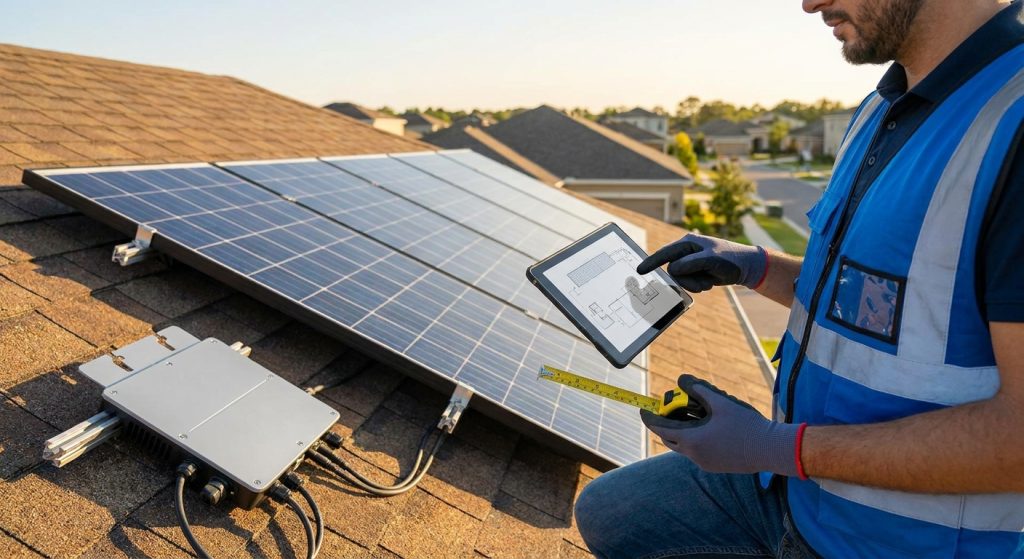
Sizing solar microinverters wrong means paying for capacity you never use, or worse, clipping your array's output on the sunniest days of the year. Sizing solar microinverters means matching each unit's rated AC output to the DC wattage of the panel it's paired with, then checking the total against your inverter's per-branch and whole-array limits. For a standard 400W-440W residential panel, an Enphase IQ8A or IQ8M microinverter is a solid pick for most 2026 installs, while an APsystems DS3-L dual-unit works for tighter roof layouts running two panels per inverter. Undersizing clips output on peak-sun days; oversizing wastes money on inverter headroom you'll never touch — the target is a DC-to-AC ratio between 1.10 and 1.30, not a flat one-to-one match.
Why this matters
A microinverter that's undersized for its panel clips the DC output the moment irradiance climbs, which happens more often than most homeowners expect – clear spring afternoons in most U.S. climate zones push panels past their STC rating regularly. An oversized microinverter isn't dangerous, but it's dead weight on your invoice with no upside.
Get the ratio right and you capture nearly all of what the panel can produce without paying for AC capacity that sits idle 355 days a year. Sun Supply PV stocks residential microinverters from Enphase and APsystems, and both brands publish DC input ranges that make this calculation straightforward once you know the formula.
What you'll need
- Panel spec sheet (wattage, Voc, Isc, temperature coefficient)
- Microinverter spec sheet (max DC input, max continuous output, MPPT range)
- Roof layout or string diagram showing panel count and orientation
- A calculator or spreadsheet – this is arithmetic, not software
- Local weather data or NREL PVWatts output for your ZIP code
- Panels and microinverters from a distributor that ships promptly – microinverters ship free through Sun Supply PV, which matters when you're ordering 20-30 units for a full array
The steps
1. Pull the panel's actual DC wattage, not the marketing number
Check the datasheet for the panel's rated power at Standard Test Conditions (STC), typically 400W to 440W for residential modules in 2026. This number is the ceiling your microinverter needs to handle on a cold, bright day when panel output actually exceeds the STC rating.
Common mistake: using the panel's PTC (PVUSA Test Conditions) rating instead of STC. PTC is always lower and will make your microinverter look oversized when it isn't.
2. Check the microinverter's max DC input rating
Every microinverter datasheet lists a maximum DC input in watts. An Enphase IQ8A, for example, is rated for a specific max DC input that comfortably covers a 400W-440W panel with headroom to spare.
Expected outcome: your panel's STC wattage should sit at 80% to 95% of the microinverter's max DC input rating. If the panel wattage exceeds the microinverter's max input, you'll clip on sunny days – full stop.
3. Calculate the DC-to-AC ratio
Divide the panel's DC wattage by the microinverter's rated continuous AC output. A 400W panel paired with a microinverter rated for 350W AC output gives you a ratio of 1.14 – solidly in the healthy range.
Ratios below 1.05 mean you're paying for AC capacity the panel can't fill. Ratios above 1.35 start clipping meaningfully on high-irradiance days, and the clipped energy is gone for good – it doesn't get stored or shifted, it's just lost.
4. Match microinverter type to your panel layout
Single-panel microinverters like the Enphase IQ8 series pair one unit to one panel, giving you panel-level MPPT and easier troubleshooting later. Dual or quad-panel units like the APsystems DS3 series cut hardware count for large arrays but tie two panels to shared MPPT, which matters most on roofs with mixed orientation or partial shade.
If your array spans multiple roof faces with different azimuths, single-panel microinverters isolate each panel's performance and are the safer call for 2026 installs on complex rooflines.
5. Confirm branch circuit and whole-home AC limits
Each microinverter branch has a maximum number of units it can carry before voltage rise or amperage limits kick in – typically specified per brand and per breaker size. Add up the total continuous wattage across your planned array and confirm it against your main panel's available capacity, especially if you're integrating a whole-home monitoring setup.
Common mistake: sizing microinverters correctly per panel but forgetting to total the branch circuit load, which trips inspection when the AC output exceeds what the breaker and wire gauge can handle.
6. Account for shade and orientation before finalizing count
If any part of the array sees partial shade at any point in the day, panel-level microinverters resolve most of the mismatch that string inverters can't – one shaded panel won't drag down its neighbors. For roofs with recurring shade patterns from trees or chimneys, microinverters designed for shaded roof arrays are worth pricing against a standard configuration before you finalize the order.
Expected outcome: your final BOM lists one microinverter model, exact unit count, and a confirmed DC-to-AC ratio between 1.10 and 1.30 for every branch in the array.
Troubleshooting
Problem: Output looks clipped on sunny afternoons.
Check your DC-to-AC ratio. If it's above 1.35, the microinverter is capping legitimate panel output – re-quote with a higher-capacity unit or add a unit per fewer panels.
Problem: Monitoring shows one panel consistently underperforming.
This usually isn't a sizing issue – it's shade, soiling, or a wiring fault at that specific microinverter. Isolate it before assuming the whole array is mis-sized.
Problem: Inspector flags the branch circuit for exceeding rated ampacity.
Recalculate total continuous AC wattage per branch against the breaker and conductor size. This is a common failure point when installers size per-panel correctly but skip the branch-level total.
Problem: Uncertain whether microinverters or optimizers make more sense for a partly shaded roof.
Microinverters convert DC to AC at the panel; optimizers condition DC and send it to a central string inverter. For roofs with heavy or recurring shade, compare solar power optimizers built for partially shaded roofs against microinverters before locking in equipment – the right call depends on your string inverter budget and shade pattern, not a blanket rule.
Problem: Homeowner asks why the array doesn't hit its "rated" wattage on the app.
STC ratings assume lab conditions (25°C cell temperature, 1000 W/m² irradiance) that real rooftops rarely match exactly. Slightly below-rated output on a hot day is normal, not a sizing error.
Tools and resources
- Panel and microinverter datasheets (always check the 2026 revision, not a legacy PDF)
- NREL PVWatts calculator for expected annual output by ZIP code
- Wholesale solar panels for residential installers for current panel wattage options and stocked models
- A running spreadsheet tracking panel wattage, microinverter model, and ratio per branch – this becomes your as-built documentation for inspection
What to do next
Once microinverter sizing is locked, the next equipment decision is usually backup power. If the homeowner wants battery storage layered on top of the array, work through how much battery capacity the home actually needs before quoting hardware – undersizing a battery bank is the same mistake as undersizing a microinverter, just with higher stakes.
FAQ
What's the best DC-to-AC ratio for residential microinverters?
A ratio between 1.10 and 1.30 is the target range for most residential installs in 2026. Below 1.05 wastes AC capacity; above 1.35 starts clipping real output on sunny days.
Is one microinverter per panel better than a dual-panel unit?
Single-panel units give better panel-level data and isolate shade or fault issues; dual-panel units reduce hardware cost on large, unshaded, single-orientation roofs. The right choice depends on roof complexity, not a universal rule.
How much does it cost to size microinverters wrong?
There's no fixed dollar figure, but undersizing clips real production every peak-sun day for the life of the system, and oversizing means paying for AC capacity that never gets used. Both cost money over a 20-25 year system life.
Do microinverters work better than a string inverter for shaded roofs?
Microinverters isolate each panel's performance, so one shaded panel doesn't drag down the whole string – a meaningful advantage over a single string inverter on roofs with partial shade.
Can I mix microinverter brands on one roof?
Technically some systems allow it, but mixing brands complicates monitoring, warranty claims, and troubleshooting. Stick to one brand and model family per array whenever possible.
Do microinverters ship free through Sun Supply PV?
Yes – inverters and microinverters ship free, which matters when ordering enough units to cover a full residential array.
How many microinverters does a typical residential array need?
One microinverter per panel for single-unit models, or one dual/quad unit per two or four panels depending on the model – the count is always driven by panel count, not roof square footage.
What happens if I oversize a microinverter for a small panel?
Nothing breaks, but you're paying for AC output capacity the panel will never generate. It's a wasted-money problem, not a safety or performance problem.
One last thing
The DC-to-AC ratio math gets all the attention, but branch circuit totals are where most sizing mistakes actually surface at inspection – not at the panel-to-microinverter level. Run both calculations every time, even on a repeat roof layout you've quoted before.
Related guides
