 Inverters & Batteries ship FREE
 Ask about rewards for referring friends and family
 U.S. Based Support
 Want to Add a battery?
solar inverters
How to Size an MPPT Charge Controller (2026 Guide)
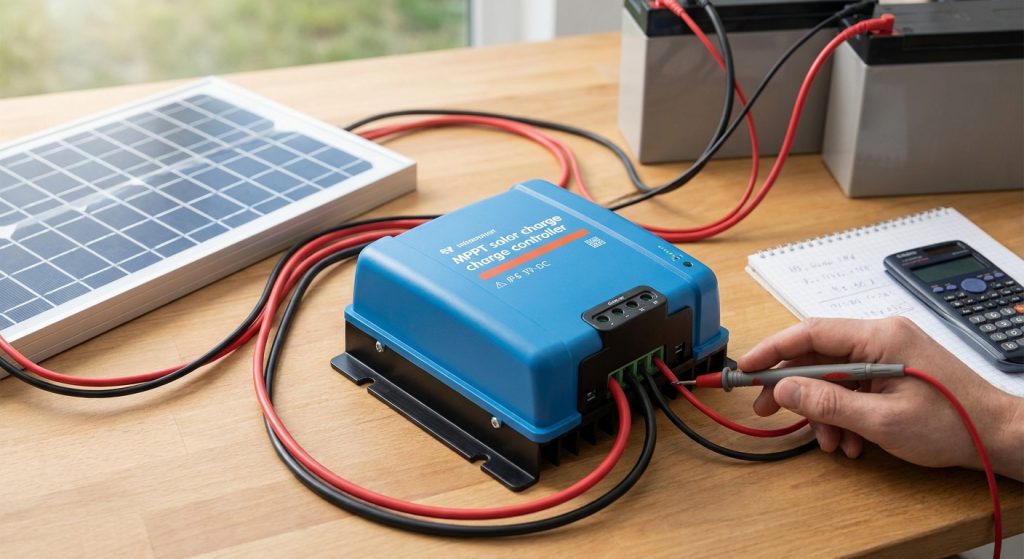
Undersize an MPPT charge controller and it clips your array's output on the sunniest day of the year. Oversize it by a wide margin and you've spent money on capacity you'll never touch. Getting the number right takes about fifteen minutes of math and a spec sheet, not a guess.
The short version: match the controller's rated amperage to your array's short-circuit current with a safety margin, then confirm the controller's maximum voltage window covers your coldest-day open-circuit voltage. Every other decision in this guide builds on those two numbers. A 400-watt, four-panel 12V array typically needs a controller rated for at least 40A once you apply standard NEC-style derating. Skip the math and you either starve your battery bank or damage a controller that wasn't built for your array's voltage.
Why this matters
An MPPT controller undersized on current throttles itself in full sun, and you lose real charging capacity exactly when you need it most. One sized wrong on voltage is worse. Feed a controller more open-circuit voltage than its input rating and you risk permanent damage to the unit, not just lost output. Cold mornings push panel voltage up, sometimes 15-20% above the STC rating printed on the spec sheet, and that's the number that actually matters for controller safety.
This matters just as much for a residential DIY installer running a single string as it does for a licensed installer speccing a full off-grid solar system with a lithium battery bank. The math doesn't change with scale, only the numbers you plug into it.
What you'll need
- Panel spec sheet with Voc, Vmp, Isc, and the panel's temperature coefficient (usually listed as %/°C for Voc)
- Record low temperature for your install location (NEC 690.7 uses the ASHRAE extreme minimum design temp)
- Battery bank nominal voltage — 12V, 24V, or 48V
- Controller spec sheet showing max PV input voltage, rated charge current, and max input power
- A calculator, or a spreadsheet if you're sizing more than one string
- Wire gauge chart and a breaker sized to the controller's output rating
The steps
1. Pull your panel's Isc and multiply by the NEC safety factor
Short-circuit current, not Imp, is the number code requires you to size against. It's the worst-case current a panel produces under bright, cool, high-irradiance conditions, which happens more often than most people expect. NEC 690.8 calls for a 1.25 multiplier for irradiance variance, then another 1.25 for continuous duty, which compounds to roughly 1.56x the panel's rated Isc.
A panel rated at 10.5A Isc times 1.56 comes out to about 16.4A per string. Run three strings in parallel into one controller and you're at roughly 49A of continuous demand before you've even picked a controller model.
Common mistake: using Imp (operating current) instead of Isc. Imp is always lower, and sizing off it undersizes the controller for the exact condition the safety factor exists to cover.
2. Calculate your coldest-day open-circuit voltage
Voc rises as temperature drops. Most crystalline silicon panels carry a coefficient around -0.29%/°C to -0.35%/°C. Take the panel's rated Voc, find the difference between 25°C (the STC test temp) and your area's record low, and apply the coefficient.
Example: a panel rated at 41V Voc with a -0.30%/°C coefficient, installed somewhere that hits -10°C on a cold clear morning, sees a 35°C swing from the 25°C rating point. That's a 10.5% voltage increase, pushing real-world Voc to roughly 45.3V per panel. String four of those in series and you're looking at over 181V hitting the controller input on that morning.
3. Match the controller's voltage window to your worst-case Voc, not the nameplate number
This is where most sizing mistakes happen. A controller rated for 150V max sounds like plenty of room for a 140V nameplate string voltage, until you run the cold-weather math and realize actual Voc exceeds the controller's ceiling. Build in a margin. Most experienced installers won't run a string closer than 5-10% under the controller's stated max input voltage, ever.
4. Confirm the controller's rated output current covers your derated array current
Go back to your step-1 number. If your derated array current comes out to 49A, a controller rated for 40A output is undersized, regardless of what the wattage numbers on the box suggest. Round up to the nearest standard controller size: 50A, 60A, or 80A units are common steps, and it's normal to land slightly above your calculated number rather than exactly on it.
5. Size the wire and breaker to the controller's output, not the panel's
Once you know the controller's rated current, size PV input wire and breakers to that number with standard ampacity tables. Undersized wire between the array and controller is a fire risk independent of how well you sized the controller itself. A 60A controller typically wants a 60A-rated breaker and conductor sized for continuous duty at that current, adjusted for conduit fill and temperature.
6. Match the charge profile to your battery chemistry
An MPPT controller sized correctly on volts and amps can still undercharge or overcharge a bank if its charge algorithm doesn't match the chemistry. Lead-acid banks want a different absorption and float profile than lithium iron phosphate. If you're pairing the controller with an EG4 battery for off-grid solar or similar LiFePO4 bank, confirm the controller supports a user-programmable or LiFePO4-specific charge profile before you buy. Not every older MPPT unit does.
7. Leave headroom for array growth
If there's any chance you'll add panels later, size the controller to the array you'll have in two years, not just the one on the roof today. Jumping from a 40A to a 60A controller after the fact usually means new wiring and a new breaker too, so the smarter move in 2026 is buying one size up if expansion is even a possibility.
Troubleshooting
- Controller derates or shuts down on hot afternoons — most MPPT units start reducing output above 104-113°F internal temperature. Improve ventilation around the enclosure or move it out of direct sun; this isn't a sizing error, it's a thermal one.
- Charging current lower than expected on a clear day — check for a voltage mismatch first. If array Vmp sits too close to the controller's low-voltage cutoff, tracking efficiency drops even though nothing is technically wrong.
- Controller trips on cold, sunny mornings — this is almost always a step-2 miss. Recalculate cold-weather Voc against the controller's max input rating; a string that tested fine in mild weather can exceed limits at your area's actual record low.
- Lithium battery won't accept a full charge — confirm the controller's charge profile is actually set for LiFePO4 and not a lead-acid default. A BMS communication mismatch between the controller and battery can also cap charge current well below the controller's rating.
- Controller runs fine alone but underperforms with a second string added — parallel strings need matched Voc and Isc, or the controller's MPPT algorithm ends up tracking a compromise point that isn't optimal for either string.
Tools and resources
- Panel spec sheet (Voc, Isc, temperature coefficients) from the manufacturer
- NEC 690.7 and 690.8 tables for voltage and current correction factors
- A wholesale panel catalog to confirm exact Isc and Voc for the model you're speccing against
- Battery manufacturer's charge profile documentation for lithium or lead-acid banks
- Sun Supply PV's product pages list controller-compatible battery and inverter specs together, which saves a step when you're matching a charge profile to a specific battery model, and batteries and qualifying inverters ship free.
What to do next
Once the controller is sized, the next constraint is usually the battery bank itself: how many amp-hours you need and how the controller's output current maps to charge time. The battery sizing guide for whole-home backup walks through that math using the same Isc-and-Voc approach as this guide, just applied to the storage side of the system.
FAQ
What size MPPT charge controller do I need for a 400W array?
A typical 400W, four-panel 12V array with a combined Isc near 10.5A per string needs a controller rated around 40A once NEC-style derating is applied. Confirm against your specific panel's Isc rather than the wattage number alone.
Can an MPPT charge controller be too big for the array?
Yes, technically, but oversizing on current rarely causes problems. You just pay for capacity you don't use. Oversizing on voltage window is fine too; the real risk is the opposite, a controller rated below your array's actual voltage or current.
What's the difference between sizing an MPPT versus a PWM controller?
PWM controllers need array voltage to closely match battery voltage, so sizing is mostly about current. MPPT controllers tolerate a much wider voltage difference and convert the excess, so sizing requires both the current calculation and the cold-weather voltage check covered above.
How do I calculate cold-weather Voc without a spreadsheet?
Take the panel's rated Voc, multiply by the temperature coefficient (as a decimal) times the degree difference between 25°C and your area's record low, then add that to the rated Voc. Most manufacturer datasheets list the coefficient directly.
Do I need one MPPT controller per string or can I combine strings?
Strings can share a controller if their Voc and Isc are closely matched. Mismatched strings on the same controller reduce overall tracking efficiency, even if total wattage looks fine on paper.
How much amperage headroom should I build in above the calculated minimum?
Rounding up to the next standard controller size (40A to 50A, 50A to 60A) is common practice in 2026 installs and covers both minor calculation variance and future panel additions.
Does controller sizing change for a lithium battery bank versus lead-acid?
Voltage and current sizing math is identical. What changes is the charge profile setting, which needs to match the battery chemistry to charge correctly and protect the pack.
Is a bigger controller always more efficient?
No. Running a controller far below its rated capacity doesn't hurt efficiency meaningfully, but it doesn't help either. Size to the array's real current and voltage, not to the biggest unit available.
One last thing
The number installers miss most often isn't the amperage calculation, it's the cold-weather Voc check, because most spec sheets lead with the STC-rated voltage and bury the temperature coefficient in a footnote. Pull that coefficient before you buy anything in 2026, run the cold-morning math against your actual local record low, and confirm the controller's max input voltage clears it with room to spare. That one number prevents more field failures than any current calculation does.
Related guides
