 Inverters & Batteries ship FREE
 Ask about rewards for referring friends and family
 U.S. Based Support
 Want to Add a battery?
solar inverters
Off-Grid Solar System Design for a Cabin (2026 Guide)
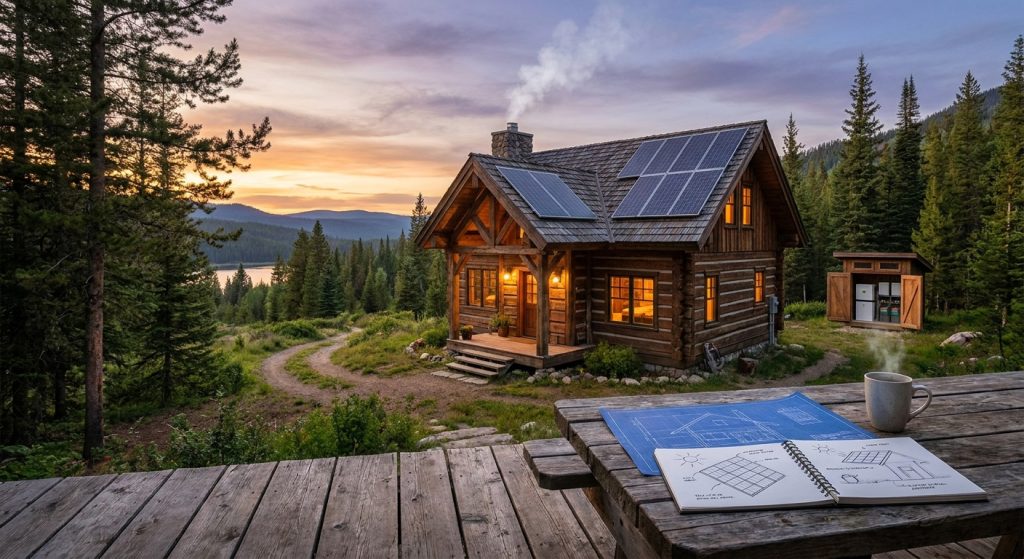
Designing an off-grid solar system for a remote cabin means solving a different problem than a grid-tied rooftop job — there's no utility to lean on when the sun disappears for three cloudy days in a row, so every component has to be sized with margin, not guesswork.
A cabin with no power line has one non-negotiable requirement: the battery bank and array have to cover your worst week of the year, not your average day. Get that math wrong and you're running a generator every night in January. Get it right and the system runs itself for 2026 and well beyond.
Why this matters
Grid-tied systems get to cheat — if solar production falls short, the utility fills the gap. Off-grid cabins don't have that safety net. Every load, every cloudy stretch, and every winter sun-angle has to be accounted for before a single panel goes on the roof or ground mount.
Undersizing the battery bank is the single most common mistake in off-grid design. It shows up as voltage sag, shortened battery life, and a system that "used to work fine" until the first real winter storm. The fix isn't complicated, but it does require actual numbers instead of rules of thumb.
What you'll need
- A full load inventory: every appliance, its wattage, and hours of daily use
- A lithium battery bank sized for your autonomy days (an EG4 battery for off-grid solar systems is a common choice for cabin-scale banks)
- An MPPT charge controller matched to your array voltage and battery bank
- Solar panels sized against your worst-month sun-hours, not your annual average
- Racking rated for your site's wind and snow load
- DC and AC disconnects, fusing, and properly sized cable
- A multimeter, torque wrench, and a day set aside for commissioning and testing
The steps
1. Calculate your daily energy load
List every device the cabin will run: lights, a refrigerator, a well pump, a laptop charger, maybe a space heater for shoulder-season nights. Multiply each device's wattage by its daily hours of use to get watt-hours, then add a 20% buffer for inefficiencies in the wiring and inverter.
A typical minimalist cabin — LED lighting, a 12-volt fridge, phone charging, a small water pump — lands somewhere between 2,000 and 4,000 watt-hours per day. A cabin running a full-size refrigerator, power tools, and Starlink internet can easily double that. Write the number down; every later step depends on it.
Common mistake: forgetting startup surge loads. A well pump or refrigerator compressor can draw 3-5x its running wattage for a second or two at startup, and that spike has to be covered by the inverter's surge rating, not just its continuous rating.
2. Size the battery bank for autonomy days
Autonomy days are how many days the battery bank needs to run the cabin with zero solar input. For a remote cabin, 2-3 days of autonomy is the standard target; anything less and one string of overcast days in 2026's winter months leaves you in the dark.
Multiply your daily watt-hour load by your autonomy days, then divide by your target depth of discharge — lithium banks can typically run to 80-90% depth of discharge without meaningfully shortening lifespan, versus 50% for older lead-acid chemistry. A 3,000 watt-hour daily load with 2 days autonomy at 90% depth of discharge needs roughly 6,700 watt-hours of usable capacity. Batteries and inverters ship free, which matters here since a properly sized lithium bank is heavy freight.
3. Choose battery chemistry and wire the bank
Lithium iron phosphate batteries are now the default for off-grid cabins — longer cycle life, no ventilation requirements, and better cold-weather performance than flooded lead-acid. Stack the modules to hit your target capacity and confirm the nominal voltage matches your inverter's DC input.
Wiring the bank correctly is where a lot of DIY installs go wrong: torque specs on battery terminals, correct series/parallel configuration, and a properly rated DC breaker between the bank and the rest of the system are not optional steps. A step-by-step walkthrough on how to wire an EG4 battery for off-grid backup power covers the terminal torque specs and breaker sizing in detail.
Common mistake: mixing battery modules from different production batches without checking the manufacturer's stacking rules — this can cause imbalance between modules and premature capacity loss.
4. Size the solar array to recharge the bank
The array has to replace what the battery bank used the day before, using your site's worst-month sun-hours — not the annual average, which will leave you short every winter. If your cabin sits somewhere with 3 peak sun-hours in December and a 3,000 watt-hour daily load, you need roughly 1,000 watts of array just to break even, then add 20-30% oversizing to account for panel degradation, dirty glass, and non-ideal tilt angles.
Most remote cabin arrays land between 2,000 and 6,000 watts of panel depending on load and latitude. Higher-efficiency panels reduce the physical footprint needed on a limited roof or ground-mount pad — worth factoring in if your site is tree-shaded or space-constrained.
5. Select and size the charge controller
An MPPT charge controller extracts 20-30% more usable power from the same panels compared to older PWM controllers, which matters even more off-grid where every watt has to come from a limited array. Match the controller's max input voltage and amperage to your specific panel string configuration — undersizing it forces the array to work below its potential; oversizing it wastes money without adding capacity.
A dedicated guide on MPPT charge controllers for off-grid battery banks breaks down amperage ratings by system size, and the companion piece on how to size an MPPT charge controller for a solar array walks through the string voltage math step by step.
Common mistake: exceeding the controller's max open-circuit voltage rating in cold weather — panel voltage rises as temperature drops, and a string sized fine for a 90-degree summer day can trip or damage a controller on a 10-degree morning.
6. Plan the racking and mounting for your site
Ground-mount racking is the standard choice for remote cabins where roof space is limited, shaded by trees, or simply doesn't face the right direction. It also makes seasonal tilt adjustments easier — tilting steeper in winter recovers meaningful production when the sun sits low on the horizon.
Confirm the racking is rated for your site's actual wind and snow load before ordering — a rating that works fine in a sheltered valley can fail on an exposed ridge. Check local wind and snow load data before finalizing racking selection.
7. Wire the system with proper safety disconnects
Even off-grid systems need DC disconnects between the array and charge controller, and between the charge controller and battery bank, plus an AC disconnect on the inverter output. Size every conductor for the actual current at your system voltage, not just "what looks about right" — undersized wire is a fire risk, not just an efficiency loss.
Label every breaker and disconnect clearly. A cabin visited a few times a month needs a system that a second person — or a future you, six months later — can understand at a glance.
8. Commission and test the system
Before relying on the system, run it through a full day cycle: charge the battery bank from empty, run your actual load list, and confirm the numbers match your design math. Check terminal torque again after the first week — connections settle and can loosen slightly under initial thermal cycling.
Log your battery state of charge for the first month. That baseline tells you immediately if winter production is falling short of your worst-month estimate.
Troubleshooting
- Battery voltage sags under load: usually undersized wire gauge or a loose terminal connection — recheck torque specs before assuming the battery itself is the problem.
- Charge controller shows fault codes in cold weather: check open-circuit voltage against the controller's max rating; cold-weather voltage rise is the most common cause.
- System runs a generator more than expected in winter: the array was likely sized against annual average sun-hours instead of worst-month — recalculate using your lowest-production month.
- Battery capacity seems lower than spec after a few months: confirm the depth of discharge setting matches the chemistry — running lithium at too shallow or too deep a cycle affects reported capacity differently than expected.
- Inverter shuts down on appliance startup: the inverter's surge rating is likely undersized for compressor or pump startup current — check the inverter's surge spec against your highest-draw appliance.
Tools and resources
- Load calculation worksheet (spreadsheet or paper — track every device and its daily hours)
- Multimeter for voltage and continuity checks during wiring and commissioning
- Torque wrench rated for battery terminal specs
- Manufacturer spec sheets for your chosen battery, controller, and panels
- Local wind and snow load data for racking selection
What to do next
Once the core system is designed, the next decision is generator backup sizing for extended low-sun stretches — a topic worth its own deep dive before you finalize your parts list for 2026 installation.
FAQ
How many solar panels does an off-grid cabin need?
Most remote cabins need 2,000-6,000 watts of panel, depending on daily load and worst-month sun-hours at the site. A cabin running minimal LED lighting and a small fridge sits at the low end; one running power tools, internet, and a full refrigerator sits at the high end.
How many days of battery autonomy does an off-grid cabin need?
2-3 days of autonomy is the standard target for a remote cabin. Fewer days leaves the system exposed during multi-day cloudy stretches, which are common in winter months across most of the U.S.
Is lithium or lead-acid better for an off-grid cabin battery bank?
Lithium iron phosphate batteries are the standard choice in 2026 for off-grid cabins — longer cycle life, no ventilation requirement, and better cold-weather performance than flooded lead-acid.
Do off-grid cabins need a rapid shutdown device?
Rapid shutdown requirements are primarily a grid-tied NEC requirement; fully off-grid systems with no utility connection are typically exempt, though local code can vary, so check with your local permitting office.
How much does an off-grid solar system for a cabin cost?
Costs vary by load size, battery chemistry, and array size — get a parts list built to your specific load calculation before pricing rather than estimating from a generic per-watt figure.
Can an off-grid cabin system run a well pump?
Yes, but the inverter and battery bank need to be sized for the pump's startup surge, not just its running wattage — surge current on well pump motors can be 3-5x the running draw.
What size charge controller do I need for a 4,000 watt array?
Controller sizing depends on your specific panel string voltage and configuration — run the array's max power current through the sizing math before choosing a controller, since undersizing it caps your usable output.
Do batteries and inverters ship free from Sun Supply PV?
Yes — batteries and inverters ship free, which is worth factoring into total system cost since these are typically the heaviest and most freight-sensitive components in an off-grid build.
One last thing
The detail most first-time off-grid designers miss isn't the battery bank or the array — it's seasonal tilt. A ground-mount rack that lets you steepen the panel angle for winter can recover a meaningful production gap during the exact months when sun-hours are already scarcest, often for less trouble than oversizing the array to compensate. Worth deciding on before racking gets ordered, not after.
Related guides
