 Inverters & Batteries ship FREE
 Ask about rewards for referring friends and family
 U.S. Based Support
 Want to Add a battery?
solar inverters
EV Charger for Solar Battery System: 2026 Buying Guide
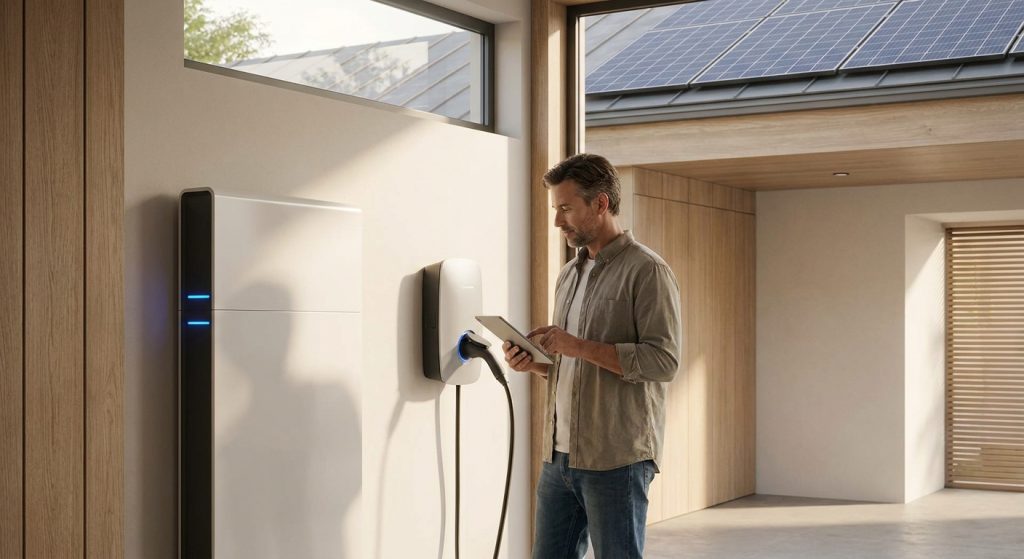
Buying an EV charger without checking how it talks to your battery is the single most common mistake homeowners make in 2026 — and it usually shows up as a charger that either can't pull enough power or one that drains the battery faster than the panels can refill it. Matching a charger to a solar battery system comes down to three numbers: your panel's available amperage, your battery's continuous discharge rating, and your charger's draw in amps. A Level 2 charger pulling 48 amps will overload most battery systems unless you add load management — something the Sigenergy battery systems for EV charging integration are built to handle natively. Look for a charger rated at or below your battery's continuous output, and be cautious with any 60-amp unit unless you've confirmed your service panel and battery can support it. Get this wrong in 2026 and you'll either trip breakers nightly or void your battery's backup mode during an outage.
Why this matters
Most EV chargers were designed assuming a 200-amp grid-tied panel with no battery in the loop. Add a home battery — Tesla Powerwall, FranklinWH, Sigenergy, EG4 — and the math changes completely, because now the charger is competing with your house loads for whatever the battery can discharge at once, not what the utility can theoretically supply. A battery rated for 5 kW continuous output can't feed a 48-amp (11.5 kW) charger and run your HVAC at the same time. That's not a defect, it's physics, and it's why so many installers get callbacks in year one over the charger not working during an outage.
The Tesla Powerwall for homes with EV chargers page breaks down which charger amperages pair cleanly with which Powerwall configurations — worth a look before you buy either component in isolation.
What you'll need
- Your electrical panel's rated capacity (100A, 150A, or 200A service) and current headroom
- Your battery system's continuous discharge rating in kW
- A Level 2 EV charger rated between 32A and 48A (most residential installs land here)
- A licensed electrician for the permit and circuit work
- A load management device if your panel is near capacity
- Your utility's net metering or backup-mode paperwork, if applicable
The steps
1. Pull your panel's available capacity
Check your main panel's rated amperage and subtract what's already committed to HVAC, range, dryer, and other 240V loads. A typical 200-amp panel with a heat pump and electric range might have only 40-60 amps of real headroom left. This number caps everything else you do — there's no charger or battery configuration that gets around insufficient panel capacity. Common mistake: assuming 200-amp service means 200 amps of free capacity. It almost never does.
2. Match charger amperage to battery continuous output
A 40-amp charger draws 9.6 kW; a 48-amp charger draws roughly 11.5 kW. Compare that against your battery's continuous discharge rating before you buy anything. The Sigenergy battery systems for EV charging integration are built specifically around this pairing problem, with onboard load balancing that throttles charger output automatically rather than tripping a breaker. Look for a charger that sits at or below your battery's rated continuous output — don't buy the biggest charger on the shelf assuming you'll grow into it.
3. Decide hardwired versus NEMA 14-50 plug
Hardwired installs support higher amperage (up to 48A on most residential chargers) and are what most manufacturers require for full warranty coverage. A NEMA 14-50 plug-in unit caps out around 40A and gives you the flexibility to relocate the charger later. For solar-battery systems specifically, hardwired is the more common choice among licensed installers in 2026 because it plays better with load-shedding logic during backup events.
4. Add load management if your panel is tight
If step 1 left you with less than 40 amps of headroom, a load management device solves the problem without a panel upgrade. The SPAN Smart Panel gives circuit-level visibility and lets the system automatically de-prioritize EV charging when the dryer or AC kicks on, instead of forcing you to choose between them at install time. Treat this step as mandatory if you're on 100-amp or 150-amp service.
5. Set the charging schedule to sync with solar production
Overnight charging on battery power alone will drain a typical residential battery in a few hours unless it's oversized for that purpose. Schedule EV charging for the midday production window when panels are generating directly, and let the battery reserve stay intact for evening backup. Most charger apps let you set a start/stop window — use it. Common mistake: charging on a timer set for 11 PM because rates are cheaper, which forces the battery to do all the work with zero solar input.
6. Confirm backup mode actually supports EV charging
Not every battery's backup mode allows EV charging by default — some systems shed the EV circuit first during an outage to protect whole-home backup. Check your battery's backup profile settings before an outage happens, not during one. This is a five-minute check in the app that prevents a very bad surprise in January 2026 during a multi-hour outage.
7. Pull the permit and schedule inspection
EV charger circuits above 40A and any battery interconnection work require a permit in nearly every jurisdiction as of 2026. Skipping this step doesn't just risk a fine — it can void manufacturer warranties on both the charger and the battery if something fails and the install wasn't inspected.
8. Test the full loop before you depend on it
Run a full charge cycle with the battery at 100%, then again at 50%, and watch how the system behaves under load with other appliances running. This is the only way to catch a load management misconfiguration before it matters during a real outage.
Troubleshooting
- Charger won't communicate with the battery app: Most compatibility issues trace back to firmware — update both the charger and battery/inverter firmware before assuming it's a wiring fault.
- Breaker trips only when charging and AC run together: Classic load management gap. Add a monitoring/load-shedding device rather than upsizing the breaker.
- Charging stops during a power outage: Check the battery's backup mode settings — many systems exclude EV circuits from backup power by default.
- Charging speed drops to a crawl: Often the charger is throttling itself because it's detecting insufficient available amperage, not a fault in the unit itself.
- Battery drains overnight faster than expected: Reschedule charging to daylight hours so solar production offsets the draw directly instead of pulling 100% from stored capacity.
- Panel inspection fails: Usually a missing permit or an undersized breaker for the actual charger amperage — confirm the nameplate rating matches what was pulled.
Tools and resources
- A licensed electrician for panel capacity assessment and permit filing
- Battery spec sheet with continuous and peak discharge ratings
- Charger manufacturer's amperage and hardwire/plug documentation
- A load management device if panel headroom is under 40 amps
- Sun Supply PV carries batteries and inverters with free shipping, which matters when you're pairing a charger purchase with a battery upgrade in the same order
What to do next
If you haven't sized your battery system yet, start there before locking in a charger — amperage decisions cascade backward from battery capacity, not forward from the charger. The how to size a solar battery system for whole-home backup guide walks through the load calculations that determine which battery tier actually supports EV charging without compromising backup power.
FAQ
What's the best EV charger for a home solar battery system?
There's no single best charger — the right one is whichever amperage your battery's continuous discharge rating supports without load shedding other circuits. A 40A hardwired charger paired with a battery rated for 10+ kW continuous output is a safe baseline for most homes in 2026.
Is a 48-amp charger better than a 32-amp charger for solar setups?
Not automatically. A 48A charger charges faster but demands more from your battery and panel simultaneously; a 32A charger is easier to run alongside a battery with lower continuous output and still fully charges most EVs overnight.
How much does an EV charger cost with a solar battery system?
Pricing varies by charger brand, amperage rating, and whether hardwiring or a NEMA 14-50 plug is used — check current pricing directly rather than relying on a fixed figure, since installer labor and permit costs shift by region.
Can I charge my EV during a power outage with a solar battery?
Only if your battery's backup mode is configured to include the EV charging circuit — many systems exclude it by default to preserve whole-home backup capacity.
Do I need a load management device for EV charging with solar batteries?
You need one if your panel has less than 40 amps of available headroom after existing 240V loads are accounted for; otherwise a hardwired charger without added load management is usually fine.
Does Tesla Powerwall support EV charger integration?
Yes, Tesla Powerwall configurations support EV charging circuits, though the amperage you can safely run depends on the specific Powerwall generation and how many units are installed — check the spec sheet for continuous output before sizing a charger.
What amperage EV charger works with most residential batteries in 2026?
40 amps is the most common sweet spot for residential battery pairings — it charges most EVs overnight and stays within the continuous output range of most single-unit battery installs.
Should I hardwire my EV charger or use a plug-in unit?
Hardwire if you're running above 40 amps or want full manufacturer warranty coverage; a NEMA 14-50 plug-in unit works fine at 40A or below and offers more flexibility if you relocate the charger later.
One last thing
The detail most homeowners miss in 2026: your EV charger's rated amperage is almost never the amperage it actually draws during a typical session, because most EVs won't accept the charger's full output unless the onboard charger supports it. Check your vehicle's onboard charger rating before assuming a 48A charger will run at 48A — plenty of EVs cap out at 32A or 40A regardless of what the charger can technically deliver, which changes your battery sizing math entirely.
Related guides
