 Inverters & Batteries ship FREE
 Ask about rewards for referring friends and family
 U.S. Based Support
 Want to Add a battery?
solar inverters
Solar Racking Wind Load Calculation: 2026 Step-by-Step
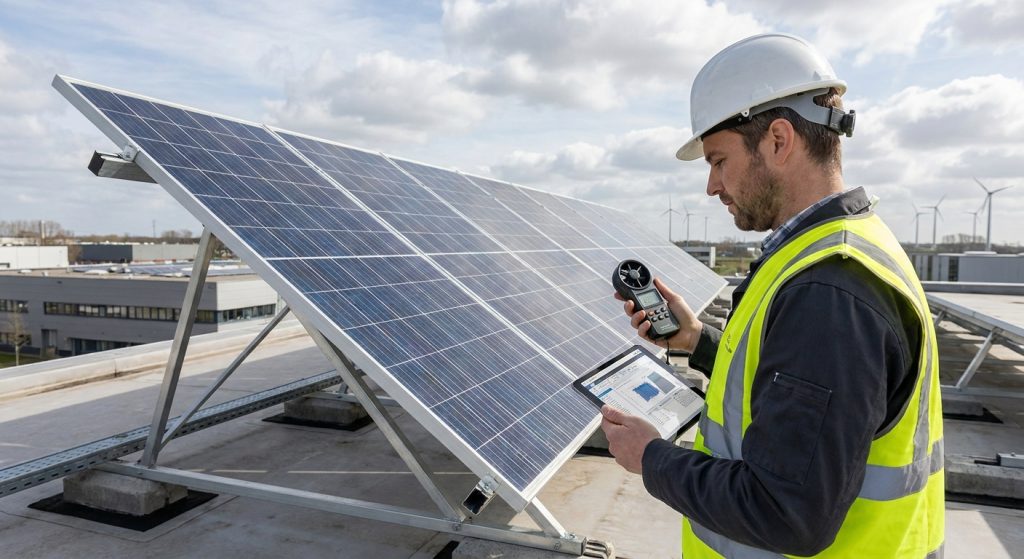
Wind load math decides whether a racking system passes permit review on the first try or bounces back with a red stamp and a two-week delay. Solar racking wind load calculation starts with your site's basic wind speed (Vult) from the ASCE 7 hazard maps, then factors in exposure category, roof zone, and the racking manufacturer's published pressure rating. A rooftop corner zone can see wind pressure 2 to 3 times higher than the field of the array, which is where most under-engineered installs fail inspection. For steep or coastal sites, ground mount racking systems with deeper post embedment are often the safer call over a marginal roof attachment. Run the full ASCE 7 calculation before you order hardware, not after.
Why this matters
Most racking failures aren't material failures — they're calculation failures. A rail rated for 40 psf uplift means nothing if your site's actual corner-zone pressure works out to 55 psf under ASCE 7-22. Building departments in 2026 are pulling stricter enforcement on wind load documentation than they were even three or four years ago, especially in wind-exposed states like Florida, Texas, and coastal California.
The calculation isn't optional paperwork. It determines attachment spacing, fastener count, ballast weight on flat roofs, and whether a licensed engineer needs to stamp the plan set. Get it wrong on a residential job and you're re-doing racking layout after the roof is already mounted. Get it wrong on a commercial flat roof and you're looking at a full ballast redesign.
What you'll need
- Site address (for ASCE 7 hazard map lookup of basic wind speed, Vult)
- Roof type and pitch, or ground mount site grading data
- Exposure category determination (open terrain, suburban, or urban/wooded)
- Racking manufacturer's engineering letter or wind load table — IronRidge, Unirac, Pegasus Solar, and S-5! all publish these
- A structural calculator or spreadsheet set up for the ASCE 7 velocity pressure formula
- Local building code amendments (some jurisdictions apply their own wind speed overlays)
The steps
1. Pull your site's basic wind speed (Vult) from the ASCE 7 hazard maps
This is the foundational number — everything downstream depends on it. Look up Vult using the ASCE 7 Hazard Tool (asce7hazardtool.online) by entering the project address and risk category. Most U.S. residential sites fall between 100 and 140 mph Vult, with coastal Gulf and Atlantic zones pushing past 150 mph.
Common mistake: using an old ASCE 7-10 map value instead of the current ASCE 7-22 figure your local code cycle actually references. Confirm which edition your jurisdiction has adopted before you calculate anything else.
2. Determine exposure category
Exposure category (B, C, or D) accounts for surrounding terrain roughness — buildings and trees slow wind near the ground, open water and flat terrain don't. Exposure B covers urban and suburban areas with closely spaced obstructions. Exposure C is open terrain with scattered obstructions, the default for most suburban rooftops without tree cover. Exposure D applies to sites within 5,000 feet of open water or unobstructed flat terrain, which produces the highest pressures.
A misclassified exposure category is one of the most common corner-cutting mistakes on residential jobs — installers default to Exposure B because it's less conservative, when the actual site is Exposure C.
3. Identify risk category and importance factor
Most residential and small commercial solar falls into Risk Category II, the standard occupancy classification. Risk Category II carries an importance factor of 1.0 under ASCE 7-22 for wind. Critical facilities — hospitals, emergency shelters — bump to Risk Category III or IV with higher factors, which raises the design pressure across the board.
4. Calculate velocity pressure (qz)
The core formula is qz = 0.00256 × Kz × Kzt × Kd × V², where Kz is the velocity pressure exposure coefficient (varies by height and exposure category), Kzt is topographic factor (1.0 on flat sites, higher on hills or ridgelines), Kd is wind directionality factor (0.85 for main wind force resisting systems on most structures), and V is your basic wind speed in mph.
A typical single-story residential roof at 15-20 feet in Exposure C with a 115 mph Vult produces a qz in the 20-25 psf range before pressure coefficients are applied.
5. Apply pressure coefficients for roof zone
Roofs split into zones — field (Zone 1), edge (Zone 2), and corner (Zone 3) — and each carries a different pressure coefficient (GCp). Corner zones on low-slope roofs can see negative pressure coefficients around -2.6 to -3.0, compared to roughly -1.0 to -1.4 in the field. That's the reason racking near roof corners and edges needs tighter attachment spacing or added ballast, even though the panels themselves look identical to the ones in the middle of the array.
Common mistake: applying field-zone pressure across the entire array to save calculation time. Corner and edge zones typically make up 15-20% of total roof area but drive the majority of attachment failures.
6. Compare against the racking system's published wind rating
Once you have a design pressure number for each zone, check it against the manufacturer's engineering documentation for your specific rail, clamp, and attachment spacing combination. For metal roof mounting systems, attachment point spacing and clamp type both shift the allowable pressure rating — tighter spacing raises the rated capacity.
For ballasted flat roofs, the calculation flips: instead of mechanical attachment strength, you're solving for ballast block weight per row needed to resist uplift at each zone. Ballasted flat roof mounting systems typically require 30-40% more ballast weight at corner zones than at the field of the array.
7. Document and submit to the AHJ
Compile the wind speed, exposure category, risk category, calculated pressures by zone, and racking manufacturer's letter of compliance into your permit package. Most jurisdictions in 2026 want this as a standalone structural wind load sheet, not buried in the electrical plan set. Commercial flat roof projects, in particular, tend to require a stamped engineering letter regardless of system size — check with your local building department before assuming a self-certified calculation will pass.
Troubleshooting
Permit gets rejected for missing topographic factor. If the site sits on or near a hill, ridge, or escarpment, Kzt can't default to 1.0 — recalculate using ASCE 7's topographic multiplier method and resubmit.
Racking is rated for the wrong exposure category. Some manufacturer wind load tables are published for Exposure C only. If your site is Exposure D, don't extrapolate — pull the manufacturer's Exposure D-specific table or request an engineering letter.
Ballast weight looks too high to be practical. This usually means the roof zone breakdown wasn't applied correctly — recheck whether you're using corner-zone pressure across the whole array instead of just the outer 15-20%. Commercial flat roof racking systems with variable ballast trays per zone often solve this without redesigning the whole layout.
Ground mount post embedment fails soil bearing check. Wind load and soil bearing capacity are two separate calculations — a post rated for the wind pressure can still fail if the soil report shows low bearing capacity. Get a geotechnical report before finalizing embedment depth on any ground mount over a few kW.
Attachment spacing doesn't match the manufacturer's published table. Interpolating between table values is common but risky — round up to the next conservative spacing value rather than splitting the difference.
Engineer stamp gets requested unexpectedly. High wind zones (Vult above 140 mph), Risk Category III/IV projects, and most commercial jobs over a certain size trigger a stamp requirement in many states as of 2026. Confirm this with the AHJ before submitting a self-certified calc.
Tools and resources
- ASCE 7 Hazard Tool for basic wind speed lookup by address
- Manufacturer engineering letters from IronRidge, Unirac, Pegasus Solar, and S-5! for attachment-specific pressure ratings
- Ground mount racking systems for sites where roof attachment isn't viable or wind exposure is severe
- Local building code amendments (check for jurisdiction-specific wind speed overlays before finalizing)
- If your project also includes batteries or string inverters, note that batteries and inverters ship free through Sun Supply PV — worth bundling into the same order as your racking hardware to consolidate freight.
What to do next
Once the wind load calculation is locked in, move to attachment layout and structural fastener selection for your specific roof type. If you're working a tile roof, the wind load numbers change again because of the standoff height required to clear tile profiles — that's a separate calculation from standard comp shingle or metal roofing.
FAQ
What's the basic wind speed used for solar racking calculations in 2026?
It varies by site — pull it from the ASCE 7 hazard map tool using your exact address, not a regional average. Most U.S. sites fall between 100 and 140 mph Vult, with coastal zones running higher.
Is ground mount racking rated for higher wind loads than roof mount?
Not inherently — ground mount systems handle wind through post embedment depth and footing design rather than roof attachment strength, which gives more flexibility on high-wind sites where roof structure can't support added load.
How much higher is corner-zone wind pressure than field-zone pressure?
Corner zones on low-slope roofs typically run 2 to 3 times higher than field-zone pressure due to negative pressure coefficients as steep as -2.6 to -3.0 versus roughly -1.0 to -1.4 in the field.
Do I need an engineer's stamp for a residential wind load calculation?
Depends on your jurisdiction and wind zone — many AHJs accept self-certified calculations under 140 mph Vult for Risk Category II residential projects, but high wind zones and most commercial jobs require a stamped letter.
Does exposure category change the wind load calculation?
Yes, significantly — Exposure D (open water proximity) produces meaningfully higher velocity pressure than Exposure B (urban/suburban) at the same wind speed, because it factors in surrounding terrain roughness.
Can I use the same wind load calculation for metal roofs and shingle roofs?
No — attachment spacing, fastener pull-out strength, and standoff height differ by roof type, which changes the allowable pressure rating even at identical wind speed and exposure inputs.
What happens if racking wind rating doesn't match calculated site pressure?
The system fails the design check and needs tighter attachment spacing, added ballast, or a different racking product rated for higher pressure — don't submit for permit until the numbers align.
How often do wind speed maps get updated?
ASCE updates its wind hazard maps with each code cycle, roughly every 3-6 years — always confirm which ASCE 7 edition your local jurisdiction has adopted in 2026 before pulling a number.
One last thing
The number that trips up the most installers isn't the wind speed — it's the corner-zone multiplier. A roof that calculates fine in the field at 22 psf can spike past 55 psf at the corners under the same wind speed and exposure category. Racking systems sized only for field-zone pressure are the single most common reason plan sets bounce back from building departments in 2026.
Related guides
