 Inverters & Batteries ship FREE
 Ask about rewards for referring friends and family
 U.S. Based Support
 Want to Add a battery?
solar inverters
EG4 Battery for RV and Mobile Power Systems (2026)
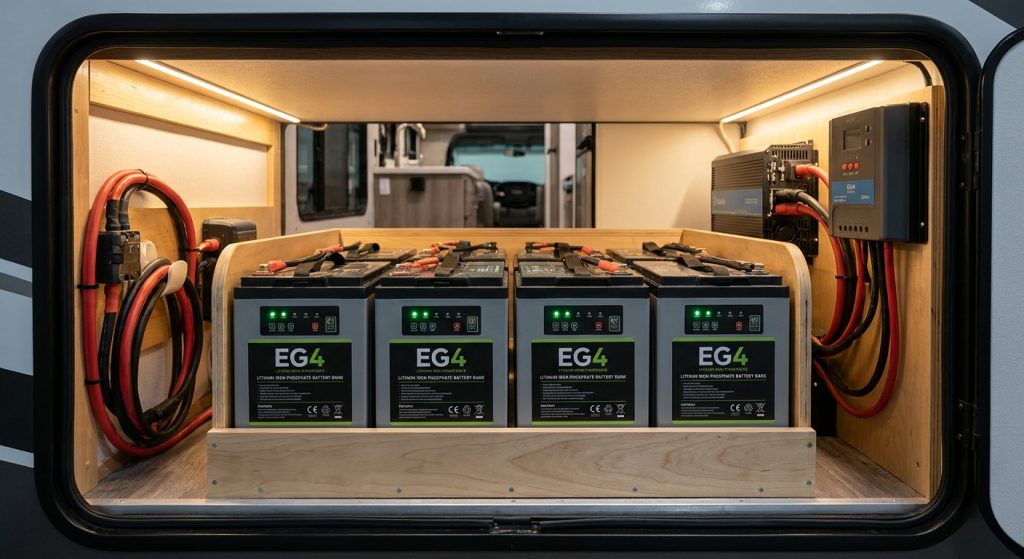
An EG4 battery is one of the most common LiFePO4 choices RVers ask about when they outgrow a single AGM battery under the bed, and this guide breaks down what actually matters for mobile power before you drop cash on a 100Ah bank or a 48V wall unit that was never meant to ride down a washboard road. An EG4 12V 100Ah LiFePO4 battery is a strong fit for most single-battery RV conversions in 2026, offering a drop-in AGM replacement footprint with roughly 1,280Wh of usable capacity and a BMS built for vibration. Stacked 48V systems like the EG4-LL make sense mainly for skoolies and van builds running induction cooktops or AC compressors off-grid. Sun Supply PV does not distribute EG4 directly, but if your RV build also needs solar panels sized for RV and marine installs or a stationary battery for a basecamp trailer pad, that's where Sun Supply PV's catalog fits alongside an EG4 battery setup. Batteries sold without a published continuous discharge rating are best avoided regardless of brand.
Why this matters
RV batteries live a different life than rooftop solar batteries. They get vibrated on washboard roads, baked in a battery compartment that hits 120°F in an Arizona parking lot, and drained hard by a fridge compressor and an inverter running a hair dryer at the same time. A battery spec sheet written for a stationary home backup unit does not automatically translate to a mobile application, and that gap is where most RV buyers waste money in 2026 — either overbuying capacity they never use, or underbuying a BMS that can't handle a surge load.
Who this is for
This guide is for two buyer types: the DIY van or skoolie builder wiring their own 12V or 48V system from scratch, and the licensed installer doing RV/marine conversions for clients who want a turnkey off-grid electrical bay. Both need the same core answer — capacity, weight, charge compatibility, and mounting — just at different scales.
What to look for in an EG4 battery for RV use
Capacity and voltage architecture
A single 12V 100Ah LiFePO4 battery delivers about 1,280Wh usable, enough for a 12V fridge, some LED lighting, and phone charging over a night without shore power. Full-time boondockers running an induction cooktop, a residential-style fridge, or a mini-split AC need to think in kWh, not amp hours, and that usually pushes toward a 48V bank instead of parallel 12V units.
Cycle life and chemistry
LiFePO4 batteries rated for 4,000 to 6,000 cycles at 80% depth of discharge are the current standard as of 2026, a meaningful jump over the 500-cycle ceiling of a flooded lead-acid battery. Confirm the cycle rating is tested at a realistic depth of discharge, not a marketing number based on a shallow 10% cycle.
Weight and mounting footprint
A 12V 100Ah LiFePO4 battery typically weighs 20-28 lbs, roughly half the weight of an equivalent lead-acid battery, which matters directly for RV axle weight ratings. Anything heavier than that in the same form factor is either an older chemistry or padded with unnecessary casing.
Charge input compatibility
An RV battery needs to accept three charge sources without babysitting: shore power through a converter, solar through a charge controller, and the vehicle alternator through a DC-DC charger. A BMS that can't handle simultaneous multi-source charging will throttle or trip, which shows up as a battery that never quite reaches full charge on travel days.
Continuous and surge discharge rating
A battery rated for only 100A continuous will trip its BMS the first time a residential AC compressor or a hair dryer draws a 3,000W+ surge through the inverter. Look for a published continuous discharge rating in amps, not just a wattage number pulled from an inverter spec sheet.
Temperature range and BMS protection
Low-temp charge cutoff matters more in mobile applications than stationary ones, since an RV parked at altitude in shoulder season can see the battery compartment drop below freezing overnight. A built-in low-temp charge disconnect protects the cells; without it, charging a frozen LiFePO4 battery does permanent damage.
Top picks
EG4 12V 100Ah LiFePO4 — the safe pick. Roughly 1,280Wh usable at a 20-28 lb weight class, drop-in compatible with most factory battery compartments sized for Group 27 or Group 31 lead-acid. This is the default swap for single-battery travel trailers and Class C rigs upgrading off a dying AGM in 2026. A strong fit for anyone replacing one or two lead-acid batteries without rewiring the whole electrical bay.
EG4-LL 48V wall-mount stacked — the heavy-duty pick. A single 48V stack runs around 5.1kWh usable, and most builders stack two to three units for full off-grid induction cooking and AC. This only makes sense in a skoolie, cargo van, or full-time coach with a dedicated electrical closet — not a weekend travel trailer. Worth considering only if your build already has a 48V inverter and the floor space for a wall-mount unit.
Pairing 12V EG4 banks with an RV/marine solar kit — the system approach. Matching a 400-600W rooftop solar array to a 100-200Ah battery bank keeps most 3-season boondockers charged without running the generator. Sun Supply PV's wholesale solar panels for RV and marine installers page is where that panel side of the build gets sourced, separate from the battery itself. Worth pricing the panel-to-battery pairing as a system, not as two unrelated purchases.
A home-backup-grade battery for a fixed pad — the stationary base camp pick. If your rig sits on a permanent or semi-permanent pad rather than traveling weekly, a stationary-rated battery built for daily cycling — like the options on Sun Supply PV's FranklinWH battery wholesale pricing page — can outperform a mobile-rated LiFePO4 bank on cycle life and warranty terms. Worth considering for basecamp trailers and park models that rarely move; less suited to anything towed weekly.
What to avoid
- Sealed lead-acid marketed as a "deep cycle RV battery" — it looks like a direct cost-saver on the shelf tag but delivers roughly half the usable capacity and a tenth of the cycle life of LiFePO4.
- Batteries with no published continuous discharge amperage — a spec sheet that only lists peak or surge wattage is hiding a BMS that will trip under real RV loads like an AC compressor startup.
- Undersized battery cable and fusing sold as a "kit" — a 100Ah battery paired with 6-gauge cable and a 100A fuse will bottleneck the battery's actual output the first time you run a hair dryer and the fridge at once.
Option comparison
| Option | Usable capacity | Weight | Best for |
|---|---|---|---|
| EG4 12V 100Ah | ~1,280Wh | 20-28 lbs | Single/dual battery travel trailers |
| EG4-LL 48V stack | ~5.1kWh per unit | 100+ lbs | Skoolies, full-time coaches |
| Sealed lead-acid | ~640Wh usable at 50% DoD | 55-65 lbs | Best avoided in 2026 |
| Stationary home-backup battery | Varies by model | Fixed install | Park models, basecamp pads |
FAQ
What is the best EG4 battery for RV use?
The 12V 100Ah LiFePO4 line is the best fit for most travel trailers and Class C RVs because it drops into a factory battery compartment without rewiring the whole bay. Full-time builds with heavier loads should look at a stacked 48V configuration instead.
Is a 48V EG4 setup better than 12V for RV solar?
48V wins on efficiency for large loads like induction cooktops or mini-split AC because it moves the same wattage at lower current, meaning thinner cable and less voltage drop. For a typical weekend or 3-season RV with lights, fridge, and charging, 12V is simpler to wire and service.
How many amp hours do I need for RV solar?
Most 3-season boondockers land between 100Ah and 300Ah at 12V depending on fridge type and AC use, with 200Ah being a common middle ground for a couple running a residential-style fridge. Full-time off-grid living with induction cooking pushes that number into 48V kWh territory instead.
Can I charge an EG4 battery with a truck alternator?
Yes, through a DC-DC charger rated for the battery's charge current, which regulates the alternator's variable voltage down to something the LiFePO4 BMS accepts safely. Wiring the battery straight to the alternator without a DC-DC charger risks overcharging.
Does Sun Supply PV sell EG4 batteries?
Sun Supply PV does not currently distribute EG4; its battery lineup runs through brands like FranklinWH and Enphase for stationary backup, alongside wholesale solar panels for RV and marine installs. Buyers building a mobile EG4 system typically source the battery separately and the solar hardware through a distributor like Sun Supply PV.
How long does an EG4 LiFePO4 battery last?
Most 2026-era LiFePO4 batteries in this class are rated for 4,000 to 6,000 cycles at 80% depth of discharge, which works out to a decade or more of typical RV seasonal use. Actual lifespan depends heavily on avoiding deep discharges below the BMS cutoff and keeping charge temperature within the rated range.
Do batteries and inverters ship free from Sun Supply PV?
Yes — batteries and inverters ship free through Sun Supply PV, which matters when you're pricing out a full RV or stationary backup system alongside panels and racking. Contact Sun Supply PV directly for current lead times on specific items.
What's the difference between a mobile RV battery and a home backup battery?
A mobile RV battery is built for vibration resistance and a compact form factor that fits a factory battery compartment, while a home backup battery is optimized for daily cycling and stationary mounting with a longer warranty window. Mixing the two use cases — running a home-backup-grade battery in a towed trailer — usually voids the vibration-related warranty terms.
One last thing
The detail most RV buyers skip past: BMS communication protocol. An EG4 battery bank that can't talk to your inverter/charger over CAN bus or RS485 will still charge and discharge fine, but you lose real-time state-of-charge accuracy and any automated load-shedding the system could otherwise do — which matters a lot more at 2am in a Walmart parking lot than it does on a spec sheet.
Related guides
