 Inverters & Batteries ship FREE
 Ask about rewards for referring friends and family
 U.S. Based Support
 Want to Add a battery?
solar inverters
EG4 Battery for Off-Grid Solar Systems: 2026 Guide
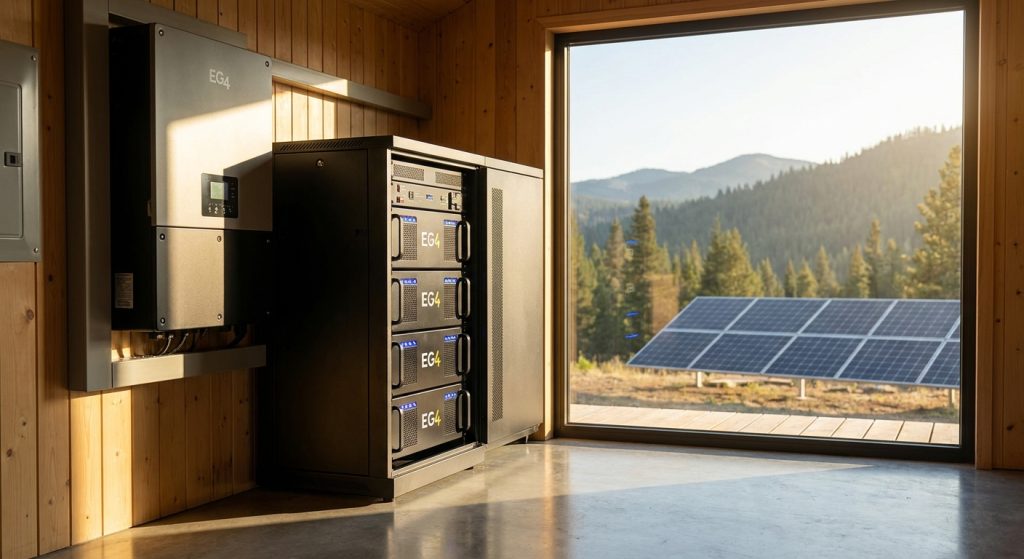
Searching for an EG4 battery for an off-grid system usually means one thing: you're sizing a battery bank for a cabin, remote property, or full disconnect from the utility, and you want a straight answer on capacity, chemistry, and what pairs with what. EG4's stackable LiFePO4 packs are a common off-grid pick for 2026 builds because of their 48V nominal design and modular capacity, but they sit outside Sun Supply PV's current wholesale lineup — check with an EG4 dealer directly and verify warranty terms before you commit. For buyers sourcing through a distributor with batteries and inverters shipping free, FranklinWH's whole-home backup system and Enphase's IQ Battery platform are strong options for true off-grid or heavy backup loads, and Tesla Powerwall is worth considering where EV charging is part of the load profile. The right off-grid battery choice comes down to continuous output rating, stacking flexibility, and whether your inverter setup is all-in-one or microinverter-native.
Why this matters
Off-grid battery sizing mistakes are expensive to fix after the fact. A pack that looks right on paper but can't hold continuous output under a well pump or HVAC startup surge leaves you back at the distributor within a season. This is true whether you're a licensed installer speccing a remote cabin job or a homeowner going off-grid for the first time in 2026.
Most people land on EG4 because it shows up early in searches for stackable, budget-conscious LiFePO4 systems. That's a fair starting point — but the battery is only half the system. Pairing it correctly with wholesale solar panels for residential installers and the right inverter matters just as much as the battery spec sheet.
Who this is for
This guide is for two overlapping buyers: licensed solar installers quoting off-grid or backup-heavy jobs, and residential DIY buyers converting a cabin, workshop, or full-time home away from the grid. Both need the same information — chemistry, stacking limits, continuous power rating, and cold-weather behavior — just applied at different scales.
What to look for in an off-grid battery
Battery chemistry and cycle life
LiFePO4 (lithium iron phosphate) is the standard chemistry for off-grid banks in 2026 because it tolerates deep, daily cycling without the degradation curve of older lead-acid or even standard lithium-ion chemistries. Off-grid systems cycle harder than grid-tied backup, so cycle life claims matter more here than in a once-a-month outage scenario.
Stackable capacity vs. fixed whole-home design
Some batteries are built to stack in small increments so you add capacity as budget allows; others are engineered as a single whole-home unit with a fixed capacity ceiling. Off-grid builds usually favor stacking flexibility because load profiles change as you add appliances, EV charging, or a second structure.
Inverter compatibility
A battery that isn't natively matched to your inverter platform adds integration risk and voids simplicity. Microinverter-based systems (like Enphase) need a battery built for that ecosystem; all-in-one inverter-battery combos need to be sized as a matched pair, not assembled piecemeal.
Continuous power output vs. surge rating
Spec sheets lead with peak or surge wattage, but off-grid loads care about continuous output. A well pump, air conditioner compressor, or workshop tool draws steady current for minutes at a time — check the continuous kW rating, not just the surge number.
Cold-weather performance
LiFePO4 packs lose usable capacity and charge acceptance in cold weather unless they include internal heating elements. If your off-grid site sees regular sub-freezing temperatures, this single spec line can eliminate half your shortlist.
Warranty and service network access
Off-grid sites are often remote by definition, so a battery with a thin service network turns a warranty claim into a multi-week ordeal. Confirm who handles service calls in your region before you buy, not after.
Top picks for off-grid battery banks
EG4 stackable LiFePO4 systems — the search-term default. EG4 batteries run 48V nominal architecture with stackable capacity, typically assembled in increments that let installers scale a bank over multiple phases. They're a legitimate off-grid option and the reason most buyers land on this page in the first place. Confirm current dealer stock, warranty terms, and service coverage directly with an authorized EG4 dealer, since EG4 is not part of Sun Supply PV's current wholesale catalog.
FranklinWH — the whole-home load-shed brain. FranklinWH's system pairs a battery with an integrated smart panel that manages circuit-level load shedding automatically, which matters when you're running a full home off a finite battery bank. It's built for backup-heavy and off-grid-adjacent use cases where you need software-managed prioritization, not just stored kWh. See the FranklinWH battery setup for whole-home backup for configuration details.
Enphase IQ Battery — the microinverter-native pick. If your array already runs Enphase microinverters, the IQ Battery platform integrates without a separate inverter conversation, and capacity scales in modular units rather than one fixed size. That modularity is a real advantage for off-grid builds that grow over time. Details on the Enphase battery model built for home backup.
Tesla Powerwall — the EV-charger co-pilot. Powerwall ships as a large single unit rather than small stackable increments, which makes it a stronger fit for backup-plus-EV-charging scenarios than for phased off-grid expansion. It still handles serious continuous loads, but sizing an off-grid system around one fixed unit takes more upfront planning than a stackable platform. See Tesla Powerwall for homes with EV chargers to check the load-profile fit.
What to avoid
- Sizing off surge wattage alone. A battery that lists an impressive peak kW number can still fall short on continuous output during a 20-minute well pump cycle — check both numbers before you buy.
- Buying a non-stackable unit for a growing off-grid load. If you expect to add a workshop, EV charging, or a second building within a few years, a fixed-capacity battery locks you into a second full purchase later instead of an incremental add-on.
- Skipping the cold-weather spec line. A pack without internal heating can lose meaningful usable capacity below freezing — this is a common and avoidable off-grid planning miss in 2026 builds sited in northern climates.
Platform comparison
| Battery platform | Chemistry | Capacity design | Inverter fit | Best fit |
|---|---|---|---|---|
| EG4 stackable systems | LiFePO4, 48V nominal | Stackable, phased | Compatible with common hybrid inverters | Budget-conscious phased builds (verify dealer) |
| FranklinWH | LiFePO4 | Whole-home, smart panel managed | Integrated system | Software-managed load shedding |
| Enphase IQ Battery | LiFePO4 | Modular, microinverter-native | Enphase microinverter ecosystem | Existing Enphase arrays |
| Tesla Powerwall | LiFePO4 | Fixed, large single unit | All-in-one, EV-load aware | Backup plus EV charging |
FAQ
Is an EG4 battery good for off-grid solar?
Yes — EG4's stackable LiFePO4 design is built for exactly this use case, with 48V nominal architecture that scales in phases as budget and load demand grow. Confirm current stock and warranty terms with an authorized EG4 dealer before ordering.
How many kWh do I need for a full off-grid home in 2026?
Most full-time off-grid homes run somewhere between 15-30kWh of usable storage depending on climate, appliance load, and backup days needed, though exact sizing requires a load calculation specific to the property.
Can I mix EG4 batteries with an Enphase or FranklinWH system?
Generally no — battery platforms are matched to their inverter ecosystem, and mixing brands without engineering review risks warranty and compatibility issues on both sides.
Do batteries and inverters ship free from Sun Supply PV?
Yes, batteries and inverters ship free through Sun Supply PV's wholesale distribution, which applies to platforms like FranklinWH, Enphase, and Tesla Powerwall carried in the current lineup.
What's the difference between stackable and whole-home battery design?
Stackable systems add capacity in small increments over time, while whole-home designs like Powerwall ship as one larger fixed unit — stackable favors phased off-grid growth, fixed favors simpler one-time installs.
Does cold weather affect off-grid battery performance?
Yes — LiFePO4 packs without internal heating elements lose usable capacity and slow charge acceptance below freezing, which matters most for off-grid sites in northern climates running through winter 2026.
Is Tesla Powerwall a true off-grid battery?
It can be configured for off-grid use, but it's designed primarily as a large single-unit backup platform, so sizing a fully off-grid system around it takes more upfront load planning than a stackable platform.
What continuous output rating do I need for well pumps and HVAC?
Check the continuous kW rating specifically, not the surge or peak number — a well pump or compressor draws steady current for minutes, and undersized continuous output is the most common off-grid battery mistake.
One last thing
The spec buyers skip most often isn't capacity — it's continuous output under real load. A battery bank that looks perfectly sized on a kWh spreadsheet can still brown out under a well pump startup if the continuous kW rating wasn't checked against actual appliance draw, and that mistake shows up in the first month, not the spec sheet.
Related guides
