 Inverters & Batteries ship FREE
 Ask about rewards for referring friends and family
 U.S. Based Support
 Want to Add a battery?
Uncategorized
Best Whole Home Battery Backup for Outages (2026)
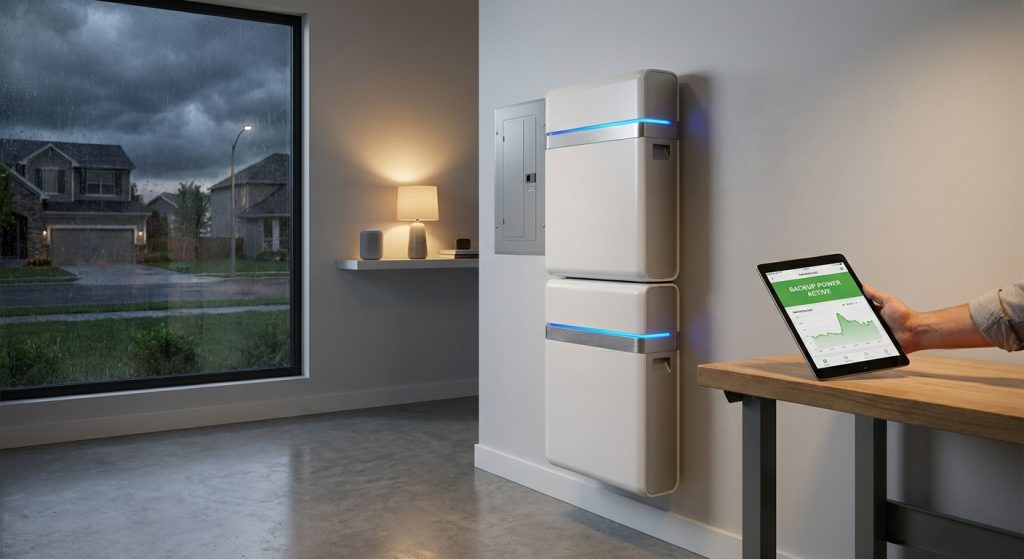
Losing power for six hours during a summer thunderstorm is an inconvenience. Losing it for four days during a winter ice storm — with a freezer full of food and a medically dependent household member on oxygen — is a different problem entirely, and it's the reason whole home battery backup for outages has become one of the fastest-growing categories in residential solar in 2026.
The short version: Tesla Powerwall and FranklinWH lead on raw capacity and software polish, Enphase batteries win on modularity for smaller homes, and EG4 batteries win on price-per-kWh for buyers who want more storage without the premium brand tax. Which one is right for your house depends less on the label and more on your panel's continuous power draw, whether you're pairing it with an EV charger, and how many days of autonomy you actually need versus how many you think you need.
Why this matters
A generator solves the fuel problem. A battery solves the silence problem — no exhaust, no refueling at 2 a.m., no noise ordinance violations, and (when paired with solar) no dependency on a fuel supply chain that also breaks down during regional disasters. The tradeoff is capacity: most whole-home battery systems are sized for critical loads or moderate whole-home use across days, not indefinite off-grid operation.
That's the calculation buyers get wrong most often. A single 10 kWh battery sounds like a lot until you realize a central AC unit alone can pull 3-5 kW on startup. Sizing matters more than brand loyalty here, and it's worth working through how to size a solar battery system for whole-home backup before you commit to a specific unit.
How this list was built
The ranking below weighs four factors that actually predict real-world outage performance: usable capacity per module, continuous and peak power output (the number that determines whether your AC or well pump will run), stackability for multi-day autonomy, and integration with existing solar arrays and EV chargers. Pricing reflects manufacturer list and distributor terms as of 2026 and will move with supply — treat any dollar figure as directional, not locked. Availability is subject to change; contact a distributor for current lead times rather than assuming stock.
The ranked list
1. Tesla Powerwall 3 — the one built for EV households
Tesla's Powerwall 3 ships with an integrated inverter rated for 11.5 kW continuous output and 13.5 kWh usable capacity per unit, and units stack up to four for homes that want serious autonomy. The built-in solar inverter means fewer parts on the wall, which installers appreciate, and the round-trip efficiency numbers Tesla publishes for 2026 units are competitive with anything else on this list.
Where it earns its spot specifically for outage backup: homes running an EV charger alongside HVAC loads need the higher continuous output, and Powerwall 3 doesn't buckle under that combined draw the way older single-inverter systems do. If your household has a Level 2 charger in the garage and central air, Tesla Powerwall for homes with EV chargers is the pairing that makes the most sense of anything in this lineup, and it's worth strong consideration if EV load is part of your outage math.
2. FranklinWH aPower — the one for multi-day autonomy
FranklinWH's aPower system delivers 13.6 kWh usable per unit with a continuous output around 10 kW, and the company's stacking architecture is built specifically around extending runtime rather than just peak power. For households in areas with multi-day outage patterns — think ice storm corridors in the upper Midwest or wildfire-adjacent grid shutoffs in California — that runtime-first design matters more than a slightly higher peak kW spec.
The best FranklinWH battery setup for whole-home backup generally pairs two or three units for a household running standard HVAC plus kitchen appliances. It's a strong option through 2026 for anyone prioritizing days of autonomy over instant peak power, and a reasonable one to shortlist if your outage history runs long rather than sharp.
3. Enphase IQ Battery 5P — the one for smaller homes and phased installs
Enphase's modular approach means you're not locked into a single large unit — the IQ Battery 5P delivers 5 kWh usable capacity per module at a 3.84 kW continuous output, and you add modules as budget or need grows. That modularity is the whole pitch: a homeowner can start with one unit for critical circuits (fridge, wifi, a few outlets) and add capacity later without replacing anything.
For smaller homes, condos with solar, or anyone easing into battery backup rather than committing to a full whole-home system on day one, the best Enphase battery model for your home backup needs is the lower-friction entry point in this category. It's a sound starting position for 2026 buyers who want to scale rather than overbuy up front.
4. EG4 battery systems — the one for stretching the storage budget
EG4's lithium iron phosphate battery lineup consistently comes in at a lower cost per kWh than the name-brand options above, without giving up meaningfully on cycle life — LiFePO4 chemistry across the EG4 lineup is typically rated for 6,000+ cycles. For buyers who want more total kWh on the wall rather than a smaller amount of storage with a premium logo, that math adds up fast once you're looking at 20-30 kWh systems.
The best EG4 battery setup for whole-home backup tends to appeal to DIY-inclined homeowners and installers working with tighter project budgets. It's a legitimate pick for 2026 if capacity-per-dollar is the deciding factor and you're comfortable with a less polished app experience than Tesla or FranklinWH offer.
5. Sigenergy SigenStor — the one worth watching, not yet the default
Sigenergy's SigenStor platform has been gaining installer attention through 2026 for its hybrid inverter-battery integration and EV charging tie-ins, and it's worth tracking as the ecosystem matures. It's a reasonable system to evaluate for commercial and larger residential projects today, but for a first whole-home backup purchase, the more established options above have a longer track record of field data behind them — worth holding off on as a first pick until more long-term performance data accumulates.
Comparison at a glance
| System | Usable capacity (per unit) | Continuous output | Best fit |
|---|---|---|---|
| Tesla Powerwall 3 | 13.5 kWh | 11.5 kW | EV charger + HVAC households |
| FranklinWH aPower | 13.6 kWh | ~10 kW | Multi-day outage regions |
| Enphase IQ Battery 5P | 5 kWh | 3.84 kW | Smaller homes, phased upgrades |
| EG4 lithium battery systems | Varies by model | Varies by model | Budget-conscious, higher total kWh |
| Sigenergy SigenStor | Varies by model | Varies by model | Installers tracking 2026 rollout |
Notice the pattern: nobody on this list wins every category. The right system is the one that matches your actual load profile, not the one with the biggest number on the spec sheet.
Where to buy
Three rules that save buyers money and headaches:
- Buy from an authorized distributor, not a reseller with no manufacturer relationship. Warranty registration and firmware support depend on proper chain-of-custody paperwork.
- Confirm lead times before you commit to an install date. Availability on specific battery models shifts through the year — ask directly rather than assuming a unit is in stock.
- Check whether the battery and inverter ship free. Sun Supply PV ships batteries and inverters free, which matters more than it sounds on units weighing 200+ pounds with freight-class shipping requirements.
If you're pairing a battery with a circuit-level monitoring setup rather than a simple critical-loads panel, the SPAN Smart Panel is worth looking at alongside whichever battery you choose — it changes which circuits you can selectively shed during an extended outage, which changes how much runtime you actually get out of a given kWh count.
FAQ
What's the best whole home battery backup for outages in 2026?
There's no single best system — Tesla Powerwall 3 leads for EV-charger households, FranklinWH aPower leads for multi-day autonomy, and EG4 leads on cost per kWh. Match the system to your home's continuous power draw and outage duration pattern rather than picking by brand recognition alone.
How many batteries do I need to power a whole house?
Most homes need 2-3 stacked battery units (20-40 kWh total) to run full HVAC, refrigeration, and general circuits through a multi-day outage. A single 10-13 kWh unit typically covers critical loads only — fridge, wifi, a few outlets, and lighting.
Is a battery better than a generator for outage backup?
Batteries run silently with no fuel or exhaust, but have finite capacity unless recharged by solar or grid power. Generators can run indefinitely on fuel but require refueling, maintenance, and produce noise and exhaust — many 2026 installs pair a smaller battery with solar recharge rather than choosing one over the other.
How much does a whole-home battery backup system cost in 2026?
Costs vary by capacity, brand, and installation complexity, and pricing shifts through the year — check current distributor pricing rather than relying on older estimates, since incentives and list prices both move.
Can I add a battery to an existing solar system?
Yes, in most cases, as long as your existing inverter is compatible or a hybrid inverter is added. Enphase and Tesla both support retrofits onto existing arrays, though the exact process depends on your current equipment.
Do whole-home batteries work during a total grid failure?
Yes — batteries with backup capability disconnect from the grid automatically and power your home independently, refilling from solar if panels are installed. Without solar, the battery runs down until grid power returns or you add a generator to recharge it.
What size battery do I need for a refrigerator and wifi during an outage?
A single 5 kWh module, like the Enphase IQ Battery 5P, comfortably covers a refrigerator, wifi router, and a handful of outlets and lights for 12-24 hours depending on usage. Add capacity if you need to run more circuits simultaneously.
Does EG4 make a whole-home battery or just off-grid units?
EG4's lineup covers both off-grid systems and whole-home backup configurations, with LiFePO4 chemistry rated for extended cycle life in either use case. The best EG4 battery setup for whole-home backup guide breaks down which configuration fits grid-tied backup versus full off-grid.
One last thing
Most buyers size their battery for the outage they remember, not the one that's actually likely. If your last outage was two hours, you don't need 40 kWh — but if your utility has had rolling shutoffs or ice-storm outages lasting 3+ days in the last few years, a single 10-13 kWh unit will leave you rationing power by day two. Pull your utility's actual outage history before locking in a system size for 2026 — it's a five-minute records request that changes the entire purchase decision.
