 Inverters & Batteries ship FREE
 Ask about rewards for referring friends and family
 U.S. Based Support
 Want to Add a battery?
solar inverters
Best Solar Power Optimizers for Partially Shaded Roofs (2026)
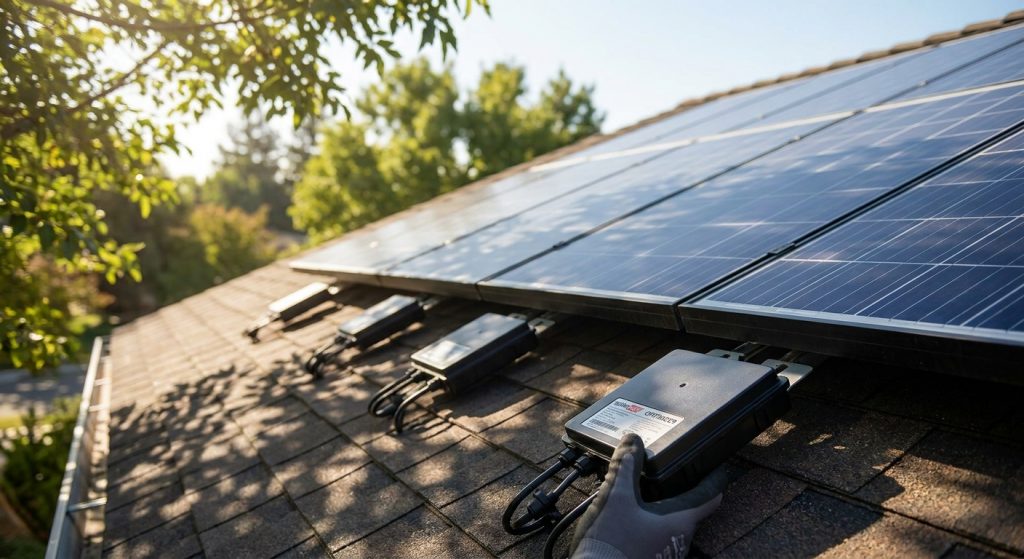
Partial shade on even one panel can drag down an entire string's output — the fix isn't a bigger inverter, it's smarter power electronics at the module level. For shaded roofs in 2026, module-level power electronics beat string-only inverters every time shade hits more than one or two panels a day. SolarEdge power optimizers remain a top pick for installers who want per-panel MPPT paired with a central inverter, while Enphase IQ8 Series microinverters are the better call when you want full panel independence with no single point of failure. Bare string inverters are worth avoiding on any roof with dormers, chimneys, or trees casting shadows past 10 a.m. — the production loss compounds fast. Both product lines are stocked for U.S. installers and residential buyers, and Sun Supply PV ships qualifying inverters free.
Why this matters
A single shaded cell doesn't just lose its own output — on a traditional string setup, it drags the whole series string down to its weakest link. Lose 30% output on one panel and you can lose 20-30% on the entire string, not just that one module. That's the math that made module-level power electronics (MLPE) standard practice on anything but a wide-open, obstruction-free roof.
Two approaches solve this differently. DC power optimizers (SolarEdge's core product) sit under each panel, track its individual maximum power point, and pass conditioned DC downstream to a central string inverter. Microinverters (Enphase, APsystems) convert DC to AC right at the panel, so each module operates as its own independent power plant. Both outperform a plain string inverter on a shaded roof in 2026 — the decision is which architecture fits the install.
Homeowners evaluating wholesale solar panels for residential installers should ask their installer which MLPE approach is spec'd before signing off on a design, because retrofitting optimizers or microinverters after a string-only install costs more than speccing it right the first time.
How we compared them
The comparisons below reflect published manufacturer specs as of 2026 — rated power handling, per-panel monitoring granularity, and documented shade-tolerance architecture (independent MPPT per module vs. per-string). No lab testing was performed for this guide; figures come from manufacturer datasheets. Recommendations weigh shade performance first, then installer familiarity and monitoring depth, since a system nobody can diagnose six years in isn't a win regardless of its shade math.
The options
SolarEdge Power Optimizers (P505 / P600 series) — the industry default
SolarEdge optimizers are rated to handle module input up to roughly 500-600 watts depending on the model, tracking each panel's MPPT independently before sending conditioned DC to a central SolarEdge inverter. That means one shaded panel's underperformance stays isolated to that panel — the rest of the string keeps producing at full capacity. Per-panel monitoring down to the individual optimizer is standard, which matters when a homeowner calls two years later asking why output dropped on the east side.
This is the most-installed optimizer architecture in the U.S. residential market, so parts, replacement units, and installer familiarity are all easier to source in 2026 than with less common alternatives. A strong default choice for any roof with partial obstruction and a preference for centralized inverter architecture.
Enphase IQ8 Series Microinverters — the shade-proof pick
Enphase's IQ8 line converts DC to AC at the panel, with models rated for continuous AC output in the 349-386 VA range depending on the variant paired to the module wattage. Because each microinverter operates independently, a shaded panel doesn't touch the electrical performance of any other panel on the roof — there's no string to drag down. IQ8 units also carry grid-forming capability, which matters if backup power is part of the plan.
For roofs with heavy shade patterns — multiple trees, complex rooflines, panels split across east and west faces — this is the cleanest architecture available. Full specs and residential pairing guidance live on the best solar microinverters for residential solar systems page. The strongest pick when shade is severe or the roof has more than one orientation.
APsystems DS3-L Dual Microinverter — the value-conscious dual-panel option
APsystems' dual-input microinverter connects two panels to a single unit, splitting the per-panel independence of a true microinverter with fewer physical devices on the roof. Rated combined DC input runs up to roughly 880 watts across the two connected modules, with each channel tracked separately. That's a meaningful cost and labor reduction on larger residential arrays without losing the module-level isolation that makes microinverters shade-resistant in the first place.
Installers running higher panel counts often prefer this over a one-microinverter-per-panel layout purely on installed unit count. A solid architecture when budget and roof size favor fewer physical devices, though it doesn't quite match single-panel Enphase units for total independence.
SolarEdge Home Hub Inverter + Optimizer System — the whole-home shade solution
Pairing SolarEdge optimizers with the Home Hub inverter platform adds energy management on top of the shade-tolerance benefit — production, consumption, and (where applicable) storage integration in one monitored system. On a partially shaded roof feeding a home with EV charging or battery backup ambitions, this bundled approach keeps the optimizer-level shade correction while adding whole-home visibility installers can hand to homeowners without extra training.
SolarEdge inverters ship free through Sun Supply PV, which keeps landed cost predictable for installers quoting multi-unit jobs in 2026. A strong fit for shaded roofs that are also adding storage or EV charging in the same project.
Microinverters on commercial rooftop arrays — different math, same shade logic
Commercial flat and low-slope roofs face a different shade problem — HVAC units, parapets, and adjacent rooftop equipment casting shadows across sections of an array rather than a whole string. The per-module independence that microinverters bring translates directly to commercial installs, where isolating shaded zones without redesigning the whole electrical layout saves real labor. Details on rated output and array-scale deployment are covered on the commercial rooftop microinverter arrays page. Worth considering for any commercial roof with rooftop equipment casting partial shadows across sections of the array.
Bare string inverter, no MLPE — the one to avoid
A string inverter with no optimizers and no microinverters is still the cheapest way to wire a roof, and it's still the wrong call the moment shade touches more than a token corner of the array for more than an hour a day. Production losses on a shaded string aren't proportional to the shaded area — they follow the weakest panel in the series, which is exactly the failure mode optimizers and microinverters exist to prevent. Best avoided on any roof with dormers, trees, chimneys, or adjacent structures casting recurring shadows.
Comparison at a glance
| Option | Architecture | Rated handling | Shade isolation |
|---|---|---|---|
| SolarEdge Power Optimizers | DC optimizer + central inverter | ~500-600W per module | Per-panel |
| Enphase IQ8 Series | AC microinverter | ~349-386 VA per unit | Per-panel, full independence |
| APsystems DS3-L | AC microinverter, dual-input | ~880W combined per unit | Per-panel, shared device |
| SolarEdge Home Hub bundle | DC optimizer + smart inverter | Same as optimizer above | Per-panel |
| Bare string inverter | String only | N/A | None |
Where to buy
- Order through a wholesale distributor, not a big-box retailer — pricing tiers, technical support, and stock accuracy differ meaningfully, and licensed installers get access to volume pricing residential-only retailers don't offer.
- Confirm the optimizer or microinverter model matches your panel's voltage and current specs before ordering — mismatched module input ratings are one of the most common return reasons on shade-correction hardware.
- Ask about lead times directly rather than assuming stock — availability on any given SKU shifts through the year, so confirm before committing to an install date.
FAQ
What are solar power optimizers for shade?
They're DC-to-DC devices installed under each solar panel that track that panel's individual maximum power point, so a shaded panel's underperformance doesn't drag down the rest of the string. SolarEdge is the primary manufacturer of this architecture in the U.S. residential market as of 2026.
Are microinverters better than optimizers for shaded roofs?
Microinverters give full panel-by-panel independence since each unit converts DC to AC on its own, which edges out optimizers on roofs with severe or scattered shade patterns. Optimizers still isolate shade well and pair with centralized inverter monitoring many installers prefer.
How much shade is too much for a standard string inverter?
Any shadow that regularly crosses more than one panel for more than an hour a day is enough to justify module-level power electronics. Trees, chimneys, dormers, and adjacent rooflines are the most common culprits.
Do power optimizers cost more to install than microinverters?
Labor and material costs vary by roof layout and panel count, and pricing should be confirmed directly with a distributor before budgeting a project. Architecture choice should be driven by shade pattern and monitoring needs first.
Can I add optimizers to an existing string-inverter system?
Retrofitting optimizers onto an already-installed string system typically means adding a unit under each panel and rewiring, which is more labor-intensive than specifying them at install time. It's usually more cost-effective to plan for shade correction upfront.
Do Enphase microinverters work with any solar panel brand?
Enphase IQ8 units are compatible with a wide range of panel wattages and voltages, though installers should confirm exact pairing specs against the panel's datasheet before ordering. REC, Q.Cells, and similar panel brands are commonly paired with Enphase hardware.
Is a dual-panel microinverter like the APsystems DS3-L as effective as one-per-panel units?
It still isolates each connected panel's output separately even though two panels share one physical device, so shade tolerance holds up close to single-panel microinverters. The tradeoff is fewer devices to monitor and service versus marginally less redundancy if one unit fails.
Do batteries and inverters ship free from Sun Supply PV?
Yes — inverters and batteries ship free, which keeps landed cost predictable when quoting a shade-correction retrofit or new install in 2026.
One last thing
The detail installers miss most often: shade isolation only works as well as the monitoring behind it. An optimizer or microinverter system that isn't paired with per-panel monitoring software leaves you guessing which module is underperforming and why — the hardware solves the electrical problem, but the software is what lets you actually diagnose a shaded string six months after the customer stops thinking about their solar system at all.
Related guides
