 Inverters & Batteries ship FREE
 Ask about rewards for referring friends and family
 U.S. Based Support
 Want to Add a battery?
solar inverters
Best Hybrid Solar Inverter 2026: Top Picks Ranked
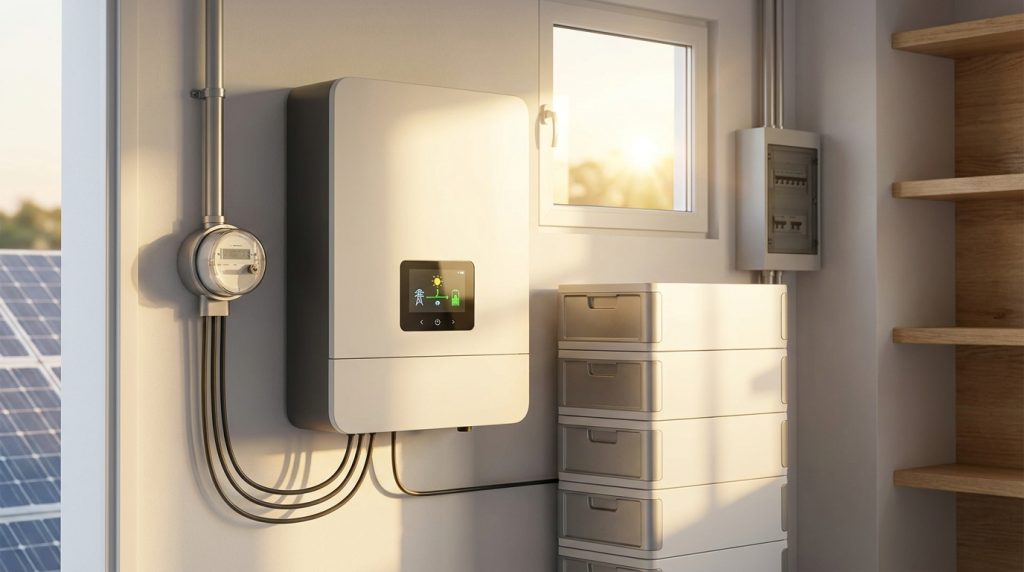
Hybrid inverters do two jobs at once: they convert your panel output to usable AC power and manage battery charge and discharge, all through one box instead of two. Picking the best hybrid solar inverter for 2026 comes down to matching continuous output, battery compatibility, and backup switching speed to what your roof and your panel actually need.
Why This Matters
More installers are specifying hybrid inverters by default now, not just for off-grid jobs. Utilities across the country have shifted more customers onto time-of-use rate structures over the past two years, and a hybrid inverter is what lets a battery actually respond to those rate windows instead of just sitting there as blackout insurance. Add in grid instability in wildfire and hurricane zones, and a straight grid-tie string inverter without battery management starts to look outdated for a lot of 2026 installs.
The catch is that "hybrid" isn't one spec sheet. A Sol-Ark hybrid inverter paired with an EG4 whole-home battery setup behaves very differently from an Enphase microinverter system pushing power into IQ Batteries, and neither behaves like a Tesla Powerwall 3's built-in inverter. Buyers who don't separate these categories end up oversizing or undersizing the wrong component.
How We Ranked
This list is built around published manufacturer specs for continuous AC output, battery stack compatibility, and transfer/backup switching, cross-referenced against what installers are actually specifying for 2026 residential and light-commercial jobs. Ranking weighs three factors: how many battery chemistries and brands the inverter actually pairs with, whether it supports whole-home backup versus partial-panel backup, and how it performs at both ends of the load spectrum — a small bungalow and a 4,000 sq ft home with a well pump. Distributor pricing tiers and lead times were not part of the ranking criteria since those change by region and by month; check current availability directly.
The Best Hybrid Solar Inverters for 2026
Sol-Ark 15K — the workhorse pick
The Sol-Ark 15K puts out 15,000 watts continuous with a 200% surge rating, which covers well pumps, HVAC startup, and shop equipment without a subpanel workaround. It's built for whole-home backup, not partial-panel backup, and pairs with multiple lithium battery brands rather than locking installers into one ecosystem. For 2026 jobs where the homeowner wants true whole-house coverage and the installer wants flexibility on battery sourcing, this is the inverter that gets specified first. It's a strong recommendation for off-grid and heavy-backup residential jobs where output headroom matters more than a slim form factor.
SolarEdge Energy Hub Inverter — the string-inverter hybrid
SolarEdge's Energy Hub line integrates DC-optimized string architecture with battery management in one unit, which matters on roofs with partial shading where per-panel optimization already makes sense. It supports backup power delivery through a dedicated backup interface rather than a full transfer switch replacement. The tradeoff is it's built around SolarEdge's own optimizer ecosystem, so it's the right call when the array is already spec'd with SolarEdge power optimizers, not a retrofit-anywhere choice. Recommended for shaded or complex-roof jobs already committed to SolarEdge optimizers.
Enphase IQ8 Microinverters with IQ Battery — the microinverter hybrid
Enphase's approach skips a central hybrid inverter entirely — IQ8 microinverters handle AC conversion at the panel level and the IQ Battery system manages storage, with grid-forming capability that lets panels keep producing during an outage even without the battery fully charged. That grid-forming behavior is unusual among hybrid architectures and worth knowing about if backup resilience during extended outages is the priority. It's a strong fit for residential roofs where module-level monitoring and shade tolerance matter as much as backup power. This is the pick for homeowners who want per-panel visibility and don't want a single point of failure at one big inverter box.
FranklinWH aGate — the whole-home backup specialist
The FranklinWH aGate hybrid inverter is built specifically around whole-home backup switching, and it's designed to work alongside the FranklinWH battery stack without a separate transfer switch installation. Combined with a FranklinWH whole-home backup setup, it's aimed squarely at homeowners who've had an outage bad enough that partial-panel backup isn't good enough anymore. The unit's strength is simplicity of install for full-home coverage rather than maximum surge output. Recommended when the job brief is literally "keep the whole house running," not just the fridge and a few outlets.
Sigenergy SigenStor Hybrid Inverter — the commercial-scale pick
Sigenergy's SigenStor line scales into commercial and multi-unit territory in a way most residential hybrid inverters don't, with modular battery stacking behind a single hybrid inverter head unit. That modularity is the reason it shows up on light-commercial and multi-family jobs in 2026 where a single Sol-Ark or FranklinWH unit would need to be paralleled multiple times. It's a reasonable fit for installers quoting commercial rooftop or small multi-tenant backup jobs, not a typical single-family retrofit. Worth specifying when the load profile is commercial-scale, not residential.
Tesla Powerwall 3 integrated inverter — the all-in-one pick
Tesla folded the hybrid inverter directly into the Powerwall 3 unit itself, rated at 11.5 kW continuous output with the inverter and battery management built into one enclosure. That means no separate hybrid inverter purchase decision at all — it's a single SKU with Tesla Powerwall 3 wholesale pricing covering both functions. The simplicity cuts installation steps but also means less flexibility to swap battery brands later without swapping the inverter too. Recommended for homeowners who want one integrated system and don't plan to mix battery brands down the road.
SMA Sunny Boy Storage — the legacy reliability pick
SMA has been building grid-tie inverters longer than most brands on this list, and the Sunny Boy Storage line carries that reliability track record into hybrid territory with broad third-party battery compatibility. It's not the newest architecture and doesn't lead on any single spec, but it's a dependable choice where installers already have SMA service experience and want to avoid a completely new learning curve. A sound pick for installers standardizing on a single, well-documented brand across a fleet of jobs rather than chasing the newest feature set.
Hybrid Inverter Comparison Table
| Inverter | Continuous Output | Battery Compatibility | Backup Type | Best For |
|---|---|---|---|---|
| Sol-Ark 15K | 15,000W | Multi-brand lithium | Whole-home | Heavy loads, off-grid |
| SolarEdge Energy Hub | Varies by model | SolarEdge ecosystem | Partial/dedicated | Shaded, optimized roofs |
| Enphase IQ8 + IQ Battery | Per-panel, grid-forming | Enphase IQ Battery | Whole-home | Module-level monitoring |
| FranklinWH aGate | Whole-home rated | FranklinWH stack | Whole-home | Full outage coverage |
| Sigenergy SigenStor | Modular, scalable | Sigenergy stack | Whole-home/commercial | Commercial, multi-unit |
| Tesla Powerwall 3 | 11.5 kW | Tesla only | Whole-home | Single-SKU simplicity |
| SMA Sunny Boy Storage | Varies by model | Broad third-party | Partial/dedicated | Fleet standardization |
Where to Buy a Hybrid Solar Inverter in 2026
- Confirm authorized distribution. Buying through an authorized distributor for the brand you're specifying protects warranty registration and gets you accurate documentation for permitting.
- Ask about lead times directly, not assumptions. Hybrid inverter availability shifts month to month depending on the manufacturer and model — treat any stock figure as subject to availability and confirm before quoting a customer a hard install date.
- Match wholesale tiers to licensing status. Licensed installers buying at volume should be on a distributor account with wholesale pricing tiers; residential DIY buyers can typically order the same hardware at standard pricing. Sun Supply PV ships batteries and inverters free, which matters more on heavier units like the Sol-Ark 15K or a Tesla Powerwall 3 than it does on smaller accessories.
FAQ
What is the best hybrid solar inverter for 2026?
There's no single best hybrid solar inverter for every job — the Sol-Ark 15K leads on raw output and whole-home backup flexibility, while the Tesla Powerwall 3 wins on single-SKU simplicity and Enphase IQ8 wins on module-level monitoring. Match the pick to load size and battery ecosystem, not to a single "best overall" label.
Is a hybrid inverter better than a standard grid-tie inverter?
A hybrid inverter is better when battery storage is part of the system now or planned within a few years, since it manages charge/discharge without a separate charge controller. A standard grid-tie inverter is simpler and often cheaper if there's no battery in the plan at all.
Can I add a battery to an existing grid-tie inverter?
Some grid-tie inverters support an AC-coupled battery addition, but that's a different architecture from a true hybrid inverter and usually costs more in equipment to retrofit. Confirm AC-coupling compatibility with the specific inverter model before assuming it works.
How much continuous output do I need from a hybrid inverter?
Size the inverter to your peak simultaneous load, not your average draw — a home with a well pump and central AC running together often needs 10-15 kW continuous, which is why the Sol-Ark 15K shows up often on well-pump backup jobs.
Do hybrid inverters work during a grid outage?
Yes, but only if they're configured for backup mode with a compatible battery charged and connected — a hybrid inverter without a battery behind it still shuts down in an outage just like a standard grid-tie unit, per standard anti-islanding requirements.
What's the difference between whole-home and partial-panel backup?
Whole-home backup powers every circuit in the house during an outage, while partial-panel backup only powers circuits wired to a dedicated backup subpanel. FranklinWH and Sol-Ark are built around whole-home backup; some SolarEdge configurations run partial-panel setups instead.
Does battery brand limit which hybrid inverter I can buy?
Sometimes — Tesla Powerwall 3 only works with Tesla's own inverter, while Sol-Ark and SMA units pair with multiple third-party battery brands. Confirm compatibility before locking in a battery purchase if you want inverter flexibility later.
Do hybrid inverters and batteries ship free?
Batteries and inverters ship free through Sun Supply PV, which is worth factoring into total landed cost on heavier units like a 15 kW hybrid inverter or a multi-battery stack.
One Last Thing
The spec that gets skipped most often in 2026 hybrid inverter shopping isn't output wattage — it's surge rating. A 15,000W continuous rating on the Sol-Ark 15K means little if the 200% surge capacity isn't enough to start a well pump motor cold, and that's the exact failure mode installers see on backup-only jobs where nobody sized for motor startup. Check the surge spec before the continuous spec, not after.
Related Guides
