 Inverters & Batteries ship FREE
 Ask about rewards for referring friends and family
 U.S. Based Support
 Want to Add a battery?
solar inverters
Best Solar Disconnect Switch for Utility Interconnection 2026
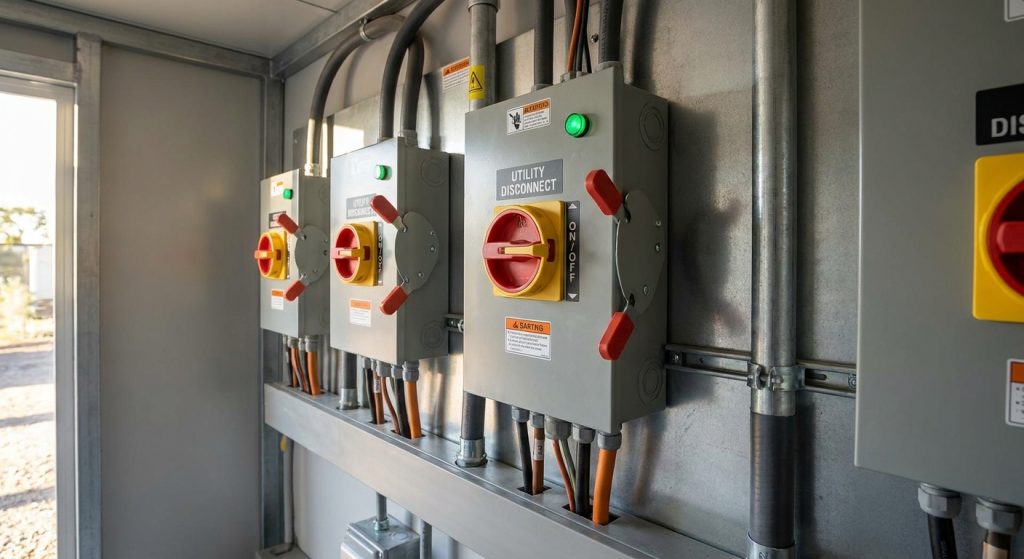
Utilities won't energize your interconnection agreement if the disconnect switch on the wall doesn't match their spec sheet, and that single rejection can push a residential install back two to three weeks. The best solar disconnect switch for utility interconnection is a UL98-listed, visible-blade unit rated to match your system's amperage and voltage, mounted where the utility can read it without opening a panel cover.
That's the short version. The rest of this guide breaks down which disconnect ratings satisfy most utility interconnection agreements in 2026, what installers actually stock on trucks, and where residential DIY buyers get tripped up ordering the wrong enclosure type.
Why this matters
Every grid-tied solar system needs a way for a utility lineman to physically kill power to the array before working on nearby lines. NEC 690.13 requires a readily accessible disconnecting means, and most utilities go further, requiring a visible-break switch mounted outdoors within 10 feet of the utility meter. Get the amp rating wrong, use a non-fused switch where the utility wants fused, or mount it where it's not "readily accessible" per their definition, and the interconnection inspection fails.
This isn't a spec you improvise. Utility interconnection handbooks published by regional operators in 2025 and 2026 spell out exact requirements — enclosure rating, lockable hasp, amperage that matches the inverter's output circuit, and sometimes a specific manufacturer list. Installers who stock the wrong disconnect switch eat a truck roll. Residential buyers doing a DIY interconnection eat a rejected application and a second trip to the utility office.
How this list was built
This ranking pulls from published utility interconnection standards, NEC 2023/2026 code cycle requirements for disconnecting means, and UL98 listing data for general-use AC disconnect switches. Amp ratings, enclosure classifications (NEMA 3R vs. 4X), and fused-vs-non-fused configurations are compared against what shows up most often on interconnection applications for residential and small commercial systems in the 5kW to 50kW range. Pricing and exact SKU availability shift by distributor, so specs and code fit are weighted heavier than sticker price.
The ranked list
1. 60A non-fused disconnect (NEMA 3R) — the interconnection default
The 60A non-fused, NEMA 3R-rated disconnect is what most utilities expect to see on a standard residential grid-tie install with a single string inverter under 10kW. Non-fused units are simpler to inspect because there's no fuse rating to cross-check against the inverter's output circuit, which is exactly why utility reviewers gravitate toward them. A visible-blade design lets a lineman confirm the array is de-energized from outside the enclosure, satisfying the "readily visible" language in most interconnection agreements.
This is the safe default for a homeowner installing a single hybrid inverter setup, and it pairs cleanly with the AC and DC disconnect switches for grid-tie systems that Sun Supply PV stocks for exactly this use case. It's the pick when you want zero surprises at inspection.
2. 100A fused disconnect (NEMA 3R) — the commercial-adjacent option
Step up to 100A fused when the array pushes past 10kW or feeds a service panel shared with other high-draw circuits. The fuse adds a layer of overcurrent protection some utilities specifically require on larger systems, and 100A gives headroom for future array expansion without a full disconnect swap.
The tradeoff is inspection complexity — fused switches need the fuse rating documented and matched to the inverter's max output current, which adds a line item to the interconnection paperwork. Worth the extra step on any system over 10kW; overkill on a small residential retrofit.
3. 30A compact disconnect — the small-system pick
For microinverter arrays or a single-string system under 4kW, a 30A disconnect keeps the install proportional and avoids paying for headroom nobody needs. Compact 30A units also fit tighter mounting spots on older homes where meter panel real estate is limited.
The catch: some utilities set a 60A minimum regardless of system size, purely to standardize their field crews' training on one switch type. Check the interconnection handbook before ordering — this is the single most common reason a correctly-sized disconnect still gets rejected.
4. NEMA 4X stainless disconnect — the coastal and corrosive-environment pick
Standard NEMA 3R enclosures handle rain but not salt air. In coastal counties or anywhere with heavy road-salt exposure, a NEMA 4X stainless enclosure resists corrosion that eats through galvanized steel in three to five years. Some utility interconnection agreements in coastal jurisdictions now specify 4X as a baseline requirement, not an upgrade.
This costs more upfront and it's the right call for any install within a few miles of saltwater, or anywhere road crews run de-icing salt six months a year. Inland residential installs rarely need it.
5. DC-rated disconnect for battery-coupled systems — the hybrid system requirement
Systems pairing solar with battery storage — a Tesla Powerwall, an EG4 bank, or a FranklinWH setup — often need a DC-rated disconnect in addition to the AC utility disconnect, since the battery introduces a second energized source that needs its own isolation point. DC disconnects rated to 600V handle most residential battery voltages with margin.
Skipping this on a hybrid system is the most common code violation on battery retrofits, because installers used to grid-tie-only work forget the battery adds a separate disconnecting requirement. Anyone reading how to wire an EG4 battery for off-grid backup power will recognize this as the same isolation logic applied on the AC side.
6. Disconnect with integrated rapid shutdown initiator — the rooftop-array pairing
On rooftop arrays subject to NEC 690.12 rapid shutdown rules, some jurisdictions want the utility disconnect and the rapid shutdown initiator wired to the same accessible location so first responders and utility crews have one point of control. This isn't a separate switch category so much as a wiring configuration, but it changes which disconnect model you order — you need one with the extra terminal block for the rapid shutdown signal wire.
Pair this with rapid shutdown devices for NEC-compliant solar installs rather than treating the two systems as unrelated line items — most AHJ inspectors check both at the same time.
Comparison table
| Disconnect type | Amp rating | Enclosure | Fused | Best for |
|---|---|---|---|---|
| Standard AC disconnect | 60A | NEMA 3R | No | Single-string residential under 10kW |
| Commercial-adjacent | 100A | NEMA 3R | Yes | Systems over 10kW, future expansion |
| Compact disconnect | 30A | NEMA 3R | No | Microinverter arrays under 4kW |
| Coastal-rated disconnect | 60A | NEMA 4X | No | Coastal/corrosive environments |
| DC-rated disconnect | 60A | NEMA 3R | No | Battery-coupled hybrid systems |
| Rapid-shutdown-paired | 60A | NEMA 3R | No | Rooftop arrays under 690.12 |
Where to buy
- Confirm UL98 listing before ordering anything — utilities won't approve an interconnection application citing an unlisted switch, no exceptions.
- Match the amp rating to your inverter's continuous output current, not the panel's total wattage — undersizing here is the top reason for a failed final inspection in 2026 interconnection data.
- Order the disconnect alongside your inverter when possible. Inverters ship free through Sun Supply PV, so bundling the order keeps freight costs down even when the disconnect itself ships separately.
FAQ
What's the best solar disconnect switch for utility interconnection?
A UL98-listed, visible-blade AC disconnect rated to match the inverter's output current — typically 60A non-fused for residential single-string systems in 2026 — clears most utility interconnection agreements without added review.
Is a fused disconnect better than non-fused for solar?
Non-fused is simpler for standard residential systems under 10kW because there's no fuse rating to cross-check at inspection. Fused disconnects add overcurrent protection utilities sometimes require above 10kW.
How much does a solar disconnect switch cost?
Pricing varies by amp rating, enclosure material, and distributor — NEMA 4X stainless units run noticeably higher than standard NEMA 3R steel enclosures. Contact a distributor for current pricing rather than relying on list prices that shift throughout 2026.
Do battery systems need a separate disconnect from the solar array?
Yes. Battery-coupled systems typically require a DC-rated disconnect in addition to the AC utility disconnect, since the battery is a second energized source needing its own isolation point.
Where does the utility disconnect need to be mounted?
Most utility interconnection agreements require mounting within 10 feet of the utility meter, in a location accessible without keys or tools, per NEC 690.13 and standard utility handbook language.
What amp rating disconnect do I need for a 10kW solar system?
A 10kW system typically pairs with a 60A disconnect, though some jurisdictions push to 100A once the array approaches or exceeds that threshold — check the inverter's max output current first.
Can I use the same disconnect for rapid shutdown compliance?
Not directly — rapid shutdown initiators and utility disconnects serve different code sections, but they're often wired to the same accessible enclosure so inspectors can verify both at once.
Does the disconnect switch need a lockable hasp?
Most utilities require a lockable disconnecting means so their crews can secure it in the open position during maintenance — confirm this with the local interconnection handbook before ordering.
One last thing
The detail that trips up more DIY interconnections than any spec sheet: utilities frequently reject disconnects mounted inside a garage or behind a locked gate, even when the amp rating and UL listing are perfect, because "readily accessible" in their handbook means their crew can reach it without contacting the homeowner. Mount it outdoors, near the meter, before you schedule the inspection — not after.
Related guides
