 Inverters & Batteries ship FREE
 Ask about rewards for referring friends and family
 U.S. Based Support
 Want to Add a battery?
solar inverters
Best Solar Combiner Box Commercial (2026 Buying Guide)
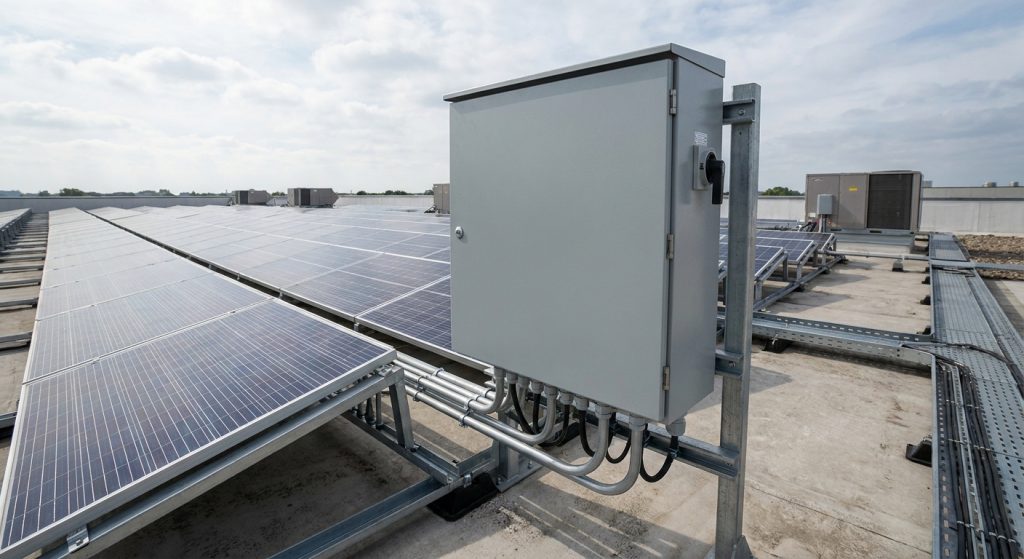
Commercial rooftop arrays over 50 kW almost always need a combiner box, and picking the wrong amp rating or enclosure grade is the fastest way to fail a plan review or trip a fuse mid-summer. This guide ranks the combiner box types that show up most often on commercial rooftop plan sets in 2026, tells you which spec actually matters for a rooftop versus a ground mount, and flags where an AC combiner replaces a DC combiner entirely.
If your commercial array uses microinverters instead of a central or string inverter, you likely don't need a traditional DC combiner box at all — you need an AC combiner panel downstream of the microinverters instead. That single distinction saves installers thousands in miswired BOS on string-inverter jobs that got quoted like microinverter jobs, and it's the first thing to confirm before you spec anything else on this list.
Why this matters
A combiner box isn't a commodity part you grab off a shelf. NEC 2023 Article 690.9 requires overcurrent protection sized to each source circuit, and on a commercial rooftop with 20+ strings, that means matching fuse count, amp rating, and enclosure type to the actual string layout — not the nearest box in stock. Get the enclosure rating wrong and a rooftop unit fails inspection for water ingress. Get the fuse rating wrong and you're replacing blown fuses every storm season.
Commercial rooftop arrays also carry rapid shutdown requirements under NEC 690.12 that residential jobs sometimes skip past. A combiner box sited near the roof penetration point needs to support that shutdown architecture, not fight it. That's before you even get to whether the array is DC-optimized, string-inverter based, or microinverter based — each path changes what a combiner box even means for the job.
How this list is ranked
Each entry below is ranked on amp rating range, fuse configuration flexibility, enclosure rating (NEMA 3R vs 4X), and how commonly it shows up on commercial rooftop plan sets filed in 2026. These are widely used manufacturer lines in commercial solar BOS — not every distributor stocks every model, and lead times vary by manufacturer, so confirm current availability before you spec a job around one.
The ranked list
1. MidNite Solar MNPV Series — the small-to-mid commercial workhorse
MidNite Solar's MNPV6 and MNPV12 combiner boxes handle 6 or 12 source circuits respectively, rated up to 600VDC and commonly speced with 15A or 20A fuses per string. The enclosure comes in NEMA 3R as standard, which is fine for a covered rooftop penetration but marginal for an open, weather-exposed commercial roof in a coastal or high-humidity climate.
These show up constantly on 50-150 kW rooftop jobs because the fuse holders are field-serviceable without special tools — a real advantage when a maintenance crew is doing a five-minute fuse swap instead of a truck roll. Solid pick for mid-size commercial rooftops where budget and serviceability matter more than a fully sealed enclosure.
2. Bentek BAC-M Series — the monitoring upgrade
Bentek's combiner line adds string-level current monitoring as a standard feature rather than an add-on, which matters on any commercial array over 100 kW where O&M contracts require string-by-string performance data. Amp ratings scale to 1000A on the busbar side with up to 16 fused string inputs per box.
The monitoring data feeds most major commercial monitoring platforms, which cuts troubleshooting time on a 200-panel rooftop from a physical string-by-string walk to a dashboard check. Worth the premium on any job where the owner or asset manager is contractually requiring production data down to the string.
3. Eaton Combiner Panels — the utility-grade standard
Eaton's commercial combiner panels are built for the high end of rooftop and carport-scale work, with busbar ratings up to 1200A and enclosures rated NEMA 4X as standard — the rating you actually want for an unshaded, fully exposed commercial rooftop that takes direct rain and UV year-round. Fuse configurations go up to 24 strings per unit on the larger models.
These cost more per unit than a MidNite or Bentek box, but on a 500 kW-plus rooftop portfolio, fewer combiner boxes with more inputs each means fewer rooftop penetrations and less conduit run. The right call on large-format commercial roofs where minimizing rooftop hardware count matters as much as the electrical spec.
4. Shoals Technologies Combiner/Recombiner Systems — the utility-scale crossover
Shoals built its combiner and recombiner boxes for utility-scale ground mount first, and the same hardware crosses over cleanly onto very large commercial rooftops — think big-box retail or distribution center roofs pushing 1 MW-plus. These units handle dozens of strings per recombiner stage and are engineered around pre-terminated wire harnesses that cut field labor significantly on large jobs.
The tradeoff is that Shoals hardware is overbuilt and overpriced for anything under a few hundred kW — it's not the box for a 75 kW rooftop retrofit. Only makes sense once the array crosses into utility-adjacent scale, roughly 750 kW and up.
5. Solectria (Yaskawa) String Combiners — the legacy commercial standard
Solectria combiner boxes, now under the Yaskawa-Solectria brand, remain common on commercial jobs installed since the mid-2010s that are now getting O&M work, repowers, or fuse replacements in 2026. Amp ratings typically run 400-800A with NEMA 3R or 4X enclosure options depending on model year.
If you're bidding a repower or service contract on an existing commercial rooftop, matching the existing Solectria combiner spec is usually cheaper than a full swap to a different manufacturer's box. The right choice for service and repower work on existing installs, not for new-build spec.
6. Generic NEMA 4X Fused Combiner Boxes — the budget fallback
Unbranded or house-brand NEMA 4X combiner boxes show up on cost-sensitive commercial jobs where the electrical engineer specs the fuse rating and enclosure class rather than a named manufacturer. These typically run 12-16 fused inputs at 600A busbar rating and meet code, but they carry no monitoring and inconsistent long-term parts availability.
Fine for a straightforward rooftop job with a tight budget and no monitoring requirement in the contract. Acceptable for code compliance on a basic job, but not the pick if the owner wants any production visibility beyond the inverter level.
Comparison table
| Combiner Box | Max String Inputs | Busbar Rating | Enclosure | Monitoring | Best Fit |
|---|---|---|---|---|---|
| MidNite Solar MNPV | 12 | 600A | NEMA 3R | No | Mid-size rooftop, covered penetration |
| Bentek BAC-M | 16 | 1000A | NEMA 3R/4X | Yes, string-level | 100 kW+ with O&M monitoring requirement |
| Eaton Combiner Panel | 24 | 1200A | NEMA 4X | Optional | Large exposed commercial rooftop |
| Shoals Combiner/Recombiner | 40+ | Varies by stage | NEMA 3R/4X | Yes | 750 kW+ utility-adjacent scale |
| Solectria (Yaskawa) | 16 | 400-800A | NEMA 3R/4X | Model-dependent | Repower/service on existing installs |
| Generic NEMA 4X | 16 | 600A | NEMA 4X | No | Budget new-build, code-minimum |
Where to source it
- Match the combiner box to the string count and fuse rating from the stamped electrical plan before ordering — not the other way around. If a structural or electrical stamp hasn't been pulled yet, that step comes first; see the guide on getting a structural engineer stamp for a solar permit before finalizing BOS orders.
- Confirm enclosure rating against actual roof exposure, not the building's general climate zone. A rooftop unit tucked under a parapet can run NEMA 3R; a fully exposed membrane roof needs 4X.
- Lead times on combiner hardware vary by manufacturer and season — treat any quoted availability as an estimate and confirm directly before committing an install date to a customer.
Sun Supply PV ships batteries and inverters free on every order, which matters on a commercial job where the inverter is often the single heaviest line item on the BOS invoice. For a hybrid string-inverter setup feeding into a combiner box upstream, the hybrid grid-tie and battery inverter lineup is the natural companion purchase to the combiner spec above.
FAQ
What's the best solar combiner box for a commercial rooftop in 2026?
There's no single best box — it depends on string count and exposure. Bentek's BAC-M line wins on jobs needing string-level monitoring, Eaton's combiner panels win on large exposed rooftops needing NEMA 4X, and MidNite Solar's MNPV series wins on mid-size covered installs where budget matters more than a sealed enclosure.
Do microinverter arrays need a DC combiner box?
No. Microinverter systems combine on the AC side, not the DC side, so a traditional DC combiner box is unnecessary — you need an AC combiner panel instead.
What amp rating does a commercial combiner box need?
Amp rating depends on total string count and inverter input, but commercial rooftop combiner boxes commonly run 400A to 1200A on the busbar side, with 15A to 20A fuses per individual string circuit.
Is NEMA 4X required for rooftop combiner boxes?
NEMA 4X is required whenever the box sits fully exposed to rain and UV without roof cover; NEMA 3R is acceptable under a parapet or covered penetration point, but confirm against your local AHJ's interpretation.
How many strings can one combiner box handle?
Most commercial combiner boxes handle 6 to 24 fused string inputs per unit, with utility-scale recombiner systems from manufacturers like Shoals Technologies handling far more across staged units.
Does a combiner box need string-level monitoring?
Only if the owner or O&M contract requires production data at the string level — Bentek's line builds this in standard, while MidNite Solar and generic NEMA 4X boxes typically don't include it.
Can I reuse an existing combiner box on a commercial repower?
Often yes, if the fuse rating and string count still match the new module specs — Solectria and Yaskawa-branded boxes installed in the mid-2010s are common on repower jobs for exactly this reason.
What NEC code governs combiner box overcurrent protection?
NEC 2023 Article 690.9 governs source circuit overcurrent protection, and Article 690.12 governs rapid shutdown requirements that affect where the combiner box sits relative to the roof penetration.
One last thing
The combiner box spec that trips up the most commercial bids in 2026 isn't the amp rating — it's forgetting that a microinverter-based rooftop array doesn't need a DC combiner at all. Crews that quote a DC combiner box into a microinverter job end up eating that cost or scrambling to swap the BOS list days before install. Confirm the inverter architecture first, then spec the combiner — never the reverse.
Related guides
