 Inverters & Batteries ship FREE
 Ask about rewards for referring friends and family
 U.S. Based Support
 Want to Add a battery?
solar inverters
Best Sigenergy Battery Setup for Commercial Buildings 2026
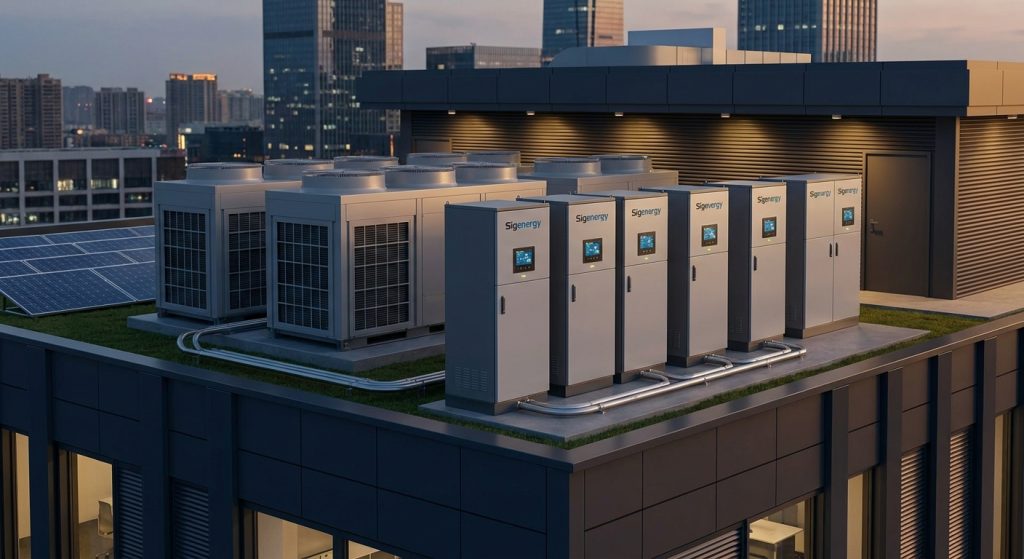
Sigenergy's battery lineup has moved fast into the commercial segment, and the question installers keep asking is which configuration actually fits a 50kW rooftop array versus a 500kW industrial site. This guide ranks five Sigenergy battery setups for commercial buildings by use case, backup priority, and building scale. For most commercial rooftops under 250kW, a stacked modular Sigenergy bank is the strongest fit — it scales without a full electrical redesign and keeps backup flexible as load grows. Single all-in-one units suit small commercial buildings under 50kW, and large industrial sites over 500kW should look at a multi-unit parallel setup, provided the interconnection timeline supports staged commissioning. Sigenergy battery commercial installs ship free through Sun Supply PV in 2026, which changes the math on freight-heavy commercial pallets.
Why this matters
Commercial battery sizing isn't the same problem as residential backup. A homeowner needs 10-15 hours of critical load coverage; a commercial building needs demand charge management, code-compliant fire separation, and a system that doesn't force a full re-permit every time the tenant adds equipment. Sigenergy built its commercial architecture around modularity specifically to avoid that trap, and 2026 utility rate structures in most states now reward peak-shaving hard enough that the storage math works on its own.
Matching the array to the commercial solar projects size class first is what determines which Sigenergy configuration actually fits — get that wrong and you're either undersized on backup or paying for capacity the building will never draw.
How we ranked
This ranking weighs four factors pulled from manufacturer spec sheets and standard NEC 2023/2026 commercial interconnection practice: scalability without electrical re-work, backup depth for critical loads, install complexity relative to crew size, and fit against typical commercial roof or ground-mount footprints. This assumes licensed-installer execution and standard utility interconnection timelines — not expedited permitting. Availability language stays general on purpose: commercial battery allocation shifts month to month, so confirm current stock and lead times directly rather than relying on a number that's already stale by the time you read it.
The ranked list
1. Single all-in-one unit — the small-building starter
One integrated Sigenergy unit covering inverter, battery, and energy management in a single cabinet. This fits buildings under roughly 50kW of solar, think single-tenant retail, small offices, or standalone restaurants. Install crews typically complete commissioning in a single day when the electrical service is already sized correctly. A strong fit for small commercial buildings that want backup without a multi-week electrical upgrade.
2. Stacked modular bank — the scalable mid-size pick
Multiple Sigenergy units wired in parallel on a shared bus, expandable in the field as the building's load grows. This is the setup that fits the 50-250kW range most commercial rooftops fall into, and it's the one installers reach for when the client says "we might add a second unit next year." Expansion doesn't require a new main panel in most jurisdictions, just an added string — the default recommendation for mid-size commercial in 2026.
3. Multi-unit parallel array — the industrial-scale build
This is a coordinated bank of Sigenergy units tied into a shared energy management layer, sized for buildings over 500kW or campuses with multiple meters. Staged commissioning matters here: bringing units online in phases avoids overloading a single interconnection application and keeps the utility review process moving instead of stalling on one oversized request. Crew coordination and commissioning time scale with unit count, so budget more field days than the mid-size build. Worth considering only if the interconnection timeline supports phased energization — otherwise the project stalls waiting on utility sign-off for the full capacity at once.
4. Critical-load-only configuration — the targeted backup play
Instead of backing up the whole building, this setup ties Sigenergy storage to a dedicated critical-load subpanel: refrigeration, servers, security systems, life-safety circuits. It's a smaller battery footprint than a whole-building setup and a faster commissioning path since it touches less of the existing electrical infrastructure. This is the right call for a building where the tenant cares about specific equipment staying online, not the whole facility riding through an outage — worth considering over a full-building setup when budget or panel capacity is the constraint, not backup ambition.
5. Retrofit pairing with existing string inverters — the addition play
Buildings that already have a string-inverter solar array installed can add Sigenergy storage as a retrofit, provided the existing inverter and the battery's energy management system are compatible for AC-coupling. This avoids ripping out functioning solar equipment just to add storage. It's more of an engineering review project than a straightforward install, and the commercial rooftop racking underneath matters here too — a commercial flat roof racking system that's already ballasted correctly for the original array needs re-checked load calcs once battery cabinets add rooftop or ground-level weight. Worth considering for buildings with working solar that just need storage added; best avoided if the existing inverter fleet isn't on the compatibility list, since forcing it adds commissioning risk without a clean fallback.
Comparison table
| Setup | Building Size | Commissioning Time | Backup Scope | Best Fit |
|---|---|---|---|---|
| Single all-in-one | Under 50kW | 1 day | Whole building | Small retail/office |
| Stacked modular bank | 50-250kW | 2-4 days | Whole building | Mid-size commercial |
| Multi-unit parallel array | 500kW+ | Staged, weeks | Whole building/campus | Industrial, phased interconnection |
| Critical-load-only | Any size | 1-2 days | Critical circuits only | Budget-constrained targeted backup |
| Retrofit AC-coupled add | Any (existing solar) | Engineering review + install | Depends on original design | Compatible existing inverter fleets |
Where to buy
Source Sigenergy battery commercial equipment through an authorized distributor, not a reseller with no manufacturer relationship — warranty registration and firmware support both depend on a clean chain of custody back to Sigenergy. Confirm the roof or mounting hardware is rated for the added battery cabinet weight before ordering; a commercial rooftop microinverters array paired with the wrong racking spec is a common reason commercial storage retrofits get flagged during inspection. Batteries and inverters ship free through Sun Supply PV in 2026, which matters more on commercial orders than residential ones given the pallet freight cost on multi-unit banks — check current lead times directly since commercial battery allocation moves month to month.
FAQ
What's the best Sigenergy battery setup for a commercial building? For most buildings between 50kW and 250kW of solar, a stacked modular bank is the best fit because it scales without a full electrical redesign. Smaller buildings under 50kW do better with a single all-in-one unit.
Is Sigenergy better than a single large battery cabinet for commercial use? Sigenergy's modular architecture generally wins over a single oversized cabinet because it lets a building add capacity in stages instead of over-provisioning upfront. The tradeoff is more field-installed units versus one larger box.
How much does a Sigenergy commercial battery setup cost? Cost varies by unit count, building size, and current distributor pricing, so check current wholesale pricing directly rather than relying on a fixed figure. Freight is not a factor on the battery itself since Sigenergy batteries ship free.
Can Sigenergy batteries pair with an existing string inverter? Yes, provided the existing inverter is on Sigenergy's compatibility list for AC-coupling. Confirm compatibility before ordering — pairing with an unsupported inverter adds commissioning risk.
How long does commercial Sigenergy installation take in 2026? A single all-in-one unit typically commissions in a day; a multi-unit parallel array for a 500kW+ site can take weeks due to staged utility interconnection. Timeline depends more on utility review than on the physical install.
Do commercial Sigenergy setups need a dedicated critical-load subpanel? Not always — whole-building setups back up the entire electrical service, while a critical-load-only configuration ties storage to a dedicated subpanel for targeted circuits like refrigeration or servers. Choose based on whether the building needs full backup or targeted backup.
What roof or mounting system works with Sigenergy commercial installs? The battery setup itself is roof-agnostic, but the solar array feeding it needs racking rated for the building type — flat roof, ground mount, or carport all carry different load and ballast requirements. Confirm the racking spec before adding battery cabinet weight to the same structure.
Is a multi-unit parallel Sigenergy array worth it for a mid-size building? Usually not — that scale of setup is built for 500kW+ sites, and a mid-size building under 250kW gets better commissioning speed and cost efficiency from a stacked modular bank instead.
One last thing
The detail installers miss most often on commercial Sigenergy jobs isn't the battery spec sheet — it's the interconnection application sequencing. Filing for the full system capacity in one shot when a multi-unit parallel array is involved is a common cause of stalled commercial storage projects in 2026; staging the application by unit bank keeps the utility review moving instead of sitting in a queue behind a request the interconnection team has to size-check line by line.
Related guides
- Solar carport racking for commercial parking structure installs
- Sun Supply PV for current Sigenergy and battery inventory
