 Inverters & Batteries ship FREE
 Ask about rewards for referring friends and family
 U.S. Based Support
 Want to Add a battery?
solar inverters
Best Off-Grid Solar Kit for Tiny Homes in 2026
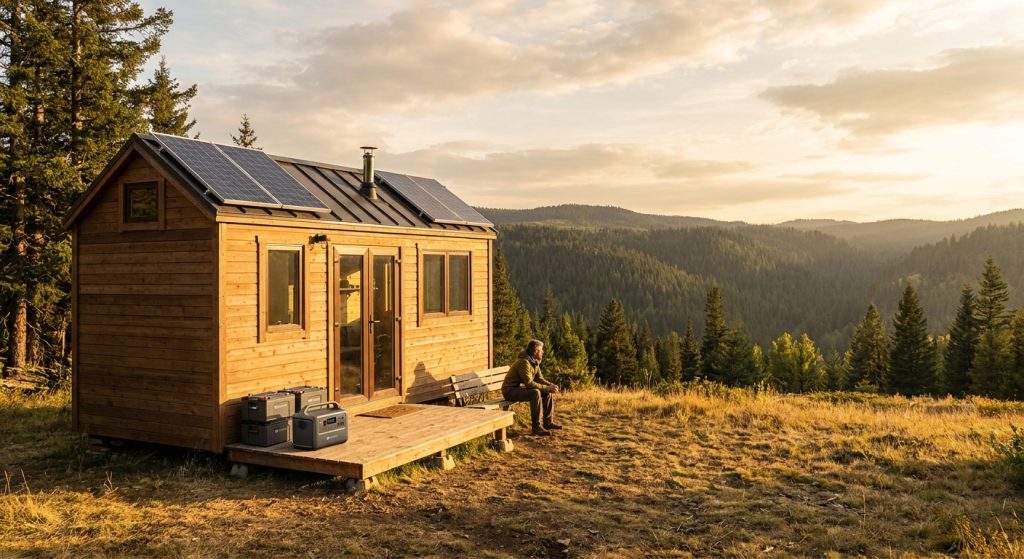
Tiny homes off the grid need a solar system sized for square footage under 400 feet, not a suburban roof — and most "off-grid kit" listings online just repackage grid-tie components that don't handle standalone battery cycling. The best off-grid solar kit for a tiny home in 2026 pairs a lithium battery bank rated for daily deep cycling, an MPPT charge controller sized to the array, and racking that survives ground mounts or trailer vibration — not whatever bundle ships cheapest.
Why this matters
A tiny home pulls maybe 3-8 kWh a day depending on whether you're running electric cooking or just lights, a fridge, and a laptop charger. That's a fraction of a standard house load, but off-grid systems fail for a different reason than undersizing: mismatched components. A 400W panel array feeding an undersized charge controller throttles output. A battery bank without proper wiring loses capacity to voltage sag. Get the pairing right in 2026 and a tiny home can run entirely on stored solar through three cloudy days in a row; get it wrong and you're running a generator every week regardless of panel count.
Licensed installers spec these systems for wind load, code compliance, and battery cycle life. Residential buyers doing it themselves need the same math without the jargon. Either way, the kit has to be judged on capacity numbers and compatibility, not marketing copy.
How these kits were ranked
Ranking here is based on component specs relevant to off-grid, standalone tiny home use — battery depth-of-discharge and cycle rating, charge controller amperage versus typical tiny-home array sizes (1.5kW-4kW), racking type (ground mount, pole mount, or roof), and NEC compliance features like rapid shutdown. Systems that only make sense at grid-tie residential scale (10kW+) were excluded. Pricing isn't factored in beyond noting that battery and inverter components ship free from Sun Supply PV as of 2026 — the ranking is about fit, not cost comparison.
The ranked list
1. EG4 lithium battery bank — the backbone pick
EG4 batteries built for off-grid duty typically run 48V nominal with deep cycle ratings well above lead-acid alternatives, which matters when a tiny home draws down overnight with no grid backstop. The EG4 battery for off-grid solar systems is built specifically for standalone use, not grid-tie backup, which is the distinction that trips up buyers shopping generic "solar battery" listings. Batteries ship free, which matters more here than on a $400 accessory. Best fit for anyone building a true standalone system rather than a grid-tie-with-backup setup — skip it if you're still connected to utility power and just want outage coverage.
2. MPPT charge controller sized to your array
A charge controller mismatched to panel wattage is the single most common off-grid failure point. The MPPT charge controllers for off-grid battery banks lineup covers the amperage ranges tiny-home arrays actually need — most tiny home systems land in the 30-60A controller range depending on panel count. Undersizing here clips your charge rate on the sunniest days of the year, which defeats the point of oversizing panels. Worth prioritizing before you even pick panels — the controller sets your real-world charging ceiling.
3. Ground-mount racking for trailer and off-grid lots
Many tiny homes sit on leased land, trailers, or lots without roof space rated for panel load. The solar panel racking systems for ground-mount installations option sidesteps roof penetration entirely and lets you angle panels for winter sun optimally, which a flush roof mount can't do. Ground mounts also make panel cleaning and future expansion easier. Best for lot-based tiny homes without adequate roof orientation — skip if your roof already faces south with minimal shading.
4. FranklinWH generator module for extended cloudy stretches
Even a well-sized off-grid system runs into multi-day low-sun stretches, especially in northern latitudes through winter 2026. The FranklinWH generator module for extended off-grid power backup integrates a generator into the same control logic as your battery bank, so it kicks in automatically rather than forcing a manual transfer switch flip at 2 a.m. Worth adding if you're in a region with more than a handful of consecutive overcast days per season — skip it if you're in the Southwest with consistent year-round sun.
5. Panel selection: REC and Q.Cells for compact arrays
Tiny home roofs and small ground-mount footprints reward higher wattage-per-panel efficiency, since you're working with fewer total panel slots. REC and Q.Cells panels, both available through Sun Supply PV, run in the 400W-440W range per panel depending on model — meaning a 6-panel array can clear 2.4kW-2.6kW without needing a tenth panel to hit your target. Best for space-constrained roofs or small ground arrays where every panel slot counts.
6. Wiring reference before you touch a battery terminal
Battery wiring mistakes on a lithium bank aren't a minor annoyance — wrong torque or wrong busbar sequencing damages cells or trips protection circuits permanently. The how to wire an EG4 battery for off-grid backup power guide walks through terminal sequencing and grounding before you energize anything. Read this before ordering, not after the battery arrives.
7. Rapid shutdown and disconnects for code compliance
Off-grid doesn't mean code-exempt — most jurisdictions in 2026 still require rapid shutdown devices and proper AC/DC disconnects on any array with exposed conductors, tiny home or not. Skipping this step is the fastest way to fail an inspection or void an insurance claim after a fire. Non-negotiable if you plan to get the system permitted, and worth doing even if you don't, for safety alone.
Comparison at a glance
| Component | Typical size for tiny home | Key spec | Ships free | Best for |
|---|---|---|---|---|
| EG4 battery bank | 10-15kWh | 48V, deep-cycle rated | Yes | Standalone daily-cycle use |
| MPPT charge controller | 30-60A | Matched to panel wattage | Yes | Any off-grid array |
| Ground-mount racking | 4-8 panel array | Adjustable tilt | No | Lot-based, trailer, or shaded roofs |
| FranklinWH generator module | Add-on | Auto-start integration | No | Low-sun climates |
| REC/Q.Cells panels | 400-440W each | High wattage-per-slot | No | Small roof or footprint constraints |
Where to buy
- Buy the battery, charge controller, and panels as a matched set rather than mixing brands on voltage-critical components — mismatched nominal voltages between battery and controller cause charging errors that aren't always obvious until months in.
- Confirm rapid shutdown and disconnect requirements with your local AHJ before finalizing a parts list — off-grid systems still fall under NEC in most counties as of 2026.
- Batteries and inverters ship free through Sun Supply PV; racking and mounting hardware freight varies, so check current lead times before locking a install date, since availability is subject to change.
FAQ
What's the best off-grid solar kit for a tiny home in 2026?
A matched EG4 lithium battery bank with an MPPT charge controller sized to a 2-4kW panel array, mounted on ground-mount racking if roof space is limited. The battery-controller pairing matters more than panel brand for reliability.
How many kWh does a tiny home need per day off-grid?
Most tiny homes use 3-8 kWh daily depending on appliances — electric cooking and AC push that number toward the higher end, while lights-and-laptop setups stay closer to 3 kWh.
Is ground mount better than roof mount for a tiny home?
Ground mount wins when the roof is small, shaded, or poorly oriented, and it allows tilt adjustment for seasonal sun angle that a flush roof mount can't match.
Do off-grid tiny home systems need rapid shutdown devices?
Most jurisdictions require them regardless of grid connection status, especially if the system will ever be inspected or insured — treat it as standard equipment, not optional.
Can I run a tiny home entirely on solar without a generator backup?
Yes in high-sun climates with an adequately sized battery bank, but a generator module like FranklinWH's covers multi-day low-sun stretches without forcing manual intervention.
What size charge controller does a 3kW tiny home array need?
Most 3kW arrays land in the 40-60A MPPT range depending on panel voltage and battery bank voltage — undersizing the controller clips charging on peak sun days.
Does battery brand matter more than panel brand for off-grid reliability?
Yes — panels rarely fail outright, but battery-controller mismatches cause the majority of off-grid charging complaints, so get that pairing right first.
One last thing
The detail most tiny home buyers miss in 2026 isn't panel wattage — it's winter tilt angle. A ground-mount rack adjusted for a steeper winter angle can meaningfully change charging performance during the shortest-daylight months, when battery reserves matter most. Roof-mounted arrays fixed at a shallow pitch lose that flexibility entirely, which is one more argument for ground mount on any tiny home without ideal roof orientation.
Related guides
