 Inverters & Batteries ship FREE
 Ask about rewards for referring friends and family
 U.S. Based Support
 Want to Add a battery?
solar inverters
Best MPPT Charge Controller for RV & Marine Solar 2026
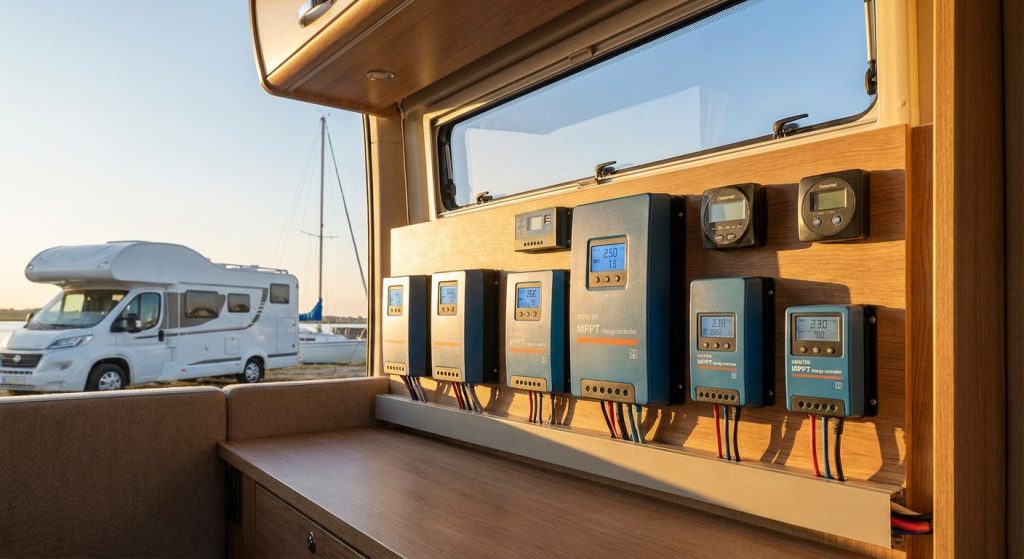
Picking the wrong charge controller on an RV or boat means shorter battery life, slower charging on cloudy days, and panels that never hit their rated output. The right MPPT charge controller for RV and marine solar setups converts panel voltage to battery voltage with 97-99% efficiency instead of the 75-80% you get from an older PWM controller, and that difference shows up as real amp-hours in your battery bank by the end of the day.
This guide ranks the MPPT controllers that show up most often in RV and marine builds in 2026, based on amp rating, voltage window, weatherproofing, and how they behave with lithium battery banks like EG4. Victron Energy's SmartSolar line, Renogy's Rover, Morningstar's TriStar MPPT, and Genasun's GV-Boost all solve slightly different problems — undersized roof space, marine-grade sealing, high-voltage strings, or oversized panel-to-controller ratios. None of them are interchangeable once you know your actual load.
Why this matters for RV and marine setups
RV roofs and boat decks are nothing like a residential rooftop. You're working with 100-400 watts of usable panel space, partial shading from AC units, antennas, or rigging, and a battery bank that has to survive vibration, salt air, and temperature swings a fixed installation never sees. A controller sized for a house roof array will either underperform in this environment or waste money on amp capacity you'll never use.
The other factor unique to mobile setups: most RV and marine installs pair a controller with a wholesale solar panel package built for RV and marine installers rather than a rooftop residential kit, so the voltage and wattage math is different from the start. Get the controller-to-panel ratio wrong and you either clip your output on a sunny afternoon or leave amps on the table every single day.
How this list was built
Rankings below weigh four factors that matter specifically for mobile installs: rated charging amps against typical RV/marine panel wattage, input voltage window (critical for panels wired in series on a boat with limited deck space), IP-rated weatherproofing or conformal coating for marine use, and Bluetooth/app monitoring since most owners aren't popping open a panel to check a screen. Efficiency figures and voltage windows below reflect manufacturer-published specs as of 2026, not lab retesting.
1. Victron Energy SmartSolar MPPT 100/30 — the compact all-rounder
Rated at 30 amps with a 100V input window, this unit handles a 400W panel array on 12V systems without breaking a sweat. It ships with Bluetooth built in, so pairing to the VictronConnect app takes under a minute and gives you real-time charging current without wiring an external display. The aluminum housing handles the temperature swings of a black RV roof in July better than plastic-shelled competitors.
This is the one to reach for on a mid-size travel trailer or a 24-30 foot boat where deck space caps you around 300-400 watts of panel. Anyone running more than 400W should size up to the 150/35 or 150/45 variants in the same line rather than push this unit past its rated input.
2. Renogy Rover 40A — the budget-conscious workhorse
The Rover line has been the default recommendation for DIY RV builds for years, and the 40A version handles up to 520W of panel on a 12V bank. It lacks the native Bluetooth of the Victron unit — you'll need the optional BT-2 module for app monitoring — but the LCD screen on the unit itself gives you voltage, current, and daily amp-hour totals without any add-on.
Installers quoting jobs for budget-sensitive RV owners lean on this controller because it hits the 40A mark at a price point that keeps the whole system affordable. Skip it if you're running a 48V battery bank — the Rover tops out at 12V/24V configurations.
3. Morningstar TriStar MPPT 60 — the high-voltage marine pick
Where the TriStar earns its spot is input voltage headroom: 150V max, which lets you wire panels in series on a boat where deck space forces long, thin panel strings rather than a wide parallel array. The 60A rating covers up to 800W on a 12V system without derating in warm engine-room temperatures.
Morningstar's conformal-coated circuit boards are built for the humidity and salt exposure marine installs deal with daily, which is the reason this shows up more often on boats than on RVs. Consider it the marine-specific choice; residential-style RV installs rarely need the extra voltage headroom.
4. Genasun GV-Boost — the small-panel specialist
Genasun built its reputation on single or dual-panel setups under 200W — think a single flexible panel bolted to a kayak or a small pop-up camper. The GV-Boost is rated for as low as 5A, and its MPPT algorithm is tuned specifically for small arrays where a standard controller's tracking overhead eats into the gains.
It's not a fit for a full RV roof array, but for anyone running a single 100-175W panel to trickle-charge a marine battery or maintain a stored boat's bank over winter, this is the controller built for exactly that job.
5. Midnite Solar Kid — the rugged 30A option
The Kid controller is built in the U.S. with a rugged aluminum case and a reputation for surviving vibration and rough handling better than most competitors in its amp class. At 30A and a 150V input window, it splits the difference between the Victron's compact form factor and the TriStar's voltage headroom.
It costs more than the Renogy Rover for the same amp rating, which is the tradeoff for the build quality. Anyone installing on a truck camper that sees washboard roads and off-pavement use should weigh that durability against the price gap.
Comparison table
| Controller | Max Amps | Voltage Window | Bluetooth/App | Best fit |
|---|---|---|---|---|
| Victron SmartSolar 100/30 | 30A | 100V | Built-in | Mid-size RV/boat, up to 400W |
| Renogy Rover 40A | 40A | 100V | Optional module | Budget RV builds, up to 520W |
| Morningstar TriStar MPPT 60 | 60A | 150V | Optional | Marine, long series strings |
| Genasun GV-Boost | 5-13A | 75V | None | Single-panel, under 200W |
| Midnite Solar Kid | 30A | 150V | None | Rugged off-road RV use |
What to avoid on RV and marine installs
A few controllers and setups look like a good fit but cause problems once installed:
- PWM controllers marketed as "solar charge controllers" without the MPPT designation. They're cheaper up front but lose 15-20% of available charging current compared to MPPT, which matters more on a 300W RV roof than it does on a 10kW residential array.
- Undersized amp ratings paired with high-wattage panel packages. A 20A controller run against a 500W panel array will clip output on every sunny day, wasting panel capacity you already paid for.
- Non-marine-rated units installed in a boat's engine bay or bilge area. Standard conformal coating isn't the same as an IP67-rated marine enclosure, and humidity will shorten the controller's life within a season or two.
Pairing your controller with the right battery bank
An MPPT controller is only half the charging equation — the battery bank on the other end determines how much of that charging current actually gets stored and used. Lithium banks like the EG4 battery built for RV and mobile power systems accept higher charge rates than lead-acid, which lets a 40-60A controller actually push its full rated current instead of throttling back to protect an aging battery.
For larger RVs or off-grid setups running multiple battery banks, the same EG4 lithium chemistry shows up in stationary installs — see the breakdown on an EG4 battery for off-grid solar systems for how amp-hour capacity scales when you're running more than a single travel trailer's worth of load.
Shading is the other variable that trips up RV and marine owners specifically — roof-mounted AC units, vents, and rigging cast partial shadows that a standard MPPT controller handles reasonably well through string design, but severe or constant partial shade is the same problem covered in the guide to solar power optimizers for partially shaded roofs, and the same logic applies whether the array sits on a house or a camper roof.
Where to buy
- Buy controller and panel together when possible so voltage and amp ratings are matched before installation day, not discovered as a mismatch afterward.
- Confirm marine-rated (IP67 or better) enclosures for any boat install — a standard RV-rated unit will not hold up in a wet bilge or open-deck mounting location.
- Batteries and inverters ship free on qualifying orders, so factor that into total system cost when comparing a controller-only purchase against a bundled kit.
FAQ
What's the best MPPT charge controller for RV and marine solar setups in 2026?
For most travel trailers and mid-size boats, a 30-40A controller with a 100-150V input window — like the Victron SmartSolar 100/30 or Renogy Rover 40A — covers a 300-500W panel array without clipping output.
Is MPPT better than PWM for RV solar?
Yes — MPPT converts panel voltage to battery voltage with 97-99% efficiency versus 75-80% for PWM, which translates directly into more usable amp-hours per day on a space-constrained RV roof.
How many amps does my RV charge controller need?
Divide your total panel wattage by your battery voltage and add roughly 25% headroom — a 400W array on a 12V system needs a controller rated at least 30-35A to avoid clipping on peak sun hours.
Do marine solar setups need a different controller than RV setups?
Not always, but marine installs benefit from conformal-coated or IP67-rated enclosures and often need higher voltage windows for series-wired panel strings where deck space is limited.
Can I run a lithium battery with any MPPT controller?
Most modern MPPT controllers support lithium charge profiles, but confirm the controller has a dedicated lithium setting — charging lithium with a lead-acid profile shortens battery life over repeated cycles.
How much does an MPPT charge controller cost in 2026?
Pricing varies by amp rating and brand, with basic 20-30A units at the low end and 60A marine-rated controllers at the high end — check current wholesale pricing directly for exact figures.
Does Bluetooth monitoring matter for RV solar?
It's a convenience feature, not a performance one — app monitoring lets you check charging current without climbing on the roof, which matters more for full-time RVers than weekend users.
What voltage window do I need for a boat with series-wired panels?
Marine installs with long, narrow panel strings often need a 150V input window rather than 100V, since series wiring pushes voltage higher than a parallel array of the same wattage.
One last thing
The amp rating on the box only tells half the story — a controller's real-world output drops when ambient temperature climbs above 104degF, which is a normal afternoon reading on a black RV roof in July. Check the temperature derating curve in the manufacturer's spec sheet before assuming a 40A controller delivers 40A all day; on a hot roof, it may throttle to 32-34A during peak heat, and sizing your panel array with that margin in mind avoids a mid-season surprise.
Related guides
