 Inverters & Batteries ship FREE
 Ask about rewards for referring friends and family
 U.S. Based Support
 Want to Add a battery?
solar inverters
Best Bidirectional EV Chargers for V2H Charging 2026
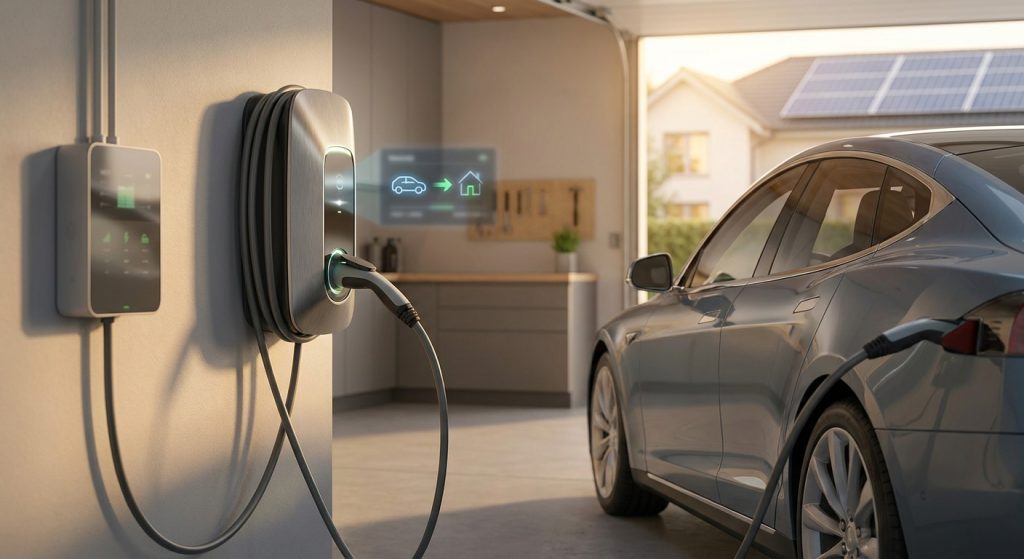
Vehicle-to-home charging turns your EV into a backup generator, and in 2026 there are finally enough real bidirectional chargers on the market to make a buying decision instead of a waiting list. This guide ranks the bidirectional EV chargers actually shipping this year, what they need from your home's electrical system, and which ones pair cleanly with a solar battery setup.
Most homeowners asking about bidirectional charging already have one foot in home battery storage, and for good reason — a charger that can push power backward is only half the equation. If you haven't settled on the electrical side of that pairing yet, start with choosing the right EV charger for a home solar battery system before you commit to hardware.
Why this matters
A standard Level 2 charger only moves power one direction: grid or solar to car. Bidirectional charging adds the electronics to reverse that flow, so the 60-100 kWh battery sitting in your driveway becomes a home backup source during an outage or a demand-response asset during peak pricing hours.
The catch is that bidirectional hardware isn't universal. The charger, the vehicle, and often a home integration device all have to speak the same protocol — CHAdeMO, SAE J3068, or a manufacturer's proprietary system. Buy the wrong charger for your car and you get a very expensive Level 2 unit with none of the backup functionality you paid for.
How this list was built
Rankings here weigh three things: how many current EV models the charger actually supports for bidirectional flow (not just Level 2 charging), how much continuous power it can send back to the house, and whether it needs a separate home integration device to work. Specs are pulled from manufacturer documentation current as of 2026. None of this is lab-tested by Sun Supply PV — this is a distributor of solar equipment, not EV chargers, and the ranking reflects publicly available compatibility and output data rather than internal testing.
The ranked bidirectional chargers
1. Ford Charge Station Pro — the truck-first standard
Ford's Charge Station Pro, paired with the Ford Intelligent Backup Power system, ships as the bundled charger for F-150 Lightning owners and outputs up to 9.6 kW back to the home panel. It requires Ford's own home integration hardware installed by a certified electrician, and it only works with Ford EVs carrying the Intelligent Backup Power option. If you already own or are ordering a Lightning, this is close to the default choice — there isn't a competing bidirectional charger built specifically for that truck. If you don't drive a Ford, skip it; there's no bridge to other manufacturers.
2. Wallbox Quasar 2 — the vehicle-agnostic option
Quasar 2 is a CHAdeMO-based bidirectional charger rated for roughly 11.5 kW of continuous output, and it's one of the few units on this list not locked to a single automaker. Compatibility depends on the vehicle having CHAdeMO bidirectional support, which narrows the field to a handful of EVs, mostly older Nissan Leaf models and select fleet vehicles as of 2026. It's the strongest pick if your vehicle uses CHAdeMO and you want a charger that isn't tied to one brand's ecosystem. For anyone driving a CCS-only vehicle, this unit won't work at all — check your car's charging port standard before ordering.
3. GM Energy Ultium Home — the ecosystem play
GM's bidirectional setup, sold under the Ultium Home banner, targets Chevrolet Silverado EV and GMC Sierra EV owners and routes backup power through a GM-specified home integration unit. Output figures GM has published put continuous backup in the 9-10 kW range, enough to run HVAC, refrigeration, and lighting circuits during an outage. This only makes sense if you're already in the GM EV lineup — outside of that, it's not an option worth researching further.
4. dcbel r16 — the all-in-one energy hub
The dcbel r16 folds bidirectional EV charging, solar inverter functionality, and a home battery interface into one box rated near 7.6 kW of home output. It's built for CCS-compatible EVs with bidirectional capability, which as of 2026 mostly means select Hyundai, Kia, and Genesis models with vehicle-to-load hardware enabled. This is the pick for someone building a new solar-plus-storage system from scratch and wanting fewer separate boxes on the wall. It's a poor fit if you already own a Tesla Powerwall or another dedicated battery — you'd be paying for redundant inverter hardware.
5. SPAN Drive — the panel-first approach
SPAN Drive works alongside the SPAN Smart Panel to manage bidirectional charging at the circuit level rather than through a standalone charger box, letting the panel decide in real time whether backup power comes from the EV, a battery, or the grid. It's compatible with a growing but still limited list of CCS bidirectional vehicles as of 2026. If you're already running or planning a SPAN panel for circuit-level control, this is worth prioritizing over a separate charger purchase. If you have no interest in smart-panel monitoring, the added cost isn't justified just for V2H.
6. Sigenergy SigenStor EV Charging Module — the storage-first integration
Sigenergy built its SigenStor battery and inverter platform with an EV charging module that ties bidirectional flow directly into the same energy management system running your solar and battery storage. Rated output through the module lands around 11 kW, and because it shares hardware with the SigenStor battery, there's no separate integration box to install. Full details are on the Sigenergy battery systems for EV charging integration page. This is the strongest choice if you're speccing a new solar-plus-storage system and want EV backup managed by the same brain as your battery, rather than bolted on as a separate device.
7. FranklinWH aGate — the battery-adjacent option
FranklinWH's aGate smart panel adds bidirectional EV charging support as an extension of its aPower battery ecosystem, with continuous output specs published in the 8-10 kW range depending on configuration. It requires an existing or newly installed aPower battery to function, so it's not a standalone charger purchase. Consider this if you're already committed to FranklinWH for home backup and want EV charging on the same monitoring app; otherwise the added system complexity isn't worth it for EV backup alone.
Comparison at a glance
| Charger | Continuous output | Vehicle lock-in | Needs separate hardware | Best for |
|---|---|---|---|---|
| Ford Charge Station Pro | ~9.6 kW | Ford EVs only | Yes, Ford integration unit | F-150 Lightning owners |
| Wallbox Quasar 2 | ~11.5 kW | CHAdeMO vehicles | No | Non-Ford, CHAdeMO owners |
| GM Energy Ultium Home | ~9-10 kW | GM EVs only | Yes, GM integration unit | Silverado EV / Sierra EV owners |
| dcbel r16 | ~7.6 kW | Select CCS EVs | No, all-in-one | New solar+storage builds |
| SPAN Drive | Panel-dependent | Select CCS EVs | Requires SPAN panel | SPAN panel households |
| Sigenergy EV Module | ~11 kW | Select CCS EVs | No, integrated with SigenStor | New battery+solar builds |
| FranklinWH aGate | ~8-10 kW | Select CCS EVs | Requires aPower battery | Existing FranklinWH owners |
Where to buy
- Confirm your EV's bidirectional compatibility with the automaker before ordering any charger — this is the single most common mismatch buyers run into in 2026.
- Work through a licensed electrician or installer for the home integration hardware; most bidirectional systems require panel-level work that isn't a DIY afternoon project.
- If you're pairing a bidirectional charger with a home battery, batteries and inverters ship free through Sun Supply PV, and lead times are subject to availability — contact the team directly for current stock on Enphase, Tesla, Sigenergy, and FranklinWH hardware.
Frequently asked questions
What is a bidirectional EV charger and how does vehicle-to-home charging work?
A bidirectional charger can send power in both directions between an EV battery and the home's electrical panel, letting the car act as backup power during an outage. It requires both a compatible vehicle and charging hardware built for reverse power flow, not a standard Level 2 charger.
Is Ford Charge Station Pro the only bidirectional charger available in 2026?
No. Ford's Charge Station Pro is the most widely deployed option because it ships with the F-150 Lightning, but Wallbox Quasar 2, GM Energy Ultium Home, dcbel r16, SPAN Drive, Sigenergy's EV Charging Module, and FranklinWH's aGate are all shipping bidirectional options as of 2026.
Do I need a home battery to use vehicle-to-home charging?
Not always, but most systems work better with one. Batteries like the Tesla Powerwall for homes with EV chargers smooth out the handoff between grid, solar, and vehicle power so the EV isn't the only backup source during an outage.
How much power can a bidirectional charger send back to my house?
Current bidirectional chargers range from roughly 7.6 kW to 11.5 kW of continuous output depending on the model, which is enough to run essential circuits — refrigeration, lighting, well pumps, HVAC — but not an entire home at full draw indefinitely.
Is Wallbox Quasar 2 compatible with any EV?
No. Quasar 2 uses the CHAdeMO standard, which limits compatibility to a shrinking list of vehicles as automakers move to CCS. Confirm your EV's charging port standard before purchasing.
Does vehicle-to-home charging drain my EV battery faster over time?
Manufacturers generally warranty bidirectional use separately from standard charging cycles, and cycle counts do add up with regular V2H use. Check the specific EV manufacturer's warranty terms for bidirectional charging before relying on it as a daily backup source.
Can I pair a bidirectional charger with a Tesla Powerwall or Sigenergy SigenStor?
Yes, though integration depends on which charger and battery you're combining — Sigenergy's own EV Charging Module is built to share hardware with its SigenStor battery, while other combinations may need additional integration equipment.
What does vehicle-to-home installation cost look like in 2026?
Costs vary by charger, home panel condition, and whether new integration hardware is required, so get a site-specific quote from a licensed installer rather than relying on a national average.
One last thing
The charger is the easy part of this decision — the vehicle is the hard constraint. Every bidirectional charger on this list only works with a specific, still-short list of EV models that ship with the onboard hardware to support reverse power flow, so check your exact vehicle model and trim before you spend a dollar on charging equipment.
Related guides
