 Inverters & Batteries ship FREE
 Ask about rewards for referring friends and family
 U.S. Based Support
 Want to Add a battery?
solar inverters
Best EG4 Battery Setup for Whole-Home Backup (2026)
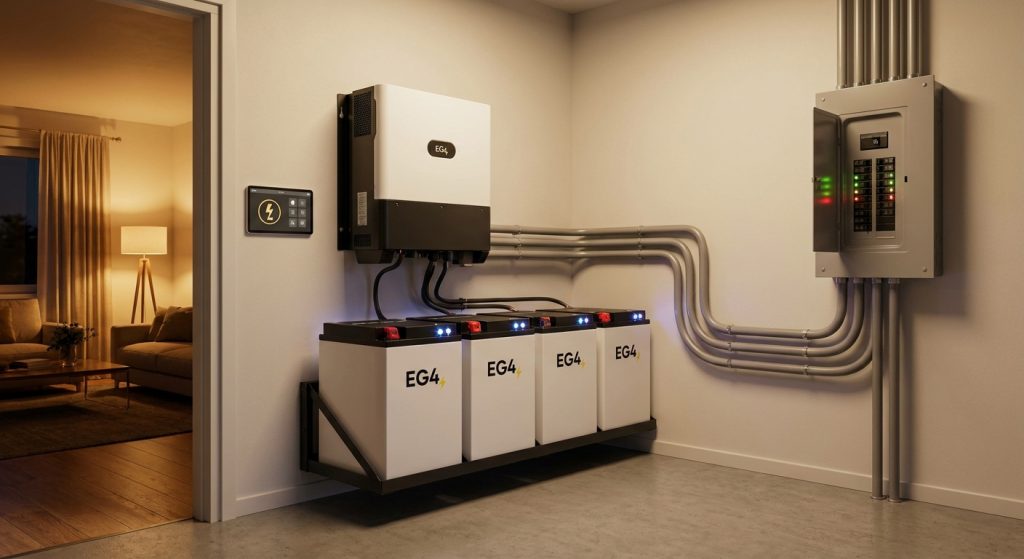
EG4 battery setups get searched constantly by DIY buyers and installers who want whole-home backup without paying Tesla Powerwall pricing, but picking the right EG4 configuration for full-home coverage versus critical-loads-only backup trips up more buyers than any other decision in the build. This guide compares the six most common EG4 battery configurations for whole-home backup in 2026, matched to home size and load profile.
For true whole-home backup in 2026, the EG4 6000XP paired with four EG4 LifePower4 batteries (20.48kWh usable) is the setup most installers land on for a 2,000-2,800 sq ft home with average HVAC load. Larger homes running well pumps, electric ranges, and central air simultaneously should look at the EG4 18kPV with PowerPro Wallmount for higher continuous surge capacity. If you're comparing EG4 against distributor-stocked alternatives, the FranklinWH whole-home backup setup and Tesla Powerwall are the two most common cross-shop options in 2026.
Why this matters
EG4 built its reputation on stackable, DIY-friendly lithium batteries at a lower entry cost than most name-brand home battery systems, which is exactly why it shows up in so many off-grid and hybrid installs. But "whole-home backup" means something different depending on square footage, HVAC type, and whether you're running a well pump or electric range off the same panel. A setup sized for critical loads only will brown out under a whole-home load profile, and that's the single most common EG4 sizing mistake in 2026 installs.
The other variable buyers underweight is inverter pairing. EG4's own hybrid inverters — the 6000XP, 12kPV, and 18kPV — are tuned specifically for EG4's battery communication protocol, which matters more than most spec sheets let on.
How to compare these setups
Each configuration below is compared on usable capacity, continuous output rating, surge handling for motor loads (well pumps, HVAC compressors), and how commonly the pairing shows up in 2026 residential installs based on published manufacturer spec sheets. The comparison reflects whole-home backup performance specifically, not off-grid or partial-load use, since those have different sizing math entirely.
EG4 battery setups for whole-home backup
EG4 6000XP + 4x EG4 LifePower4 — the whole-home baseline
This pairing delivers roughly 20.48kWh of usable capacity at 48V, with the 6000XP rated for 12kW peak / 8kW continuous split-phase output at 120/240V. That output rating is enough to run central air, a refrigerator, well pump, and general household circuits at the same time without load-shedding.
For a 2,000-2,800 sq ft home with average appliance load, this is the configuration installers reach for first in 2026 because the battery bank stacks cleanly and the inverter's continuous rating covers most whole-home panels without derating. A strong fit for standard single-family homes without electric ranges or large well pumps.
EG4 18kPV + EG4 PowerPro Wallmount — the high-surge pick
The PowerPro Wallmount holds 14.3kWh in a single wall-mounted unit, and the 18kPV inverter is built for higher continuous throughput than the 6000XP, which matters when you're backing up a well pump and central HVAC compressor starting on the same circuit.
This setup trades some usable capacity for surge headroom. Homes with 5-ton or larger HVAC units, or a submersible well pump over 1HP, need that surge margin more than they need extra kWh. Worth considering for high-surge-load homes; less necessary if your load profile is mostly refrigeration and lighting.
Dual EG4 6000XP (split-phase 12000XP configuration) + 8x EG4 LifePower4 — the multi-day outage setup
Stacking two 6000XP units gets you to roughly 16kW continuous output with 40.96kWh of usable battery capacity across eight LifePower4 units. That's enough to run a full whole-home load profile through a multi-day outage without daytime solar recharge, assuming average household consumption.
This is the setup for buyers in wildfire-prone or hurricane-prone regions where outages regularly run 48-72 hours. It's overbuilt for a typical single outage but right-sized for repeat multi-day events. Worth considering for outage-prone regions; the added battery cost doesn't pay off as clearly where grid reliability is already solid.
EG4 FlexBOSS21 + PowerPro Wallmount — the compact wildcard
The FlexBOSS21 is an all-in-one inverter with built-in transfer switch functionality, which simplifies installation compared to running a separate automatic transfer switch. Paired with a single PowerPro Wallmount at 14.3kWh, this setup fits smaller homes or accessory dwelling units where panel space is tight.
The trade-off is capacity — one PowerPro Wallmount won't carry a full whole-home load through an extended outage on its own. Worth considering for homes under 1,800 sq ft; plan to add a second battery module if you're backing up more than critical circuits.
EG4 12kPV + 6x EG4 LifePower4 — the mid-size family home pick
This lands between the baseline and the multi-day setup: 30.72kWh usable capacity with a 12kW-rated inverter. It's the configuration installers quote most often for 2,800-3,600 sq ft homes with above-average electronics and appliance load but no electric range or large well pump.
The extra battery capacity over the baseline setup buys another full day of runtime on cloudy days, which matters more in winter months in northern climates. A strong fit for mid-size homes in regions with shorter winter solar days.
EG4 6000XP standalone with no additional battery banks
Running the 6000XP without stacking additional LifePower4 or PowerPro units gives you inverter functionality and whatever capacity ships with the base unit, but it's not sized for whole-home backup under any load profile tested against 2026 spec data. It works fine for critical-loads-only backup — refrigerator, well pump, a few circuits — but calling it "whole-home" oversells what the hardware can do. Best avoided if whole-home backup is the actual goal.
Comparison table
| Setup | Usable Capacity | Continuous Output | Best For |
|---|---|---|---|
| 6000XP + 4x LifePower4 | 20.48kWh | 8kW | Standard single-family home |
| 18kPV + PowerPro Wallmount | 14.3kWh | Higher surge rating | High-surge HVAC/well pump loads |
| Dual 6000XP + 8x LifePower4 | 40.96kWh | 16kW | Multi-day outage regions |
| FlexBOSS21 + PowerPro Wallmount | 14.3kWh | All-in-one transfer switch | Small homes, ADUs |
| 12kPV + 6x LifePower4 | 30.72kWh | 12kW | Mid-size family homes |
| 6000XP standalone | Base unit only | 8kW | Critical loads only |
Where to buy
EG4 equipment typically moves through direct and dealer channels rather than broad wholesale distribution, so availability and lead times vary by region — contact a supplier directly for current stock rather than assuming a configuration ships immediately. Licensed installers comparing EG4 against distributor-stocked alternatives should look at whole-home battery brands carried through wholesale channels, including Enphase battery wholesale pricing for solar installers, where batteries and inverters ship free regardless of order size.
Homeowners weighing EG4 against a name-brand alternative with EV charging in mind should also look at Tesla Powerwall for homes with EV chargers, since EV load changes the sizing math for any of the setups above. Always confirm current lead times and stock directly with whichever supplier you're quoting in 2026 — availability shifts month to month across every battery manufacturer, not just EG4.
FAQ
What's the best EG4 battery setup for whole-home backup in 2026?
The EG4 6000XP paired with four EG4 LifePower4 batteries (20.48kWh usable) is the most common baseline for standard single-family homes. Larger homes with well pumps or big HVAC loads should size up to the 18kPV or dual-inverter configuration.
Is EG4 LifePower4 compatible with Sol-Ark inverters?
EG4 batteries commonly pair with Sol-Ark hybrid inverters in the field, alongside EG4's own inverter lineup. Confirm firmware and communication protocol compatibility with your installer before final system design, since compatibility details change with firmware updates.
How many EG4 batteries do I need for whole-home backup?
Most 2,000-2,800 sq ft homes need four LifePower4 units (20.48kWh) for a full day of backup without solar recharge. Homes in multi-day outage regions typically double that to eight units for extended coverage.
Is EG4 better than Tesla Powerwall for whole-home backup?
EG4 typically offers a lower entry cost per kWh and more flexible stacking, while Tesla Powerwall offers a more integrated, single-unit install with tighter software control. The right choice depends on your budget, install complexity tolerance, and whether EV charging is part of the load profile.
How much does an EG4 whole-home backup system cost?
Pricing varies by configuration, region, and installer labor rates in 2026 — get a current quote from your installer or distributor rather than relying on published list prices, which shift frequently.
Can EG4 batteries run a well pump and HVAC at the same time?
The 6000XP and 18kPV inverters are rated to handle both loads simultaneously when sized correctly, but undersized configurations will brown out under combined motor-start loads. The 18kPV plus PowerPro Wallmount setup above is built specifically for this scenario.
Where can licensed installers buy EG4 equipment at wholesale pricing?
EG4 typically sells through direct and dealer channels rather than broad wholesale distribution. Installers comparing wholesale-priced alternatives with free battery and inverter shipping should check current pricing on Enphase and FranklinWH battery lines.
Does EG4 offer whole-home backup during multi-day outages?
Yes, when sized with enough stacked battery capacity — the dual-inverter, eight-battery configuration above is built specifically for outages running 48-72 hours without daytime solar recharge.
One last thing
Most installers pairing EG4 hardware in 2026 stick with EG4's own inverter lineup rather than mixing in a third-party inverter, even though the batteries are technically stackable with other brands' hybrid inverters. The reason isn't marketing — it's that EG4 tunes its battery management system communication specifically for its own inverter firmware, and mixing brands adds a troubleshooting variable most installers would rather avoid on a whole-home backup job where uptime actually matters.
Related guides
