 Inverters & Batteries ship FREE
 Ask about rewards for referring friends and family
 U.S. Based Support
 Want to Add a battery?
solar inverters
Battery Backup for Well Pump: 2026 Buying Guide
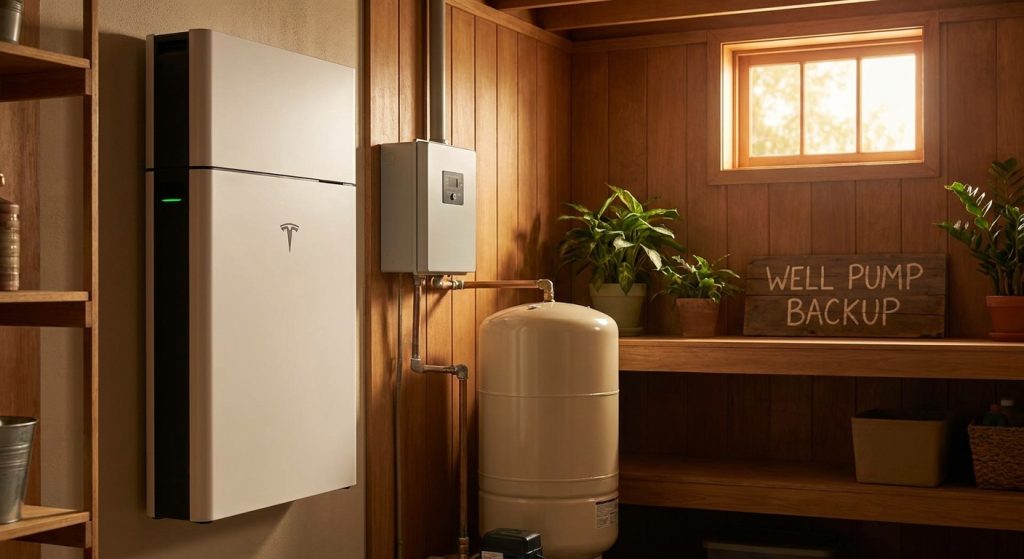
If your water comes from a well, a power outage doesn't just kill the lights — it kills your water pressure the second the pump stops spinning. Sizing a battery backup for well pump operation means matching starting wattage, not just running wattage, and that's where most backup plans fall apart before installation day.
A well pump motor pulls a short, sharp surge when it kicks on — often 2 to 3 times its running wattage for a second or two — and any battery backup system that can't cover that spike will trip offline right when you need water most. Enphase's IQ Battery 5P, FranklinWH's aPower, and EG4's stackable indoor units all handle that surge differently, and the right pick depends on whether you're backing up the whole house or just the pump circuit. Sun Supply PV carries all three, along with the SPAN Smart Panel for circuit-level control, and 2026 pricing on batteries and inverters ships free with every order.
Why This Matters
A well pump isn't a convenience load — it's the difference between running water and none. Refrigerators and Wi-Fi routers can wait out a storm; a household with a private well can't flush a toilet or run a shower without pressure from the pump. That single fact changes how you should size and wire a backup system compared to a standard whole-home setup.
Most residential battery specs are written around continuous draw, and pump motors don't behave that way. A 3/4 HP submersible pump might run at 1,000-1,200 watts once it's spinning, but the inrush current at startup can spike to 3,000-3,600 watts for a second or two. Undersize that surge capacity and the battery's inverter will trip its overload protection every time the pump cycles — which, in a drought year or a multi-day outage in 2026, could be dozens of times a day.
Who This Guide Is For
This is written for two buyers: licensed installers speccing backup systems for rural and semi-rural clients on private wells, and homeowners who've already lived through an outage with a dry tap and want it fixed properly. Both need the same answer — enough surge headroom to start the pump and enough usable capacity to keep it running through a multi-day outage, not just a few hours.
What to Look For in Battery Backup for a Well Pump
Surge Capacity, Not Just Running Watts
The single biggest mistake in well pump backup sizing is reading only the continuous power rating on a spec sheet. A battery-inverter combo needs a peak or surge rating at least 2.5 to 3 times the pump's running wattage to survive the first second of startup without faulting out. Ask for the peak power number in watts, not just kW continuous, before you spec anything.
Usable Capacity for Multi-Day Outages
Well pumps don't run constantly, but they cycle often — every time a toilet flushes or a shower runs, the pressure switch calls for power. A single 5 kWh battery might handle a pump fine for an evening, but a 3-day outage with a family of four demands more stacked capacity. Sizing a solar battery system for whole-home backup walks through the math on daily load versus stacked kWh, and it's worth running before you order anything.
Whole-Home vs. Critical-Loads-Only Wiring
Some installs back up the entire panel; others wire only a handful of circuits — well pump, fridge, a few outlets — through a sub-panel. Critical-loads-only wiring stretches a smaller battery further, but it means the homeowner loses HVAC and other big draws during an outage. Decide this before you size the battery, because it changes the math entirely.
Circuit-Level Visibility and Control
A well pump on a shared circuit with other high-draw appliances can quietly drain a battery faster than expected. Circuit-level monitoring shows exactly what's pulling power in real time, which matters when you're trying to stretch a battery through day three of an outage without guessing.
Recharge Speed From Solar
If the outage runs past the battery's stored capacity, recharge speed from a paired solar array becomes the deciding factor. A battery that recharges slowly from a modest rooftop array leaves the pump dry by mid-afternoon on day two; faster charge acceptance keeps the cycle going.
Install Location and Environmental Rating
Well pump equipment often lives in a pump house, basement, or unconditioned outbuilding, and the battery backing it up frequently ends up in the same space. Confirm the battery's operating temperature range and enclosure rating before mounting it somewhere that sees freezing winters or humid summers — a unit rated for a conditioned garage won't necessarily hold up in a detached shed.
Top Picks for Well Pump Backup
Enphase IQ Battery 5P — the modular workhorse. Each 5P module delivers a continuous output built for stacking multiple units on the same branch circuit, and Enphase's microinverter-based architecture means each battery module manages its own power conversion rather than relying on one central inverter to survive every surge. That distributed design is a genuine advantage for pump loads, since a fault on one module doesn't take the whole system down. Best Enphase battery model for home backup needs breaks down which 5P configuration fits a single well pump versus a full whole-home setup. This is a strong fit for installers who want a system that scales module by module as a client's backup needs grow past 2026.
FranklinWH aPower — the whole-home stacker. FranklinWH's aPower units are built to stack for larger continuous and surge loads, which matters when a well pump shares a panel with a furnace blower or a sump pump on the same emergency circuit. The best FranklinWH battery setup for whole-home backup covers how to pair units for households running multiple high-surge appliances off one backup system. This is the pick for a household that wants the whole panel covered, not just the pump.
EG4 stackable indoor battery — the budget-conscious option. EG4's lithium units are priced to let installers build out capacity in smaller increments, which suits a client who wants critical-loads-only backup now and room to expand later. The best EG4 battery setup for whole-home backup lays out stacking configurations for well pump plus a handful of other essential circuits. This is a solid choice when the budget calls for phased expansion rather than one large purchase.
SPAN Smart Panel — the visibility layer. The SPAN panel isn't a battery, but pairing it with any of the above turns a blind backup system into one where every circuit, including the pump, reports its live draw. The SPAN Smart Panel for whole-home circuit-level monitoring page covers install requirements and which battery brands it integrates with. For a household where the pump shares a sub-panel with other equipment, this is worth adding regardless of which battery gets chosen.
What to Avoid
- Small "essentials only" battery kits marketed for general backup. Many of these are sized around a fridge and a few lights, with a continuous rating too low to survive a well pump's startup surge even once.
- Batteries with no published surge or peak rating. If a spec sheet lists only continuous watts and kWh with no peak number, assume it hasn't been tested against motor-driven loads like a pump.
- Undersized wire runs from the battery to the pump circuit. Even a correctly sized battery can trip a breaker or sag under load if the wiring between the battery output and the pump panel wasn't run to handle the surge current.
Verdict Comparison
| Battery | Surge Handling | Best Wiring Setup | Best For |
|---|---|---|---|
| Enphase IQ Battery 5P | Distributed, module-by-module | Whole-home or critical-loads | Scalable installs, growing backup needs |
| FranklinWH aPower | Stackable for high combined surge | Whole-home | Multiple high-surge appliances on one panel |
| EG4 Stackable Indoor | Stackable, budget-friendly | Critical-loads-only | Phased backup, tighter budgets |
| SPAN Smart Panel (pairing) | N/A — monitoring layer | Any of the above | Real-time circuit visibility |
FAQ
What size battery backup does a well pump need?
Most residential well pumps need a battery-inverter combo rated for at least 2.5 to 3 times the pump's running wattage in surge capacity, with usable stacked capacity sized around expected outage length rather than a single evening. A 3/4 HP pump running at roughly 1,000-1,200 watts continuous can spike to 3,000+ watts on startup, so the surge number matters more than the continuous rating.
Is a whole-home battery backup better than critical-loads-only for a well pump?
Whole-home backup covers everything but costs more and drains faster during long outages; critical-loads-only wiring stretches a smaller battery further by isolating the pump, fridge, and a handful of outlets. The right choice depends on outage frequency in your area and budget.
Can a Tesla Powerwall run a well pump?
Tesla Powerwall units are built for whole-home continuous and surge loads and can run a well pump alongside other household circuits, particularly in homes that also run an EV charger. The Tesla Powerwall for homes with EV chargers page covers sizing for households running both loads together.
How long will a battery backup run a well pump during an outage?
Runtime depends on stacked usable kWh and how often the pressure switch cycles the pump, not just the battery's rated capacity. A household using water normally might cycle the pump dozens of times a day, so sizing for a multi-day outage means stacking capacity well beyond a single-evening estimate.
Do batteries and inverters ship free from Sun Supply PV?
Yes — batteries and inverters ship free on every order in 2026, regardless of brand or configuration.
What happens if a battery's surge rating is too low for a well pump?
The inverter will trip its overload protection every time the pump's motor tries to start, cutting power to the pump circuit even though the battery has plenty of stored energy left. This is the most common installation mistake with well pump backup systems.
Does a well pump need its own dedicated battery, or can it share a system with the rest of the house?
It can share a system as long as the combined surge and continuous ratings account for the pump running at the same time as other loads. Circuit-level monitoring through something like the SPAN Smart Panel makes it easier to confirm the pump isn't competing with a furnace blower or well pressure tank heater on the same draw.
Is EG4 or FranklinWH better for a well pump backup system?
EG4 fits budget-conscious, phased installs with critical-loads-only wiring, while FranklinWH's aPower is built for whole-home setups running multiple high-surge appliances at once. Both stack for added capacity, so the choice comes down to wiring scope and budget rather than one being universally better.
One Last Thing
The detail installers miss most often isn't the battery spec — it's the wire gauge between the battery output and the pump's sub-panel. A battery rated for a 3,600-watt surge won't deliver it reliably through undersized conductors, and that mismatch shows up as random pump trips that get blamed on the battery instead of the wiring. Check the run before blaming the equipment.
Related Guides
